Your Shopify Store Is Hiding Its Best Subscription Offer
The Absorption Company was giving shoppers almost 19% off to subscribe on its Shopify store. The product page said 10%.
Nobody was lying. The bigger pack had a 10% bundle discount, subscribing took off another 10%, and the brand only talked about one of them. Jordan Narducci found it in his audit.
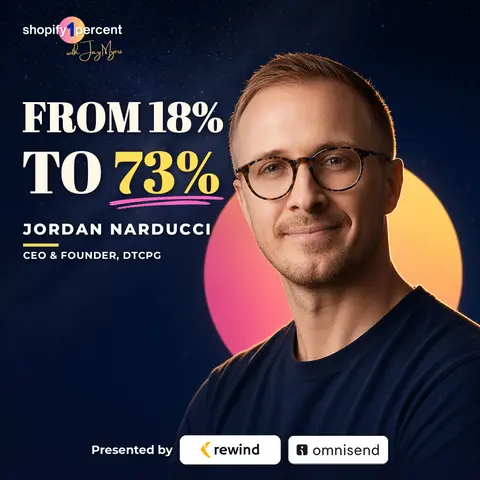
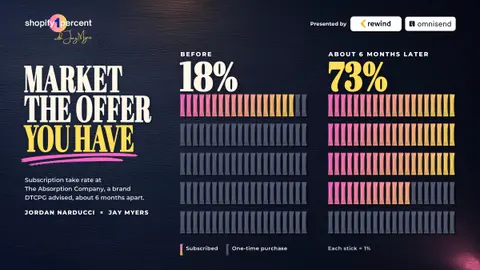
Jordan is the founder and CEO of DTCPG, where his team calls itself "lifetime value consultants." Before that he ran DTC at Kellogg and ecommerce at Momentous. DTCPG helped The Absorption Company take subscription opt-in from 18% to 73% in about six months. When I called that "some kind of record," Jordan said he can't take full credit and handed it to the brand's team.
To get more Shopify customers to subscribe, default your product page to subscription, add up every discount you already give, and show that combined number to every visitor instead of hiding part of it in a welcome email. Then keep those subscribers through orders two to four by shipping on the schedule they actually use the product. That's the playbook Jordan Narducci of DTCPG walked me through on episode 97 of Shopify1Percent.
What's a good subscription opt-in rate for a Shopify store?
Jordan gave me real benchmarks, with a warning that they're for US supplement brands. Beauty struggles to reach 50%, and his team in Latin America tells him nobody there subscribes to anything.
For supplements, under 10% is a real problem. 25 to 50% is where a lot of brands sit. DTCPG tries to get every client above 50%, and the best brands that still sell one-time run 75 to 90%.
Under 10%, you're probably running a flat 10% subscribe and save without defaulting to subscription. Flip the default and he says you can pick up as much as 10 percentage points, and the adoption gain always outweighs the bit of extra churn.
Then he called take rate a bit of a vanity metric, which I loved, coming from a guy whose case studies lead with it. Anyone can hit 100% by turning off one-time purchase, or by giving the first month free, which brands did ten years ago, "and then they never come back." Recharge's 2026 first-order discount study agrees: full-price subscribers renewed 65% of the time, while those who got 90% or more off renewed 53.4% of the time.
I'm honestly still torn on one-time purchase. A brand shared a test on LinkedIn where removing it hurt their subscription numbers. Jordan says subscription-only has always sent acquisition costs "through the roof" for him, so he keeps one-time and makes subscribing the no-brainer.
How did The Absorption Company go from 18% to 73% subscription opt-in?
Their best product, a variety pack of powder stick packs, couldn't be subscribed to. The plan was try it first, subscribe later. Jordan's analysis found most people never came back.
So they turned subscription on for the best seller and started showing the combined discount instead of 10%. Jordan called it 18% on the call. My calculator says 19%, and I'm not going to fight a guy over a percentage point.
Then they took the 10% welcome code only email subscribers saw and made it an evergreen offer on the site. Jordan guessed that lands at "maybe 27% off or something." He was right: 90% of 90% of 90% is 72.9%. So the buy box became about 27% off your first order, then 10% after.
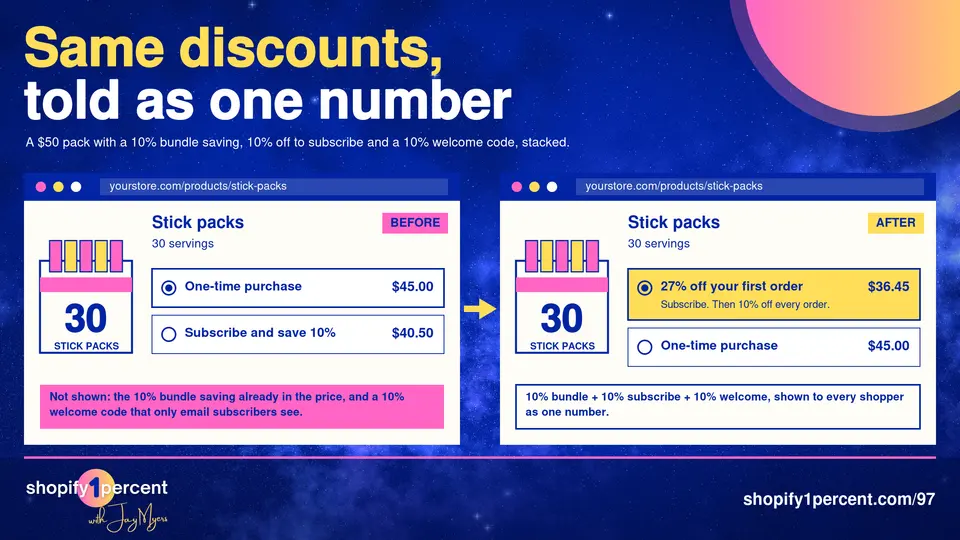
"Those things alone got it above 50%," Jordan said.
That welcome-code move came from Momentous. An investor who was an executive at Chewy told them only about 10% of shoppers give their email (15 to 20% at the best brands) and half of those open it. So the welcome offer reaches about 5% of your audience. Momentous put 25% off the first order and then 10% on the site for everyone, and Jordan says their take rate exploded.
What I love is that nobody told the brand to give away more margin. Jordan says his team sometimes takes margin back, because 20 to 25% off the first order and then 10% beats a flat 15 to 20% off every month once someone sticks around a few months. Most stores still bury all of it in the copy under your subscribe button.
The last piece was what Jordan calls "subscribe more, save more," where the bigger discount only goes to subscribers who take more packs on a longer cadence.
Are quarterly subscriptions better than monthly?
I pushed back here. Doesn't quarterly drag down take rate, since the first order costs more?
"No."
He offers it next to monthly, never instead of it. Shipping one box a quarter instead of three can save $20 to $30, which he says pays for an extra 5% discount. He's "never seen that tactic not work." In Recharge's August 2026 billing interval analysis, lifetime churn was 84.2% on monthly plans against 67.7% on quarterly, yet only 14.7% of subscribers were on quarterly.
I tried annual on him too, since Shopify itself gives you a discount for paying yearly. Jordan doesn't push it for CPG. Nobody wants 12 tubs of protein in the pantry, and prepaid plans get awkward when someone wants out. An annual plan on a physical product almost guarantees a bad breakup, and customers who leave mad don't come back.
Why do Shopify subscribers cancel after the first few orders?
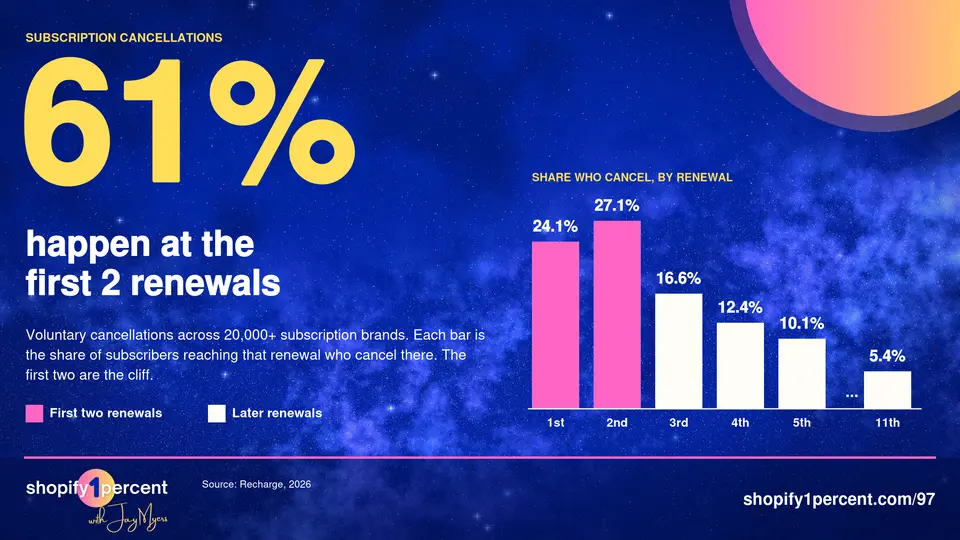
Recharge found that about 61% of voluntary cancellations happen at the first two renewals (2026). Jordan puts it as orders two, three and four.
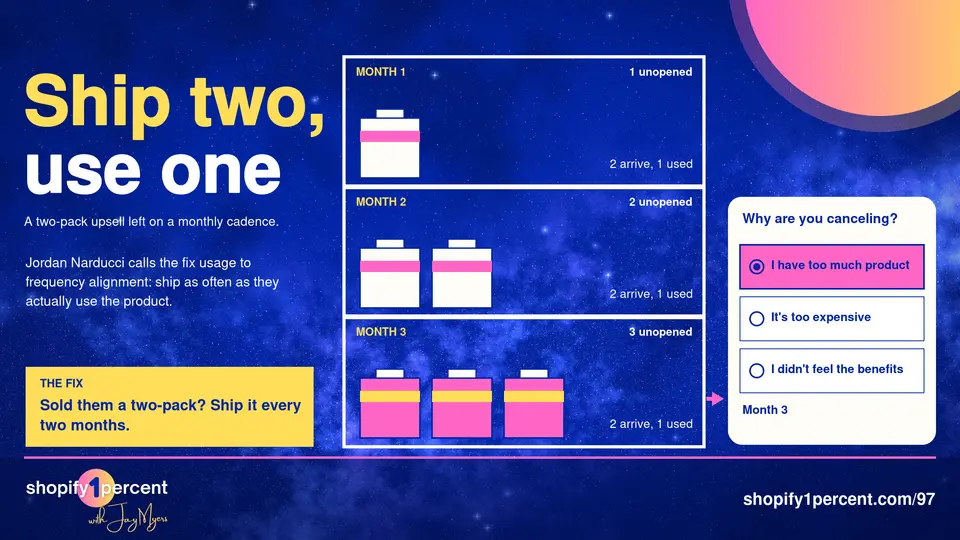
His first fix is what he calls "usage to frequency alignment." A brand upsells a two-pack after checkout and leaves the subscription on monthly. The customer can't finish it, and "even the best brands still do this" because the AOV bump looks great. The pile grows in the cupboard, and too much product is the number one reason people cancel.
He also checks the portal, where sometimes the best seller defaults to every four weeks while 70 to 80% of subscribers have quietly switched to every two months.
Then he front-loads. Jordan likes making subscriptions your loyalty program, and I agree 100%. We built some of the first subscription and membership apps on Shopify at Bold, so I'm biased, but subscribers are your best customers. Skip the bigger discount at month six. That's margin handed to someone staying anyway. Put gifts in orders two to four, and "test your way into gifts" by giving one to half your subscribers and keeping it only if the retention gain covers the cost. I did a whole episode on how a $10 gift can beat $70 in ad spend, so I was nodding the whole time.
Pick a gift that builds the habit, like a shaker bottle on order two, and the rebill reminder stops reading like a cue to cancel: "Hey, get excited. We're about to send you this $20 free shaker."
Fatty15 tells subscribers what they should feel in months one and two, then three through six. It's like wine. A $50 bottle with no story tastes fine. Tell me where it's from and what to notice, and it tastes better.
Is a skipped subscription order really a save?
Not always. Subscription apps count a skipper as active. Jordan counts orders. At one brand his team found 35% of the customers who skipped were confused, came right back and canceled. He says only a third to half of skippers ever buy again, so count orders after a skip, not your active count. It's the same blind spot behind the repeat rate Shopify doesn't show you. For second-order retention, he calls above 70% very strong and 50% or lower a problem.
For the cancel flow, start with the data: the share of cancels for each reason and the save rate on each. Fix the most-picked, lowest-save reason first. Open with a short screen, ideally a founder video, and offer "delay" or "change your date" before "skip," which Jordan calls healthy friction. Then solutions for the reason they picked, and only then a discount. At a $100 AOV he tests dollars against percentages, because "$20 sounds like a lot more than 20%."
My soapbox: we run cancel flows too, and most people aren't leaving over a price they already agreed to. It's like abandoned cart emails. They knew the price when they hit add to cart. "Too expensive" still makes Jordan's top reasons, so discount, just not on screen one. We've covered more cancellation flow strategies on the show.
The 1% takeaway
Open your product page next to your welcome email this week and add up every discount a new subscriber can get: the bundle, the subscribe and save, the welcome code. If the buy box shows less than that, put the full number in it, default to subscribe and show it to everyone. You're probably not short on discount. You're short on telling people about it.
Jordan's most active on LinkedIn.
🎧 Search #Shopify1Percent anywhere you listen to podcasts to get the full episode. And if you're not subscribed yet, fix that before you touch your buy box.

Co-Founder @ Bold Commerce // Host Shopify1Percent
Jay Myers has been in the ecommerce game for over 25 years. First as a merchant, then a service provider, and today a software provider. His company, Bold Commerce, has helped over 800,000 online stores sell more on Shopify. Their suite of apps help brands maximize LTV (Customer LifeTime Value), and AOV (Average Order Value).
Bold has been ranked one of Canada's Top Medium Sized Employers, ranked in the top 50 fastest growing companies in Canada by Deloitte multiple years, a Top Growing Company in Canada by the Globe and Mail, and winner of the Ernst and Young Entrepreneur of the Year award.
Your Shopify Store Already Has an Influencer List. Go Count It.