5 Ways to Turn a Basic Shopify Subscription Into a Membership People Actually Want

I clicked subscribe on a coffee brand’s Shopify store and found one sentence underneath: a legal disclaimer ending in the words ”if permitted.” That’s it. On this Shopify podcast I walk through the five places a subscription should be sold on your store and probably isn’t, plus the fifteen-minute fix you can ship tonight. Search Shopify1Percent and press play.

 Apple Podcasts
 Spotify
 YouTube
 Amazon Music
 Audible
 I clicked the subscribe option on a coffee brand's Shopify store and found exactly one sentence underneath it. Not a benefit, not a reason to commit, just the legal disclaimer, ending in the words "if permitted." That's the most common subscription setup on Shopify by a mile: somebody installs an app, switches on a 10% discount, and waits for recurring revenue that never shows up. In this episode I walk through the five places on your store where a subscription should be sold and probably isn't, why a credit beats a discount every time, and the fifteen-minute fix you can ship before dinner tonight.
KEY TAKEAWAYS
- Why does paid commitment change how much a customer spends with you?
- Can anyone actually find the subscription on your Shopify store?
- Is 10% off enough, and what should sit alongside it?
- What five lines belong under your subscribe button?
- Why does a use-it-or-lose-it credit outperform a straight discount?
- How do you sell a subscription to someone who already said no?
⭐️ Support our amazing sponsors that make this show possible ⭐️
SATHI
This episode is brought to you by SATHI, the best affiliate platform built for Shopify brands.
70% of influencer-driven revenue isn't showing up in your dashboard. Codes are leaking. Affiliates are ghosting. And you're paying commissions on sales that never should've counted.
SATHI fixes all of it. Built by the incredible team behind SARAL (200+ top brands, $59M in revenue with influencers).
🎁 Our listeners get early access at MySATHI.io and use code JAY for 20% off
OMNISEND
I personally use Omnisend for email and SMS on every Shopify store I manage, and for this show too! I've tried them all, and it's hands down the best way to run every email and SMS automation and campaign you need, segment to personalize them, and A/B test everything to optimize conversion.
But here's what has me genuinely excited lately: you can now connect Omnisend to ChatGPT or Claude and just ask “where can my email and SMS be making more money?” It reads your actual store data and tells you, then builds the campaign for you right from the chat. It even writes in your brand's voice. Fifteen years doing this and it's the closest I've felt to having a full-time marketer sitting beside me. (Plus most merchants report paying about half the price of Klaviyo.)
🚨 Listeners (YOU) get an exclusive 30% OFF 3 MONTHS: http://shopify1percent.com/omnisend
Did you know leaving a ⭐️⭐️⭐️⭐️⭐️ review on Spotify, or Apple will give your shop gooood ecommerce karma? ❤️
I was going through a coffee brand's Shopify store a couple weeks ago. They're a Canadian brand. They are a real business. These are cafes you walk into all across Canada, bags on grocery shelves. Let's just say a very large brand. Now, on the product page, there was a toggle, a one-time purchase or a subscribe and save.
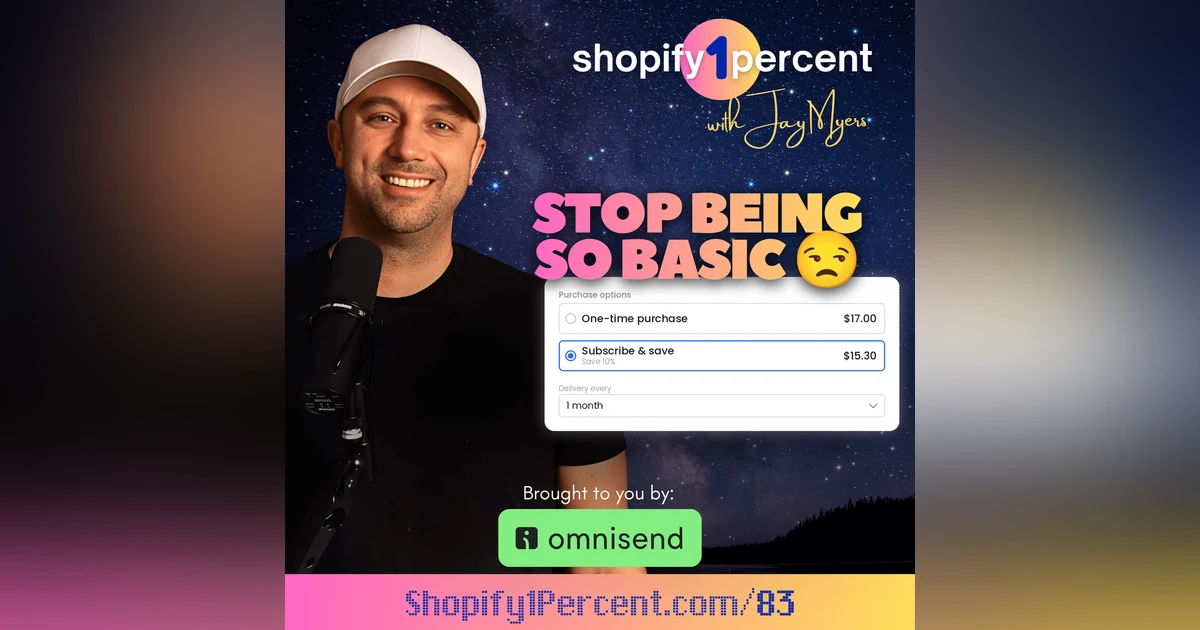
So I click Subscribe, and underneath that option, there was exactly one sentence of copy, just one. It was the legal disclaimer, the one that, you know, authorizes them to charge your card on a schedule and ends like this: "Until my order is fulfilled or I cancel, if permitted." If permitted. So that's the last thing a human reads before deciding whether to buy your coffee forever
Now, I am not here to pick on this brand at all. In fact, I love this brand. Their coffee is amazing, and I wanna be straight with you about what I actually looked at because it does matter. I [00:01:00] never got into their Shopify admin. I didn't see their subscriber numbers, their churn, their emails, their customer portal, or even their cancellation flow, none of it.
I just looked at what a customer sees on the front end. That's all. And what I found there is the most common subscription setup on Shopify by a mile. Someone installed a subscription app, somebody switched on a 10% subscribe and save, and then everyone waited for recurring revenue to show up. And six months later, in a meeting, someone says, "You know, subscriptions just aren't really working for us."
Subscriptions worked fine. You installed the checkbox and you expected it to behave like a business model. So today, I'm gonna walk you through five places on your store a subscription should be sold, but it probably isn't. And one of those five places you can have up and running in less than 15 minutes. You can do it before dinner tonight. I'll make sure I flag that one
So McKinsey ran a customer paid loyalty survey back in [00:02:00] 2020, and one number from it has kind of stuck with me ever since. People who join a paid loyalty program are 60% more likely to spend more with that brand after. For a free loyalty program, that number is 30%.
Same customer, same brand, same flavor, same product, same co- everything, but the difference is whether they commit to something.
And that's the argument for subscriptions in really one stat. And notice it isn't about billing. It's about commitment. Commitment cuts both ways, and this is the part that should... It will make you feel a little bit uncomfortable. And actually Recurly put out their 2026 State of Subscriptions report, and it's a big sample.
2,200 merchants, 76 million in subscription revenue. 41% of consumers say they're feeling subscription fatigue, Now, that panel does lean a little bit towards digital and streaming, so, treat it as a direction, uh, not specifically a coffee [00:03:00] benchmark, but the point 100% still stands.
Every- everybody's already tired of subscriptions. They have more than they can manage. They, they don't even... It's more stressful than it is convenient. And, uh, $1.70 off a big bag of coffee is just not cutting it anymore. So let's talk about from the front end where you can improve this.
So place one, your navigation. So on the store I looked at, the main menu says Shop Wholesale, Visit a Cafe, and Learn. First of all, there's a lot here that we can dig into because I did a full episode on how you should structure your main navigation. Every single button in your main nav needs to lead to revenue.
So Learn, I think could for sure be in the footer. Wholesale, arguably in the footer as well too. I think things that should be on the menu that instead of Wholesale and Learn might be trending this month, new flavors, most popular. Like that's what people wanna [00:04:00] see. They wanna come and see like what products everyone else is buying but that's not what this episode's about.
So, the shop here, if you click it in the main menu, it actually goes to coffee and gift cards. It just goes to all of them. Now, the biggest problem is nowhere in that menu does the word subscribe appear, or membership, or club. There is a subscription collection page. It exists and it's live, but nothing links to it.
So the only way a customer can find a subscription is by opening an individual product, and if they happen to scroll down and notice that there is a s- subscription toggle, that's it. Think about what your navigation actually is. It's not a list of pages. It's a billboard. It's telling your customer what you care about.
And if your nav says Cafes and Recipes and never says Subscribe, well, the customer's reasonable, reasonable conclusion is that like you don't have a subscription program. Now compare that to there's another brand, Trade Coffee. [00:05:00] Subscribe is right in the main nav, and you click it, and you get a real page, how it works, a quiz that walks you through and matches you to the best flavor that you should s- subscribe to, what you get, what happens if you don't like it, and a clear next step every screen.
Now, same product, coffee, but a completely different offer. So there's two things to do here. First, in your Shopify admin, go to online store, then navigation, and then to your main menu, and then add the item. Add it. Takes 90 seconds. Always have subsc- subscribe or subscriber portal in your main menu. Don't overthink the label.
It could be coffee clubs whatever. Subscriptions wins almost every time because that's a word that people know and they recognize, and they're probably coming there to look for it. And maybe subscriptions can be a jumping-off point where they can go to, if they hover over it, subscriber portal or subscribe or, you know, but it, it's there.
Now, the second thing is, of course, you gotta build the page that it points [00:06:00] to, and it's important to make it answer five questions. So what do I get? Why is this program better than just buying it one time? How does it work? How much control do I have? And what if I change my mind? So write those five down.
I'll say it again really quick. What do I get? That has to be clear. Now, remember, we're gonna get into this, but this ha-- what you get has to be way more than just the product. That's the biggest mistake subscription brands make, is they think, "Well, they get my product every month at 10% off." Like, what other benefits do they get?
Perks do they get? I mean, I'll just say it. We have a Memberships app that is perfect for this. Like, if you sell subscriptions, I don't care what platform you use, use our Memberships app and offer VIP pricing to your members. Give them exclusive product access. Give them access to different parts on your website.
Uh, give them products before-- when you launch a new flavor before someone else. So, you have to do that kind of stuff for members. Okay. So what do I get? And then why is this better than just buying it? How does it work? How much control do I [00:07:00] have? And what if I change my mind? Now then link to it from your homepage, also from your footer, and then also from every product page where you're selling a subscription link to how the program works.
You can put it in your welcome emails, your order confirmation, your account area, everywhere. This will become a very visited page on your website. You can't expect to convert traffic, subscription traffic, if you don't have anywhere to send them. Okay, place number two, the actual offer. So the bag I was looking at is $17, so 10% off is $1.70
So $1.70 a bag and on a monthly plan, that's it. That's what I get. 20, I don't know, 20 bucks a year. Don't grade my mental math, but call it roughly 20 bucks. Meanwhile, that site offers free shipping over $50, and one $17 bag doesn't clear 50. So on a one-bag subscription, I'm paying shipping every single month, which means the pitch from the [00:08:00] customer side of the screen reads something like this: "Let us charge your customer every month forever, and we'll give you $1.70."
That's basically what it's saying. Now the other thing that I think is that the 10% is a bit light. We see some coffee brands going upwards of twenty-five or thirty percent on their subscribe and save option, but this really varies. I think at least now you have to do fifteen. That is my personal opinion. It seems to be about the average on, on Amazon, and I have t-talked to s- Amazon is an interesting case study because on Amazon, when you have your product on it, you're selling against everyone side by side.
And I've had a lot of sellers tell me that if your subscribe is ten perc- cent, it doesn't move the needle at all. They have to go at least, at least twenty, twenty-five percent. Most are doing thirty now. So you gotta be aggressive with your subscribe and save discount. Actually, I saw a case study recently where the, the winning tested offer was 10% off, 100 extra loyalty points, three free samples, plus free shipping. So it needs to be much [00:09:00] more than just the, the subscribe and save. So no, I'm not gonna tell you to hand over necessarily 30% but there is a lot more that you can give your customers.
So 10% isn't the problem. 10% as the entire offer is the problem. So build multiple layers instead. Money, which is the recurring discount, sure, but also free shipping for members, VIP pricing for everyone else, double loyalty points. And I'll just say it, this is a piece of cake to do with our memberships app.
I would love to help you do that. I'll put a link to it in the show notes. Happy to give you, like, guys, like, a extended free trial because it's really the one thing that can take any subscription program and just supercharge it. So, make sure you give them control. Emphasize this on the product.
Pick your fr-frequency, swap products, skip, pause, cancel without emailing a human, et cetera, et cetera. Make sure you explain yourself. Like, that does not, Customers don't just know that that's true. You need to say [00:10:00] it. Access. So give them access to things. New blends before anyone else gets them, new flavors, limited releasin-releases, uh, seasonal things that other non-members even can't buy at all.
So, uh, and give them access to people. You know, almost nobody builds this one, and it's where, I mean, for this particular brand they're, they're kind of a celebrity-owned brand. Uh, I think that would be an amazing thing they could do. Like, once a quarter have a, have a Zoom call, have coffee with the founder.
So, uh, w- that's one that we don't often think of, but it's, it's very powerful. And even if you're not a celebrity, that's of course totally fine. Your customers still would love to have coffee with you. So, and keep your first order offer separate from all your ongoing benefits because those are-- they do two different jobs.
So 20% off the first order plus 10% ongoing might actually beat 15% forever. A branded mug you can, you know, land for $8 might beat another 10% discount, and [00:11:00] it feels like more, and now they have a mug with your logo on it and your brand every time they drink coffee. So before you pick any number just make sure you know your gross margin, your fulfillment costs, your shipping costs, how many orders you actually get from a subscriber on average, your lifetime value and how many cancel right after the first renewal, and then choose.
And then test. That-- The test, test, test. You won't get it on the first try Okay, place number three and this is the five lines under your Subscribe button, and this is that one I mentioned in the beginning that is 15 minutes and you should really change today. I mean, all of these you should change today.
But, um, so for this particular store, when someone hovers over Subscribe it showed the legal disclaimer about the subscription. But when someone hovers over Subscribe or when they click the Subscribe toggle, they want to see what your benefits are. Their brain kind of runs a list every time. "What if I end up with too much of this?
What if I can't cancel? What if I change my flavor? What if I don't want... What about when I'm away for three [00:12:00] weeks, can I, can I skip? How hard is it to cancel? Am I gonna have to fi-" And all these questions go through a customer's head when they toggle that subscription button, and if it's not there, if you don't have what I call your objection busters, then there's a good chance you'll lose them.
But unfortunately, on most stores, the copy is just the legal disclaimer. And the- yes, sure, the disclaimer has to be there but it can be way down below. It's not selling anything. It doesn't do you any benefit. Don't have it front and center, and by default, that's where it is on, on Shopify themes and un- I think basically every subscription app, unless you put something in.
So write five or six short lines and put them right beside the toggle, and could be something like this: " Become a member, save on every delivery, free shipping on all orders, swap your roast anytime, pause schedule," or sorry, "pause, skip, cancel easy in a couple clicks, early access to new releases." Like, if I see all of that kind of stuff, I'm subscribing.
And that's it. Just make them bullet [00:13:00] points, not a big paragraph. Definitely only bullet points. You're not, you don't want them to read an essay. You want them to scan. And the control part of it is not just a nice to have. So going back to that Recurly report that we talked about earlier, 38% of consumers say they would rather pause than cancel. Three out of four subscribers who do pause come back within a few months, 75%. And merchants who put a pause option in front of the cancel button saw pause usage jump, get this, 337%.
How would you like to have 337% of your subscribers pause for a month or pause for a few months instead of canceling? So just how you arrange it makes a huge difference. So the lesson here is to make it easy to pause, and actually, hang on, that's-- I would say, I would say that's actually underselling it because the lesson is if you don't even offer a pause, you're forcing [00:14:00] someone who needs a two-week break to fire you permanently, and they will never come back.
And that's actually the real cost of not having a good pause flow. Most cancellation flows will do this, but a lot of... I mean, we have a great cancellation flow with Bold subscriptions, but a lot of brands don't s-set it up. I mean, we, we do everything we can to get them to set it up and email them and user docs and everything, but they just don't take the time.
So the cancellation flow is like, you know, you click to cancel and, um, "Why are you canceling?" "It costs too much money." "Would you like a discount?" Or, "I'm gonna be away. I don't need it right now." "How about a pause?" So make sure you set those up. They work, I can tell you that.
Okay, so place number four is what I'm calling membership, not just delivery, because the brand that I looked at has a mission statement borrowed from... Actually, the owner has written multiple books and it's th- borrowed from one of the books that they're [00:15:00] named after, and it's something about that cafe being people's parliament.
Their entire physical business is built on people sitting in a room together talking, and their subscription offer is $1.70 off a bag. They're sitting on the best membership raw material I've seen in a long time, but none of it is in the offer, and if it were mine, I'd run a quarterly virtual session, half an hour, founder and head roaster on a call with the members, and here's how we built the new brand. Here's what's coming. Here's how the beans are roasted. Let's vote on the seasonal flavor this year. Ask us anything. It costs you 30 minutes a quarter, but what it buys is it buys you a subscription nobody can price compare because no competitor can offer access to you as the founder.
There's only one you. And the other one I'd add is a small monthly member credit, which is a use it or lose it credit. This-- We see this work like crazy. It's different than a [00:16:00] discount. If someone emails you and says, "Hey, n-- this month, 20% off," you think, "Well, I have to spend money to get it." But if I email you and I say, "We added a $20 credit to your account, just log in and use it, and use it.
It's available on any order over $100," or whatever, you feel like it's a credit in your account that you have to, have to use. And yes, this is a piece of cake to do with our memberships app. I did not mean for this to turn into that, but going through the site, it's just there's so many things that member benefits truly, truly solve.
I have seen brands test offering credit rather than a discount, and the difference is staggering on the results. Like, it is night and day when you offer a credit, and it is so easy to do. But there's something different about saying, "There's $20 in your account. Log in and use it.
It expires at the end of this month," versus getting an email like, "Save 10% this month." McKinsey actually has a [00:17:00] version of this in their loyalty research that we talked about earlier, but members who actually redeem something spend 25% more than members who signed up and never, and never used a benefit.
So getting a member to redeem something, like log in and use it, will increase what they spend by 25%. So the, the, the membership enrollment is not even the big goal here. I mean, yes, it's great to have someone as a subscriber, but if they truly are part of a membership program that they're using, they're redeeming, they spend more overall as well.
So-- And on top of it, if you have retail locations, this just gets better real fast, uh, which it would for this brand, because online subscribers could get a small cafe credit when they walk in scan the member QR code, and they get a, they get a free drink, or they get access to something. Uh, they get to try a drink that they've never ordered [00:18:00] before.
A member who, who buys a bag at the counter on the way out gets a discount because they're also a member. So one benefit connects online and offline. And actually, there's a super interesting data point, and this was I was at Shopify conference last week, that customers who shop on your store and, and on offline through retail are three times more valuable than a customer who only shops on one channel.
So if you can get a customer to buy online and then also buy in your store, they are three times more valuable. So, like, do everything you can to connect the benefits between the two. And then the bottom line is these great customers that you're creating, these ones that are, are, are deeply connected to you, that show up on those quarterly calls with the founder, that are shopping online, offline with your member benefits, those are the ones that tell everybody else ab- else about your brand, and that's how the best brands right now are genuinely growing.
Find your best few hundred customers, look after [00:19:00] them properly, teach them new things, make them feel like they belong, and then let them go find more
Okay, now place number five is everywhere after they said no. So what I mean by this is someone sees your toggle, they pick one time purchase, okay? And they go to add to cart. Now, most stores treat that as the final answer, but I am here to tell you it is not. And we know this from data because we see the percentage of people that accept offers for a subscription long past the product page after they have added it to the cart as a one time.
Don't assume that they thought deeply about should I subscribe, should I not subscribe, and once they decided to not subscribe. The fact is most people come to a product page and j- they just quickly click add to cart without really thinking about it. They maybe didn't deeply understand the offer. They didn't reject subscriptions.
They probably just... They didn't, maybe didn't even toggle it onto subscriptions, so they didn't see all of your benefits, or they wanna taste the coffee before committing [00:20:00] to it monthly. So, they were on their phone waiting in a lineup at an airport and just quickly ordered it. So keep offering it politely and in the places where it makes sense.
So in the cart with an easy switch to a subscription line with whatever your strongest benefit is. You know, you don't wanna clutter up the cart, but switch to a subscription and enjoy 10% VIP pricing forever or as long as you're subscribed. If you're on Shopify Plus, you can of course also offer them a subscription upgrade in the checkout. But another great place is actually in the post-purchase email timed when they might actually be running out. So, time it for, if it's coffee, you know, 20 to 30 days after that subscription goes out, or sorry, the, the first order goes out.
Say, "Enjoyed the coffee? Ma- your ne- you know, make your next one 10% less and enjoy VIP pricing and a quarterly Zoom call with our founder on a subscription." . And then the one that I think is super strong but almost every brand doesn't do, and I buy a lot of products and I [00:21:00] don't, I rarely ever see this, but after a customer has ordered a product twice, you suggest the subscription. The majority of your customers are actually gonna order, like, on average if you, like, I can't speak for every coffee store, but I'm gonna assume, uh, this coffee brand, about 80% of their customers buy it once and then just keep buying it, and around 20% commit to a subscription.
But, you know, that varies, but that's a rough, rough average. But 80% of their customers are, are their, of their repeat customers are customers who just buy it once and then choose to buy it again. And so you can very easily set up a flow using Shopify Flow, which is available on every plan, where after a customer has bought a product twice to trigger a specific email, and that email being a call to action to subscribe.
Like, "Hey, you've bought this coffee twice. Why not subscribe, save 10%, get VIP pricing, free shipping?" Everything like that. That'll work. Like, that customer has bought it twice. [00:22:00] You're not annoying them. You're just reminding them that they could be saving getting better benefits if they subscribed instead of just keep coming back and subscribing or, um, purchasing.
And then the last thing is, you know, some people, they will drink exactly one bag of coffee a month forever. They're very consistent. And you know what? Those people are perfect for subscriptions, and everything that we've talked about today is great for them. But the truth is, most people are messier, and that's why 80% of the, the customers here who buy more than once are not on a subscription, because they're not as consistent.
They drink more when family's over, when family's visiting, or when they have guests, or when they're traveling, they drink less, or they sometimes grab a random bag at a grocery store, or someone gives them a gift, or they buy one at a cafe, and the list goes on, but they're just not consistent. And those customers will still reorder, and they just want to decide each time.
So there's two lanes of repeat customers, and you need both. Subscriptions are for the people who want it automatically, and [00:23:00] reorders and reorder nudges are for the people who say yes each time which is also why we built rePete at Bold.
We built it, we built it for that second group. So, don't ignore them. Don't just think because they're not subscribed, they're your one-time customers, and you can ignore them. They need to be treated well. RePete is fantastic for that because you can give the same discounts you give subscribers to people who just choose to one-click reorder.
And, and that's, in my opinion, okay. Like, some people just, they don't want to subscribe, and so for some people, it's a philosophical thing. They just say, "You know what? I don't subscribe to anything." And what's great about rePete is you can still give them the same benefits. You can still have the same tag on the customer, and you can maybe even give them the same perks.
It's up to you, but you can do it if you want. So it it doesn't replace subscriptions. Everything we've talked about is still super important, but if you want to treat those one-time customers the same, it's a great way to do that. So here's what I would do today, is I would open [00:24:00] your best-selling replenishable product on your phone right now, and if you're not driving, of course.
Now toggle over to the subscription option and just read every word underneath it, and if the only thing sitting there is the legal disclaimer that Shopify automatically adds, write five lines that you could add to it and try to ship that today. Can they save on every order? Can they get VIP pricing?
Can you give them free shipping? And those are all member perks, but even without any member perks, you could remind them that they could swap anytime, skip, pause, cancel in two clicks early access. This will take 15 minutes. It doesn't really require a developer, uh, no big meeting. Some of these things you probably do already.
You're just not saying it when they toggle on the subscription option. So that's your 1% win today. Every benefit that a cust- Subscriber gets when they subscribe needs to be visually shown when they toggle the Subscribe button. [00:25:00] So the rest of it the nav in the top, the club page, the founder call, the thank you page offer put that all on a list for the next couple weeks, and you're gonna build out that full subscription page.
But the five lines you can add today. Everyone can add that, and it will make a massive impact in your subscription conversion. So, I like to say no one ever subscribed to anything because of a legal disclaimer, so do not let that be the only thing they see. Okay. Last thing, if this was useful, you know what to do.
Hit Subscribe. Every time we launch a new episode, you'll get notified, and if there was something from here today that you're gonna implement in your store, leave a five-star review so someone else can learn about it too. See you on the next one.