Your Shopify Store Already Has an Influencer List. Go Count It.
I can't count how many times I've heard a Shopify founder tell the same story. Things were going fine, then one day they're scrolling and spot a celebrity wearing their shoes. That's when it all took off.
Great story. It also bugs me, because it should never come down to luck. That celebrity typed their name and address into your checkout. You could have known the day they ordered.
Yash Chavan, founder and CEO of SATHI, told me about an Australian brand that found a customer with 2.5 million Instagram followers in their order data. She'd bought from them 11 times in a year. Nobody knew. Yash's first episode covered the fraud side of affiliate programs. This one is about building the list.
Shopify brands should track an influencer list the same way they track an email list: how many creators can talk about the brand, and how often they post. According to Yash, start with the influencers already in your orders, then grow with weekly outreach, a 10 to 25% commission and creator partnership ads.
Why should a Shopify brand track an influencer list like an email list?
Ask any ecommerce brand how big their email list is and they'll answer instantly. 20,000. 50,000. Partway through the episode I asked myself what our influencer list was, and the honest answer was "I don't know."
Yash thinks it's now "almost as imperative to have a thousand true influencers in your community that are promoting you as it is to have an email list." For a smaller brand, 100 to 200 is a fine start.
He'd make it a growth team KPI with two numbers: the size of the list, and PPD, or posts per day. Any social listening tool can do the math. Sixty mentions in the last 30 days is 2 PPD. "You may have a big list, but if no one's mentioning you, it doesn't matter."
The list should skew small. My feed is full of hockey dad posts from accounts with barely any followers, and they're literally me. I've bought the stuff. On air, I guessed creators under 10,000 followers get about five times the engagement of mega-influencers. HypeAuditor's 2026 State of Influencer Marketing report puts Instagram accounts with 1,000 to 10,000 followers at 1.78% engagement, against 0.33% for accounts over a million. Closer to five and a half. I'll take it.
Is influencer marketing still worth it when everyone's an influencer?
I pushed Yash on this, because everyone with a ring light is pitching something. His answer: paid media is rented, and an active influencer list sits a lot closer to owned media. "Tomorrow, if you turn off your Facebook ads, how much growth are you gonna drive?"
My take is that it matters more than ever, because people have stopped clicking. On the episode I put the no-click number at 61%. The latest data is worse. SparkToro's 2026 study found 68% of US Google searches ended without a click in the first four months of 2026, up from 60% in 2024. If you're not one of the products AI recommends, you're close to invisible.
Search "how do I clean a frying pan with food stuck on it." The AI Overview lays out the steps and embeds a video that jumps to the exact spot where a creator explains them.
So ask how many ways your product gets used. The frying pan is for home chefs, but it's also light enough for a camper's backpack. Every angle is a different creator answering a question you'd never put on your product page. Yash thinks "AEO right now is sort of like early days of SEO."
How do I find influencers who already buy from my Shopify store?
Before you spend another night on TikTok, look at your customer list.
SATHI built an agent called Sherlock for this. (Disclosure: SATHI is one of the show's three partners.) It scans your last three months of orders on install, then again every 100 orders. Filter it down (over 10,000 followers, Instagram only) and it writes each person an invite based on their own content, like "I saw you went camping the other day." No seeding needed. They already own the product.
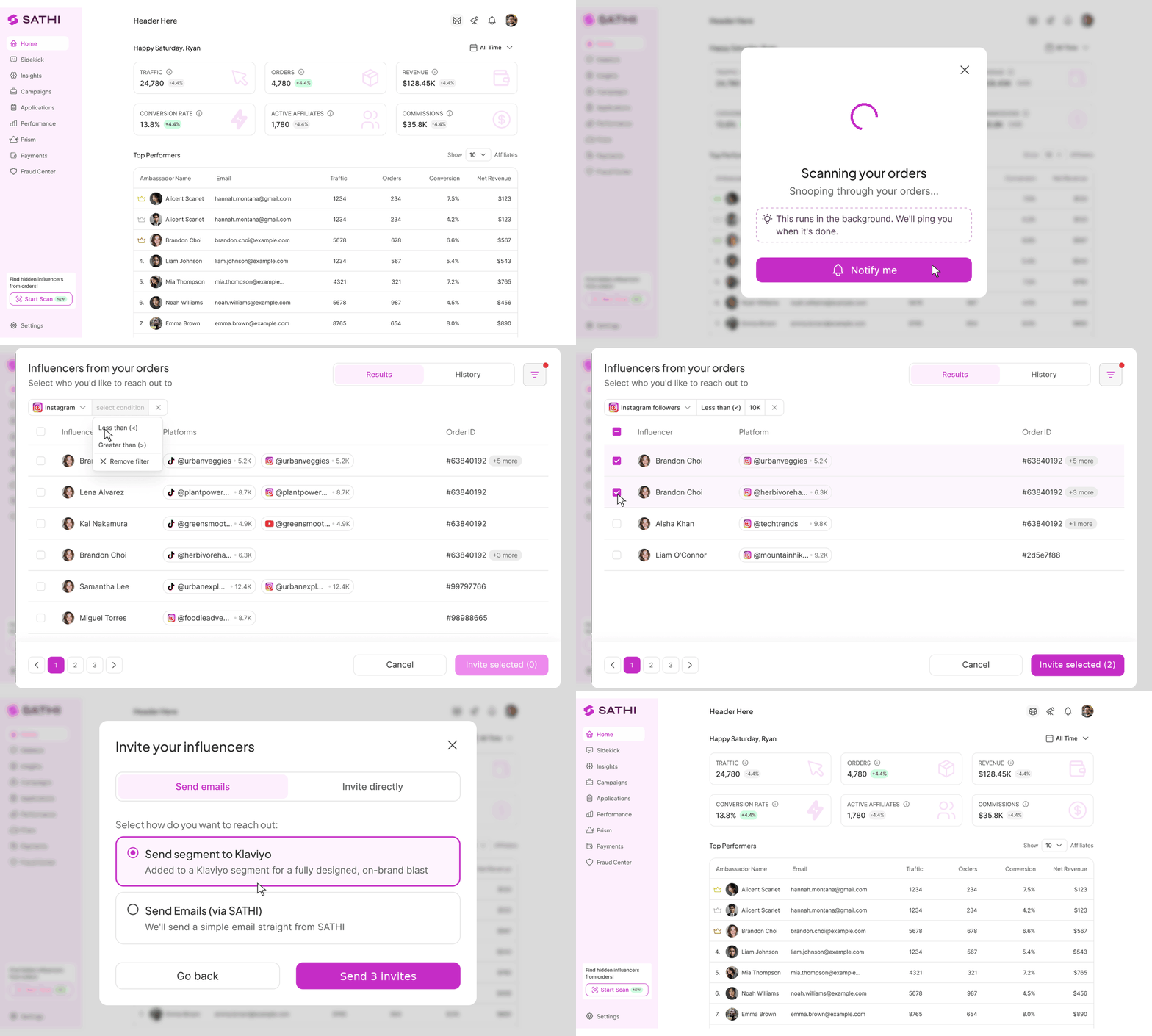
For a steady flow, Yash suggests an Inner Circle invite on the Shopify thank-you page: "Do you wanna partner with us to earn 10% commissions?" It works a lot like a refer-a-friend program. Most who join are regular customers, but as Yash put it, 50 of them with 10,000 followers each is 500K of reach.
I pitched Yash an idea here. If an influencer just ordered, flag it in Slack and have someone from support call to check it arrived, answer questions and share a direct email. No mention of the affiliate program. Thirty days later, the affiliate team reaches out.
People post about people. I'll never post "Delta's planes are amazing," but if a flight attendant snuck a pillow behind my head while I slept, I might. And if the pan turned out less stick-free than promised, you'd rather hear it on that call than in reply to your collab pitch. Yash's version: everyone gets five-star support, influencers get "seven-star support."
What should I say when I reach out to an influencer?
Start with email. Yash pointed out you can't DM someone on TikTok unless you follow each other, and on Instagram you get one message that sits in their requests folder.
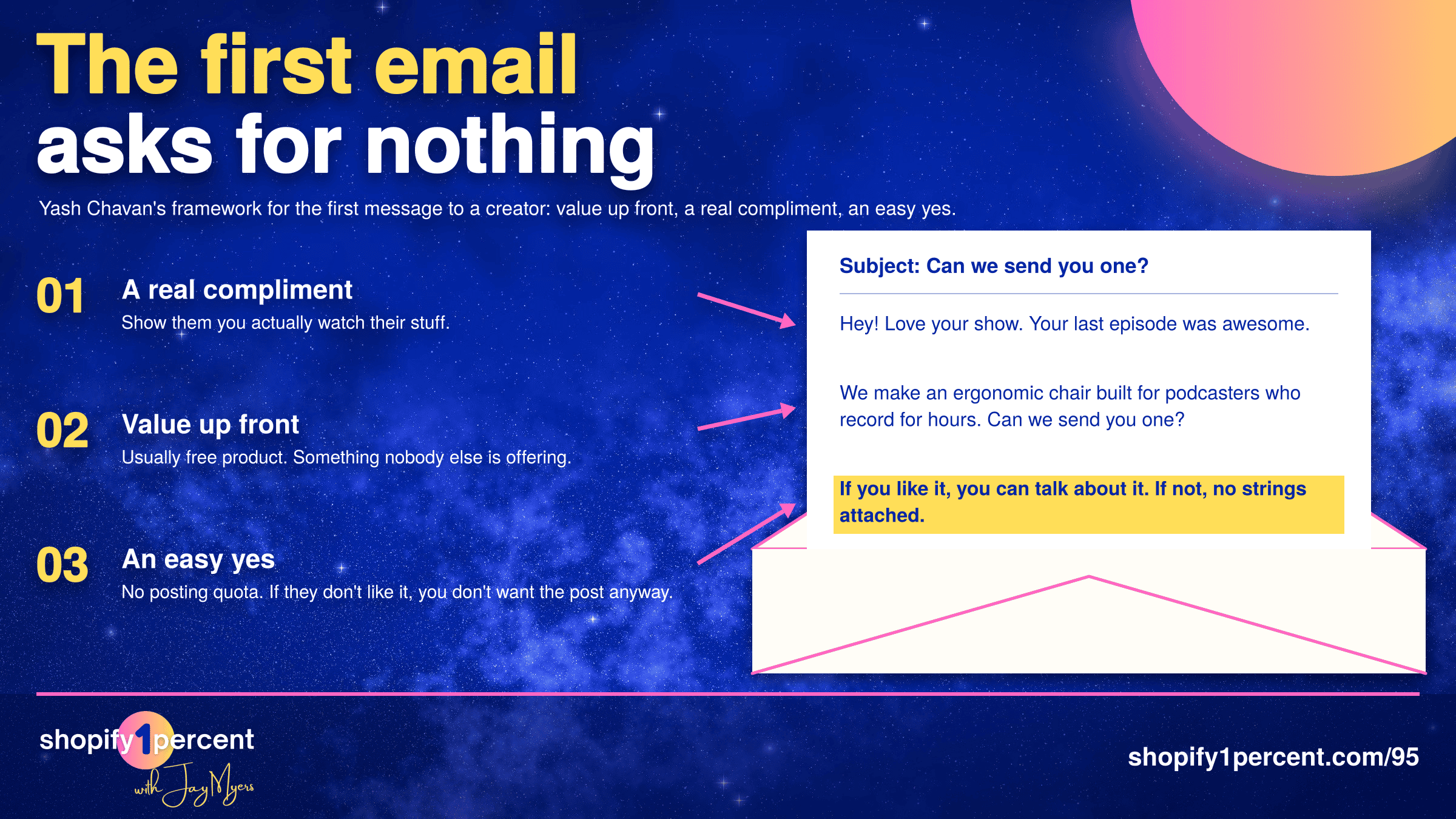
I get three to five pitches a day and ignore most. One brand offered to send me a $3,000 chair to sit in while I record, and pay me to use it. My reply was basically "Okay, sure. Send me the chair."
That email is Yash's framework. Lead with value nobody else can offer (usually free product), add a real compliment and don't ask for much. "If you like it, you can talk about it. If not, no strings attached." If they don't like it, you didn't want that post anyway.
CreatorIQ's 2025 report found only 20% of brands called gifting and seeding a top ROI driver in 2025, down from 71% in 2020. I don't think gifting stopped working. I think most brands send the box, get one post and stop. Yash says his best brands reach out to 100 or 200 new creators every week and turn the ones who love the product into affiliates. In my episode on building a creator and affiliate pipeline, I ballparked 1,000 invitations for every 100 creators posting, so that weekly number isn't overkill.
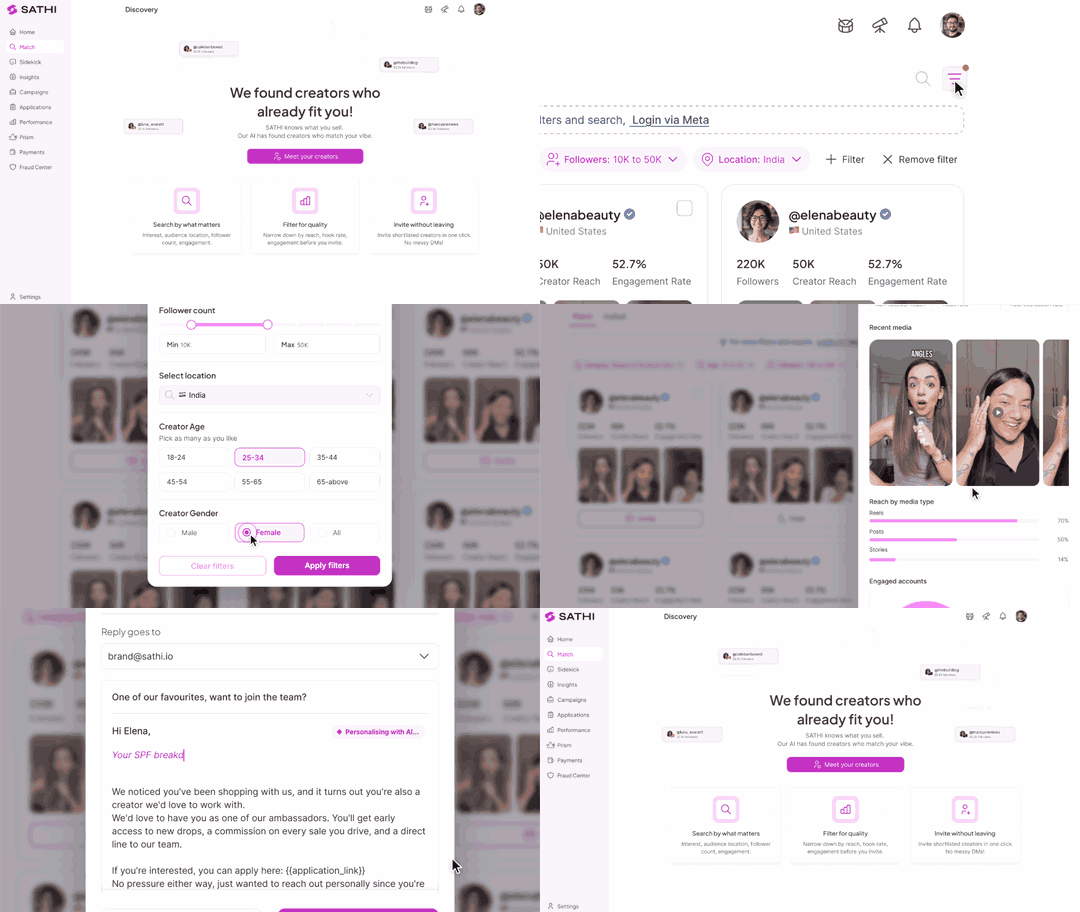
Short on orders? SATHI's Match agent finds brand-fit creators who already affiliate for other brands, so they'll work on commission instead of a fee upfront.
What commission should I pay Shopify affiliates?
Yash's rule of thumb is 10 to 25%. Single digits feels low (a 7% offer just reads odd), and you rarely need 30 or 35%.
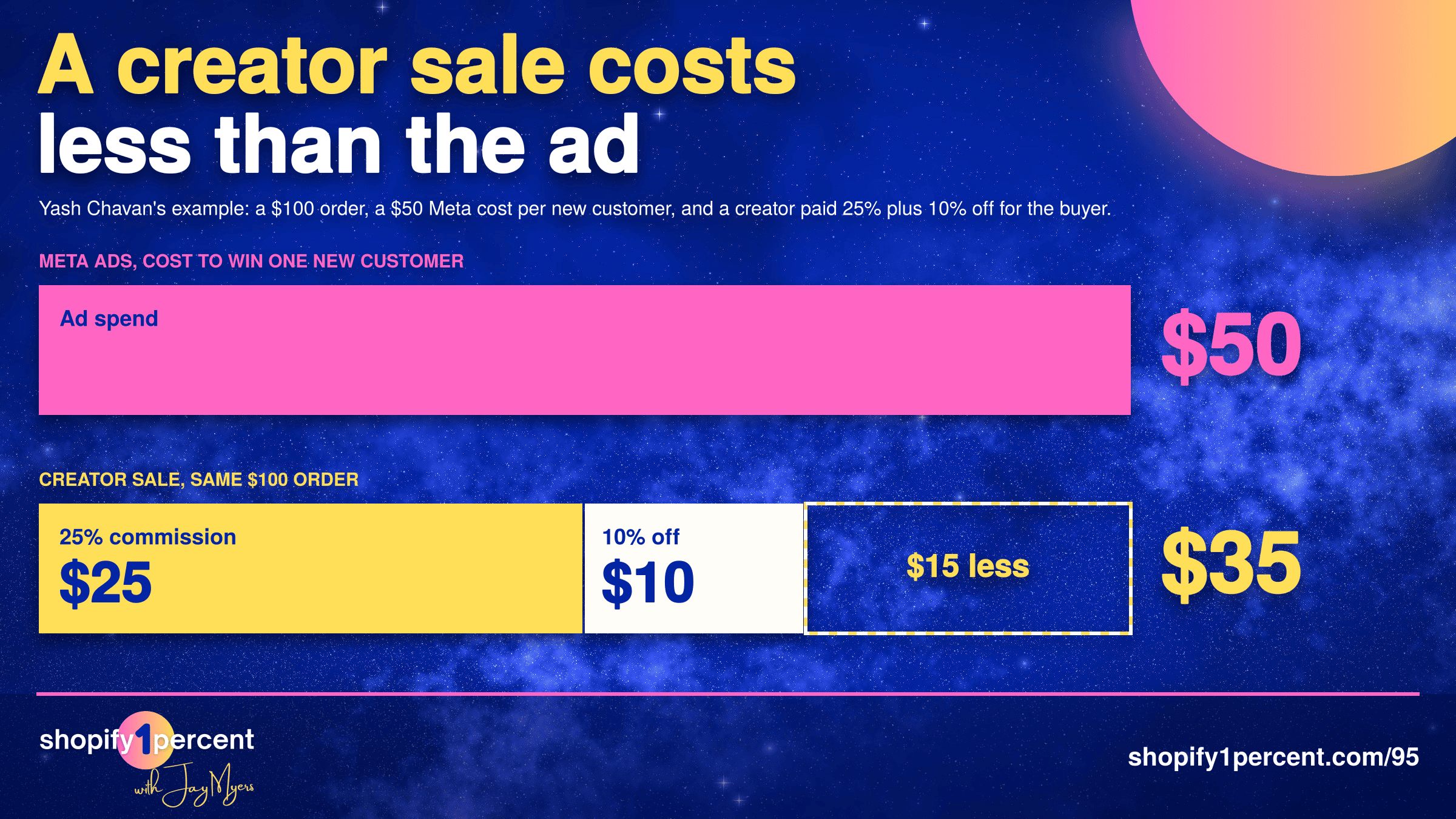
To pick within that range, work backwards from what a customer already costs you. His example: a $100 AOV with a $50 Meta acquisition cost. A 25% commission plus a 10% discount for the buyer comes to $35. That's cheaper than the ad.
The attribution window depends on how people buy. SATHI defaults to 14 days. A $15 impulse lipstick might get five. A chair people research for weeks might get 30 to 45. Yash also recommends paying more for new customers than returning ones, like 20% and 10%, or 25% and zero.
Do creator partnership ads lower your Meta costs?
Meta says yes, by a lot. Meta's partnership ads research, reported by PPC Land in 2026, found campaigns where at least 30% of assets were partnership ads had a 45% lower median cost per incremental purchase. Yash says SATHI's brands realistically see 15 to 25% lower CPAs. I honestly don't know which you'll land on. I'd plan on Yash's and celebrate if Meta's shows up.
His playbook runs on an 80/20. About 20% of your affiliates drive most of the results, and the people who drive sales are often not the people who drive views. Bump the sellers from 15% to 25%. Run the storytellers' posts as partnership ads and pay them a cut of the sales each ad drives. Yash calls them "mini creative directors."
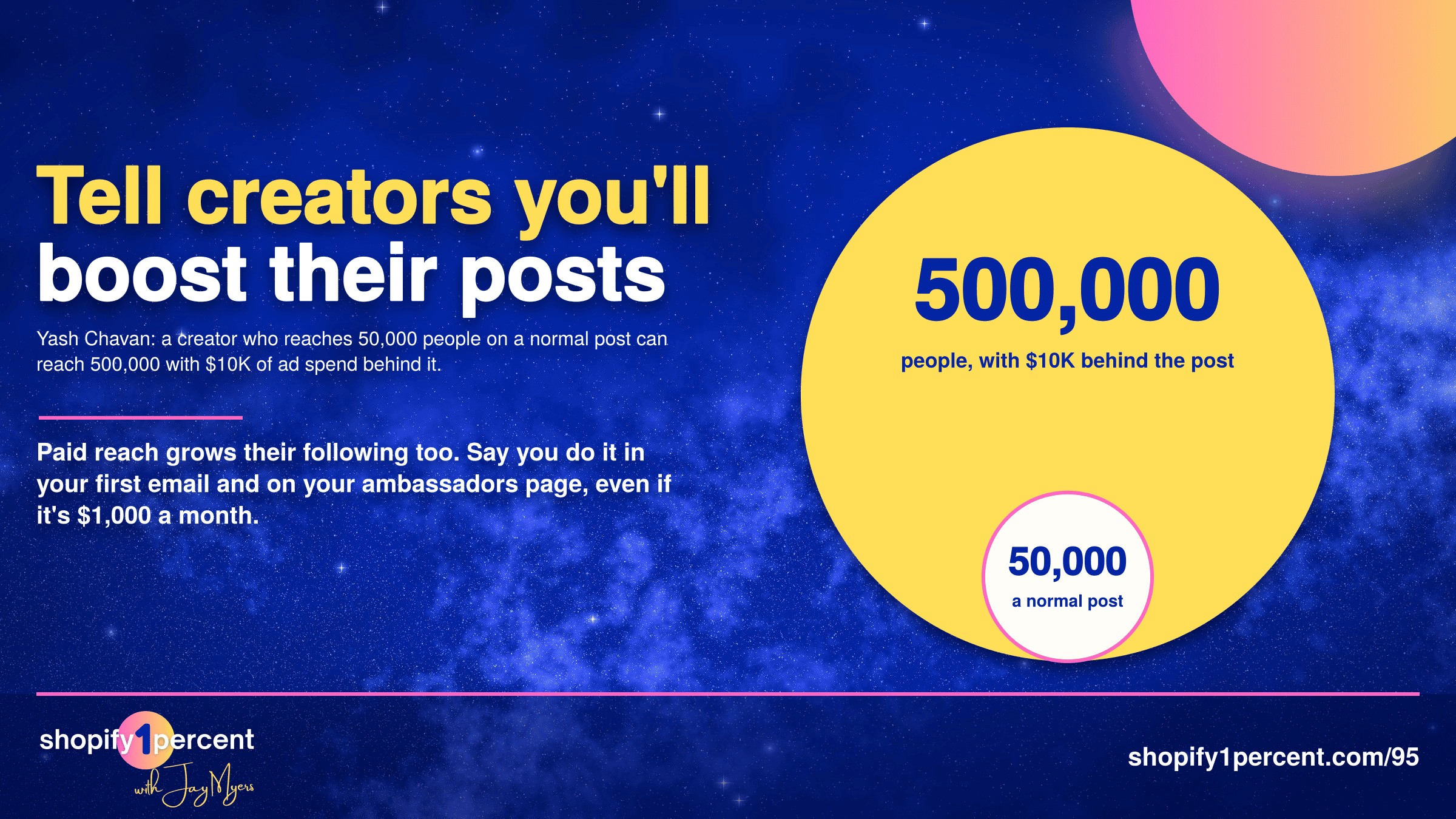
My one addition: tell creators you do this, because most brands don't. "We pay 20%" is one offer. "We pay 20% and put ad spend behind our creators' posts every month" is better, even if it's $1,000, because paid reach grows their following too. Yash said a creator who normally reaches 50,000 people can reach 500,000 with $10K behind a post. Put it on your brandname.com/ambassadors page, next to your commission tiers.
So the 1% move this week: put a number on your influencer list the way you already know your email list number, and start with the influencers who've already bought from you.
🎧 Search #Shopify1Percent anywhere you listen to podcasts to get the full episode. And subscribe so you don't miss the next one.

Co-Founder @ Bold Commerce // Host Shopify1Percent
Jay Myers has been in the ecommerce game for over 25 years. First as a merchant, then a service provider, and today a software provider. His company, Bold Commerce, has helped over 800,000 online stores sell more on Shopify. Their suite of apps help brands maximize LTV (Customer LifeTime Value), and AOV (Average Order Value).
Bold has been ranked one of Canada's Top Medium Sized Employers, ranked in the top 50 fastest growing companies in Canada by Deloitte multiple years, a Top Growing Company in Canada by the Globe and Mail, and winner of the Ernst and Young Entrepreneur of the Year award.
How to Segment Your Shopify Email List for Black Friday