How He Got 73% of Shopify Customers to Subscribe
Jordan Narducci ran DTC at Kellogg, led DTC and Amazon channels at Momentous, and now runs DTCPG. On this Shopify podcast episode he walks me through how he helped one supplement brand go from 18% to 73% subscription opt-in, why a skipped order can hide a cancel, and how GHOST’s cancel flow went from saving 4% of cancels to 31%. If your subscribe and save is a flat 10%, start here.

 Apple Podcasts

 Spotify

 YouTube

 Amazon Music

 Audible
Key Takeaways
- On the Shopify1Percent podcast, Jay Myers talks with Jordan Narducci, founder and CEO of DTCPG, about how Shopify brands can raise their subscription opt-in rate, keep subscribers past the first few orders and build a cancel flow that saves customers.
- Jordan Narducci of DTCPG says a subscription opt-in rate under 10% means you've got a real problem, 25% to 50% is where a lot of supplement brands sit, and best practice brands reach 75%, 80% or even 90%.
- Jordan Narducci says defaulting your product page to subscription can raise your subscription take rate by up to 10 percentage points, and the adoption you gain will always offset the little bit of extra early churn it brings.
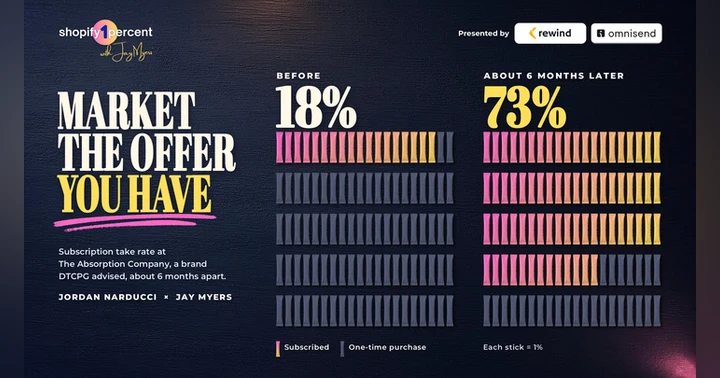
- Jordan Narducci of DTCPG helped The Absorption Company go from 18% to 73% subscription opt-in in about 6 months, and says making its best seller subscribable and marketing its stacked discounts as an evergreen offer got it above 50%.
- Jordan Narducci says a skip isn't always a save: at 1 brand, 35% of skippers came back and canceled right away because they were confused, and fewer than 50% of skippers ever come back to purchase.
- Jordan Narducci calls it usage to frequency alignment: if you upsell a subscriber to a 2-pack or 3-pack but keep a monthly cadence, they build up too much product, which he says is the number 1 reason people cancel.
How do I get more customers to subscribe on Shopify? Jordan Narducci, founder and CEO of DTCPG, says start with the discounts you're already giving away. The Absorption Company was stacking a bundle discount with a subscribe discount and telling shoppers it was 10% off. Their best product didn't even have a subscribe option. Jordan says fixing what was already there pushed opt-in above 50%. All told, the brand went from 18% to 73% in about six months. His audit sparked it, but he's quick to add he can't take full credit. Their team's execution did a lot of it.
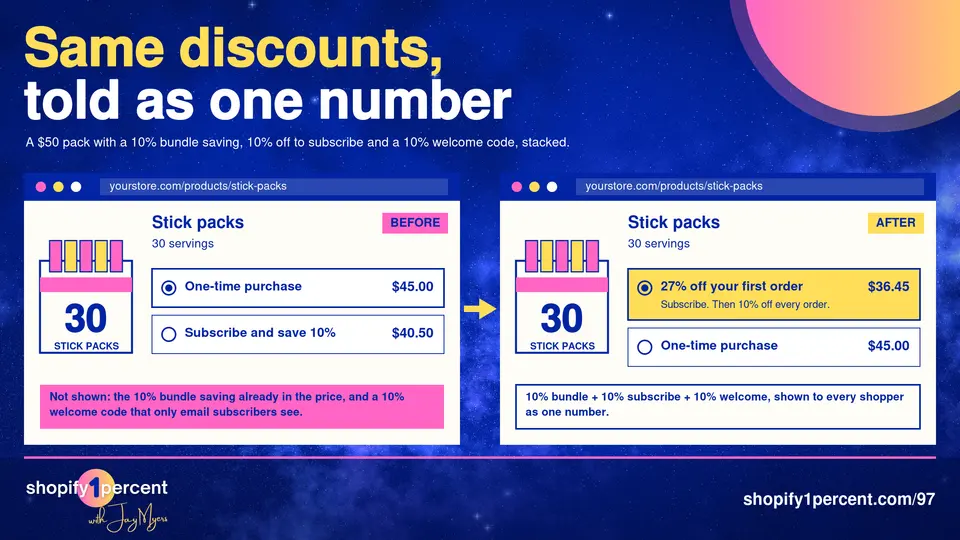
So if you're asking yourself "what's a good subscription opt-in rate for a Shopify store?" or "how do I stop subscribers from canceling after the second box?", this episode is for you. Same goes if your subscribe and save is still a flat 10% you set and forgot. Jordan says those are his favorite brands to work with, because there's so much opportunity.
📖 Want the full playbook? Read my breakdown: Your Shopify Store Is Hiding Its Best Subscription Offer
What you'll learn
- The opt-in rate Jordan says means you've got a real problem, and the one product page setting he says can add up to 10 percentage points by itself.
- Why the welcome discount sitting in your email pop-up only reaches about 5% of shoppers, and what a Chewy executive told the Momentous team to do with it instead.
- What Jordan calls usage to frequency alignment, and why upselling a subscriber to a two-pack on a monthly cadence sets them up to cancel.
- Why Jordan says he's never seen quarterly subscriptions fail, and how his subscribe more, save more ladder can lift AOV without dragging down take rate.
- Why I think the first three months of a subscription work like a $50 bottle of wine, and what Fatty15 tells its customers to expect month by month.
- Why a skip isn't always a save, and why Jordan tests $20 off against 20% off once an order passes $100.
Our partners
Support the amazing partners who make this possible.
🎁 Remember to email AirPods@Shopify1Percent.com and tell me if you install one to win a pair of the new AirPods 5
SATHI
This episode is brought to you by SATHI, the best affiliate platform built for Shopify brands.
70% of influencer-driven revenue isn't showing up in your dashboard. Codes are leaking. Affiliates are ghosting. And you're paying commissions on sales that never should've counted.
SATHI fixes all of it. Built by the incredible team behind SARAL (200+ top brands, $59M in revenue with influencers).
🎁 Our listeners get early access at MySATHI.io and use code JAY for 20% off
Rewind
The undo button for Shopify. I’ve watched merchants lose entire catalogs to one bad import or an app update... Shopify’s own terms make your store data your responsibility. Rewind backs up your products, themes, orders, and customers automatically, and restores one item, or your whole store in a couple of clicks.
In my opinion, if you're actually serious about your Shopify business, you absolutely should have Rewind running on it. There are no excuses not to have it backed up. Rewind is trusted by 25,000+ businesses including Olaplex and Dr. Martens. Set it up once and have peace of mind forever.
🚨 Our listeners get an extra full month of FREE protection and backups: shopify1percent.com/rewind
Omnisend
I personally use Omnisend for email and SMS on every Shopify store I manage, and for this show too! I've tried them all, and it's hands down the best way to run every email and SMS automation and campaign you need, segment to personalize them, and A/B test everything to optimize conversion.
PLUS, you can now connect Omnisend to ChatGPT or Claude and just ask “where can my email and SMS be making more money?” It reads your actual store data and tells you, then builds the campaign for you right from the chat. It even writes in your brand's voice. Fifteen years doing this and it's the closest I've felt to having a full-time marketer sitting beside me. (Plus most merchants report paying about half the price of Klaviyo.)
🚨 Listeners (YOU) get an exclusive 30% OFF 3 MONTHS with code JAY30: shopify1percent.com/omnisend
Resources and links mentioned
- My blog post on this episode: how to get more Shopify subscribers
- DTCPG
- DTCPG case studies (The Absorption Company and GHOST results)
- Jordan Narducci on LinkedIn
- Jordan Narducci on X
- DTCPG on LinkedIn
- The Absorption Company
- GHOST
- Momentous
- Chewy
- MOSH
- Fatty15
More from Jordan, including his bio and where to find him
Did you know leaving a ⭐️⭐️⭐️⭐️⭐️ review on Spotify, or Apple will give your shop gooood ecommerce karma? ❤️
Frequently Asked Questions
How do I get more customers to subscribe on my Shopify store?
Default your product page to subscription and make your subscribe offer the best deal on the site. Jordan Narducci of DTCPG says defaulting alone can add up to 10 percentage points to your take rate. He stacks the email welcome discount with the subscribe discount and shows it on site as an evergreen offer, because a Chewy executive told the Momentous team a discount hidden in email reaches about 5% of your audience. Let shoppers subscribe to your best sellers.
What is a good subscription opt-in rate for a Shopify store?
For a supplement brand, Jordan Narducci of DTCPG treats anything under 10% as a real problem and 25% to 50% as where a lot of brands sit. He says 50% is the minimum for a subscription-first brand, and best practice brands reach 75%, 80% or even 90%. Beauty brands find it really hard to reach 50%. Jordan says a sub-10% rate usually means a flat 10% discount and no subscription default.
What does Jordan Narducci recommend for keeping subscribers past the second order?
Jordan Narducci of DTCPG focuses on the first 3 months, because orders 2, 3 and 4 are where the majority of churn happens. Match the serving size to the delivery frequency, onboard subscribers with education and handwritten cards, and front-load gifts and incentives into orders 2 through 4. He says giving bigger discounts later, such as 25% at month 6, just gives margin away to customers who would have stayed anyway.
What is usage to frequency alignment in a subscription program?
Usage to frequency alignment is Jordan Narducci's term for matching how fast a customer uses a product to how often you ship it. Jordan, founder of DTCPG, sees brands upsell subscribers to a 2-pack or 3-pack while keeping a monthly cadence, which is good for payback but horrible for retention. At some brands, 70% or 80% of subscribers to a 4-week best seller are on a bimonthly cadence, a sign they aren't using it fast enough.
Does a skipped subscription order count as retention?
Most subscription platforms count a skipper as an active subscriber, but Jordan Narducci of DTCPG tracks order retention instead. A customer who buys once, skips 2 or 3 months in a row and cancels looks the same as a daily user on active-subscriber metrics. At 1 brand, 35% of customers who skipped came back and canceled right away because they were confused, and Jordan says usually fewer than 50% of skippers ever come back to purchase.
How do I build a subscription cancel flow that saves customers?
Start with why people cancel, then offer solutions before any discount. Jordan Narducci of DTCPG looks at the share of cancels for each reason and the save rate attached to it, and fixes the most-selected reasons with the lowest save rates first. He opens with a splash screen on the benefits of subscribing, prefers delaying or changing frequency over a skip, and treats the discount as the last attempt.
Should a cancel flow offer $20 off or 20% off?
Test both once your average order value reaches $100. Jordan Narducci of DTCPG says "$20 sounds like a lot more than 20%" at that order size, and his team has tested dollar values against percentages. Jordan also segments cancel-flow discounts by how many orders a subscriber has placed, offering bigger discounts to longer-tenured customers, and sometimes tests free product against a discount.
Are quarterly subscriptions better than monthly subscriptions?
Jordan Narducci of DTCPG says quarterly subscriptions are a great lever for retention and AOV, and that he's never seen offering them not work. Offer quarterly alongside monthly rather than exclusively, and your overall take rate can stay consistent or rise. Shipping a quarter's product once instead of 3 times can save you $20 to $30, which Jordan says can fund an additional 5% discount.
00:00 - Intro: what a subscriber is really worth
03:05 - The 3 metrics Jordan checks first
09:01 - What a good take rate looks like
14:52 - Should you drop one-time purchase?
16:43 - Why a skip isn’t always a save
20:37 - The Absorption Company: 18% to 73%
25:43 - Subscribe more, save more and quarterly plans
31:58 - Keeping subscribers past the second box
39:28 - Building a cancel flow that saves people
44:58 - Where to find Jordan
Shopify1Percent
Jay Myers: Now, the harder part is keeping them, and this is where a lot of Shopify brands are struggling in the most is keeping them past that second. and
Jordan Narducci: you're just setting yourself up for failure. Even the best brands still do this, honestly. Some of the best brands I review, they upsell because they'll take that at AOV lift immediately, which is good for payback, but it's horrible for retention. And so you need to find a way to change that frequency. you introduce more of the same.
Jordan Narducci has never seen a brand where a subscriber wasn't worth two to four times a one-time buyer. His agency, DTCPG, helps Shopify brands turn more buyers into subscribers. At one client, 18% of customers were subscribing. Six months later, it was 73%.
Jordan Narducci: That's why I'm saying, I think the platforms over time time have gotten very good at making people skip versus cancel, about a third to 50% ever ever come back. is like norm. Less than 50% is probably a better way to ever come back to purchase.
Jay Myers: It's actually from a 2025 study on 20,000 brands. Only 60% of subscribers make it to order three. Like you've increased the take rate. Now what are you doing to keep them coming back?
Jordan Narducci: You need the three months- you really want to focus on education, onboarding, helping them understand why there are benefits.
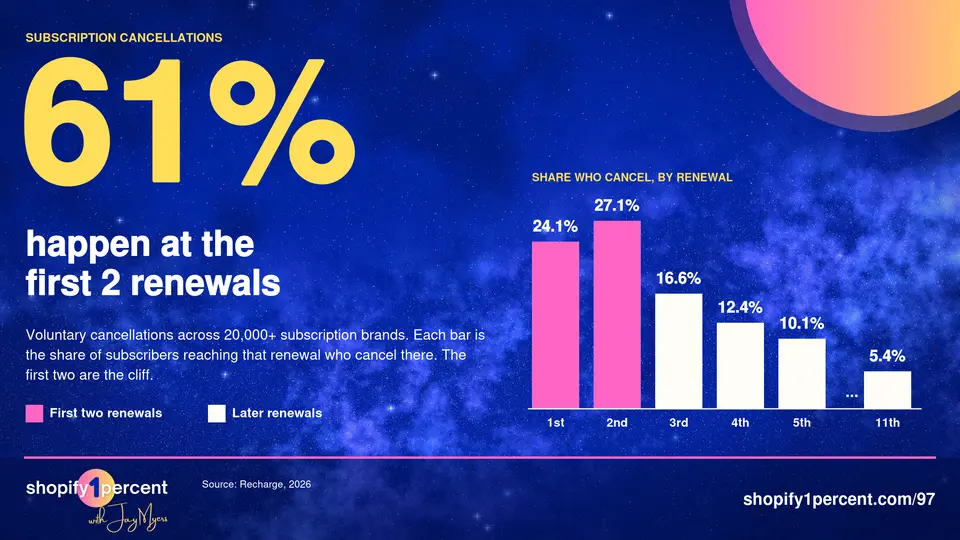
Jay Myers: A subscriber on Shopify is worth roughly three times what a one time subscribers worth. So every store with the subscribe and save button figures they've got recurring revenue handled, except the same data that that came from. that 61% of subscribers who cancel are gone by the second renewal. So, so you're basically paying to acquire them. They bought once and then the majority of them are gone and you never see them again. Now, my guest, here today. He's sitting here waiting chomping at the bit. I'm going to let him speak right away, but he's made a career out of that gap and he's got a ton of experience in the space. He ran D2C at Kellogg, he. He led e, e-commerce for Momentous, which, which is a brand that is just crushing it right now. And you can correct me if I'm wrong on these stats, but I think you were there when they had a year of triple digit. growth. Now he runs an agency, which I love the name. It's D2CPG. So D2C, CPG. Blend it into one word. I think that's genius. And he's taken supplement brands subscription op- opt-in rates. And this is straight from case studies on his website, but we're going to get into this from 18% to 73% and roughly six months. He took GHOST's cancel flow from saving 4%. to 31%. I'm so excited to get into some of the things that he did and that you can implement in your store. Jordan, welcome to Shopify1Percent. Thank you so much for being here.
Jordan Narducci: Dude, I'm so excited to be here, that was probably the best intro I've ever had about myself. So I'm watching a little bit, imagine the frame here, but yeah, I appreciate the kind words and super excited to get into some of this stuff. because I think, honestly, honestly, some of those metrics. If you only look at at that, they're kind of vanity metrics, so I'm excited to dig in a little deeper and actually explain why those are actually impactful.
Jay Myers: Okay, so I would love to jump right into it. My pet peeve, I always say with, podcast is when there's 10 minutes of background and history on a guest and how they got started. People listening, they're tuning in because they want to hear. all of that knowledge that is inside your head that you're. Working with brands and they can hopefully walk away. The whole point of the show is to make merchants 1% better after episodes. So let's, let's get right into it. When you work with a new client. and you get into their metrics and you're Rooking at the store, someone comes to, what, I know I think you've got three metrics, it could be more, but I think you've got this before, but what are the metrics you, you look at before anything else? And why are they those and let's let's start there.
Jordan Narducci: Yeah. So just let me zoom out for a second. We call ourselves Lifetime Value Consultants and we focus on subscription growth to drive Like time value the reason being you said that. at the top is usually a subscriber is two to four times more valuable. Not usually every single brand I've ever looked at has been two to four times greater than a non en. and it compounds over the, and the 1-percent every day every day obviously leads to a ton of compounding and so there are lifetime value like a couple things first off People talk about lifetime value, but usually they're talking about lifetime revenue. That's one place to start, right? Most people actually peel down macro. How do you define lifetime value? The revenue we get after . Mostly I use those as synonyms. So when I'm saying lifetime value, I'm mostly talking about lifetime revenue. Because at the end the day, they follow a similar trend and we're not going into the margin side of things. We're not helping with ops. and improving margin. So at the end of the. conversation. The reason why lifetime value is kind of a term that's hard to track and measures. Most brands only do it on a quarterly basis. Usually it's for a board meeting or some presentation that they're giving. And so, if you're only tracking it quarterly, it's like, how do we know that the things we're doing today are going to help you improve in 12 months? Right. And that's, that's where I'd say like the opportunity is. And so there are three key metrics that we've identified, like during my time at Momentous and thereafter that, that have an outsized impact on lifetime value more than anything else. If you focus on optimizing them today and you can track them today and so that's why Track these three metrics the three metrics you alluded to some of them, right? It's your adoption rate, take rate, whatever you wanna call it in-rate for subscriptions. So the percentage of people when they come to your website, that subscribe when checking person is
Jay Myers: buying it one time.
Jordan Narducci: Exactly, yeah.
Jay Myers: Okay, then you're really opt-in rate. Yeah
Jordan Narducci: Yep. The other side of that equation. So I think it's anybody can drive 100% adoption right because you can just make it a subscription only turn off one
Jay Myers: turn off one time,
Jordan Narducci: right? So that's a super easy thing. So in some regards, it's a vanity metric in that like, anybody can give a crap ton away, like you give a 90% offer or even like What brands used to do 10 years ago when I started in this space was get your first month month free and then they never come back. You get so much chirp the following month as we start attracting the wrong type of a customer. So there's this balancing act between your adoption rate, and you can either define it as your turn rate or we like to look at churn overall churn rate, which is just like a blended average. And also your month one, two and three retention rates, because that's looking at a retention curve. it downward and it's the slope is the most aggressive in the first few months or orders and then it starts to taper off and then eventually it flattens so the sooner you can get the curve to flatten the better. from a retention perspective, but, but regardless of the brand, a hundred percent of brands, the retention curve is the most intense in the beginning. And so. Yeah. Really want to focus on the first three or so orders after the first purchase and optimize there,. And so, I'm, sure we can get into that. But like, yeah, why we focus on the first three months of retention. And then the last metric, and the reason why we call ourselves lifetime value consultants versus subscription consultants is we also focus a lot on average order value because I think it's an underutilized lever to grow lifetime value. We have a brand, we had a brand that essentially over the last 12 months doubled their AOV through a mix of introducing new products. Increasing pricing moving into buy more save more tactics, which I'm sure we'll get into and doing that They're their av is literally doubled. Guess what happened to their lifetime revenue. It's more than doubled, right? Yeah. So yep Like if you increase your AOV on the first order, it shifts up the lifetime value curve and then it generally follows, whatever the retention curve, it was going to follow anyways. And so you have an elevated LTV in 12 months. And so. Those are the three metrics that we focus on at DTCPG, But it's also what I think every brand should focus on because you can measure them today, you can be focused on them, you can optimize them and then if you if you do improve those three metrics You will increase your lifetime value. It's like a it's a hundred percent of the time it works And so we our whole agency is based around those three metrics, and then our audits You know, like, how do you optimize your AOV? How do you optimize your adoption rate? How do you improve your, and by doing those things, we then rank order them based on impact effort. And we go in and like actually help you optimize those things. So, yeah, that's kind of the. That's where we go super technical, but those are the metrics that matter- that are going to have an outsized impact on lifetime revenue or value.
Jay Myers: Okay, so I want to dig in a little bit. Is there- thresholds that you look for when you're looking at a brand, like what is a good take rate and a bad take rate? What's a good churn rate versus bad churn rate? And then. AOV lifetime value, are there numbers that are kind of benchmarks. For you that like are healthy, not healthy, or how do you look at that Well,
Jordan Narducci: I guess my first response is every brand is different. So so, so first of all, the industry is quite different. If you're looking at a beauty brand versus a supplement brand, cake rates are naturally going to be a little bit different. So we lean a lot into supplements, health and wellness, I'll speak to that maybe a little bit when talking about metrics, a lot of brands that are doing just a flat rate discount. So things I look for on the adoption side, the take rate side, it's like, when I look at a buy box. I'm saying, is it just like a standard flat rate discount, right? That's what a lot that's that's what the norm was up until a a few years ago. Yeah, it was just like 10 percent, 15 percent, 20 percent, set it, forget it, slap
Jay Myers: on a subscribe and save and you're good to go. Yeah
Jordan Narducci: and that's what like the brands I love, my favorite types of clients, they're the ones still doing that. because there's so much opportunity. You know, I would say a lot of brands have learned from what I call like best practice subscription first brands. And so they've started like mirroring that. this was like one of the big unlocks we did at Momentous was like We were talking to I think that I think it was like the CRO at Chewy was an investor of Momentous and He was telling us during if you go to Chewy's website. They've optimized best practice in terms of like subscriptions for a category that's quite quite competitive competitive and he said like the biggest unlock they had was thinking about like not treating all your customers as the same and not just giving the same discount to everyone and also he said the biggest thing that at struck with me and this is one thing we always look for at a brand is your email, a lot of brands focus on their email. You sign up for email, get 10% off. A lot of brands, A, make that 10% only available to one-time purchases. And then basically you're making one time purchase. You're basically making some less, pretty much indifferent between a 10% subscribed save and a 10% one time purchase. And so it washes any of the benefits of becoming a subscriber. So that's a mistake for one. I'm going off on a little bit of tangent, but I think
Jay Myers: tangents are good.
Jordan Narducci: And then the other thing is, he said, Only about, maybe the best brands are like 15, 20% giving their email addresses and then only half of those people open their email. So it's like, you're talking about like, you're giving this to 5% of your audience. He's like, just take that thing that you're giving and you're welcome flow, stack it with subscriptions, you're actually focused on subscriptions, and then bring that to life on your website so that 100% of people see it. So, so that was the big unlock we did at Momentous was we started off offering 25 % off your first order and then 10% off subsequent orders and that s just like Our, our take rate, right we're first step and then, and then, and then message to come by and discount. But then, we like, only 10% of people are seeing that. Why don't we bring that to a hundred percent? And then we brought it to the website as an evergreen offer. And, and that was just like the first step that compounded it. And that opened a light bulb of me as like how do we just improve your take rate while keeping your retention constant? To answer, that was a long-winded way to get to the take rate side, but I think it's bring. so I would say anything that's like sub 10% is like you got a real problem, right? You're probably doing a flat rate 10% at that point, probably You want to a, you want to subscription. Yes you will get a little more churn, immediate churn, but it will always offset the benefit, the adoption rate benefit you'll get from that will always offset that little bit of churn you get. So, yeah, anything under 10%, you're probably not defaulting, you're probably getting too little away, especially on that first order, view that first order as an acquisition cost cost, group it into your overall cost, it becomes very obvious, because like we said. three times greater revenue you're gonna get in 12 months. So the paybacks quick. So yeah, so anything under 10% issue and to a 25% there's brands at like a 25% that are sustainable. Anything under that, you know, you have an opportunity 25 to 50% is where I'd say like, a lot of brands brands brands that have been focused on. We try to get every brand we Anything like 50-percent is. I would say, the minimum that like if you're subscription-first brand like you're really focused on drive description first that's the minimum the best practice brands that are not just like a I would say 75, 80, maybe even 90%, I know brands that are at 90%, but that's like truly crème de la crème and everything is focused on subscription. No other benefits. And then obviously there's a hundred percent for the brands that go subscription only. Downside to that. There's a lot of debate about this, like subscription only versus happy one time options. I've always personally found that like your CAC goes through the roof, it becomes just really hard to acquire customers. There are exceptions to that brands that do that really I've always But just having it be such like have your subscription offer be so enticing that it becomes a no brainer for 100% of, your customers like that's the move because you can anger against a more expensive price in that case.
Jay Myers: I just there's been a really a few interesting debates about that on LinkedIn recently actually Andrew Mosh from... sorry Right.. Andrew, he did a test and he found that they actually removed the one time purchase option a year or two ago and it hurt. So there are subscription numbers too. They Bernstein, that's his last name. I'm trying to try because the one-time purchase, they found a little bit of a lead and into the subscription, not everybody's ready to commit. You get them to buy at one time and then if you have really good flows to encourage the one-time person to eventually subscribe, then that's just another path that people take. It's not that they're not a subscriber. They're just taking a different path.
Jordan Narducci: Yeah, I have other perspectives on that, but we can get into that. Like, like, and this is why I said like mosh. Every brand is very different. Right. And so I know I don't think there's a one-size -fits-all eating these metrics. I'm quoting you. Those are true of supplements beauty brands. It's really hard to get to like 50% adoption. It's totally yes. And retention is harder with beauty too, because it's like. Everybody goes through like a a serum I use different lotions and different things at night like once you get married you're you're like whole world opens up to like facial treatments and things like that and The difference in like the amount that I use is very different than what others you know a very much And so yeah getting getting the usage to frequency alignment. Alignment is really hard with beauty and I would say it's just a little bit farther behind it's kind of like the way a lot of people talk about the UK it's a little farther behind people just aren't quite there yet I have some people on my team that are in Latin America No one subscribes to anything. You can have a subscription offer on your pay, be the best offer ever, no one's taking it. So it's like, there's cultural things, there's a lot of factors here that I just want to acknowledge. Space supplement brands, that's what I'm talking about. And then and then there's on the retention side, there's two ways you can define a retention when it comes to subscriptions. And I think a lot of brands, I did this. Almost everybody talks about retention through the lens of. active subscribers and this is where I was saying your cancellation flow and certain metrics can be vanity metrics and we'll get into that There's there's two or two types of retentions. There's like you're you're an active subscriber still like ie I subscribed But then maybe I skip two or three months in a row. That's a very different and then I cancel That means I only really purchased once from you. I skipped a few a times and r canceled. That's a very different smurf than someone who came with actually adopted your product, used it every day from an act perspective, active retention perspective, they're both the same, according to the platforms. arms. Yeah. from a order retention perspective. dramatically different, and from a lifetime revenue perspective, very different. So that's why I'm saying I think the platforms over time have gotten very good at Making people skip versus cancel and I think like you know, and I'm part of that I'm on that bandwagon and I still believe like a skip is much better than a cancel If they never come back, it's not really right. So yeah, I think like a I think there are there are ways to Manipulate your metrics especially cancel flow metrics. Yeah And so we're actually starting now, especially with AI is making this way easier. We track a few things and the MCP is now available that are all the platforms now or most of them soon to be all of them. We can ask questions like. how many, at what percentage of customers that skipped came back and canceled right away because they were confused. And like, we did this with a brand recently. 35% of customers a were actually confused about the journey, came came back immediately and canceled. and then we learned I would I would actually say it's very common about a third to 50% of customers when they skip never come back only only sorry the other way around about a third to 50% ever come back. is like more, less than 50 50% is probably a better way I ever come back to purchase and so like you need to start paying attention and some of the platforms are better at this allow you to see this right like pretty easily but a lot of them don't. And so actually tracking like what happens after a skip is really important. But yeah, if we want to keep going on the other side of the equation, on the retention side, I would say like if you're above 70% order retention. On the second order that's that's very strong.I've seen brands eighty percent plus you know in the supplement space again I'm talking about when you get into like you know there are great businesses out there that like like Brita water filters. Those are gonna be in the 90s, right? Those are the best.
Jay Myers: That has a hardware component is always always
Jordan Narducci: the challenge with them though is like most of these brands are Omni so you actually don't know if they're coming back or like yeah. But yeah, so I think like anything like 60 to 70% is sustainable. Less than that, when you get to 50% or lower, you have a problem. And you kind of quoted that stat at the beginning. That would be a real, in my opinion, problem if only, I think you said 61%, I've actually never heard that stat. If only 40% of people or subscribers are coming back to order 2, that is not. and a sustainable business.
Jay Myers: Yeah, it's actually from a 2025 study on 20,000 brands. Only 60% of subscribers make it to order three. Okay,
Jordan Narducci: I heard something very different than that. That makes more sense.
Jay Myers: okay. Yeah, no, sorry not a get to the second process. I got the second order. So the third order This leads into the next question. I wanted I had a few things I wanted to make sure I asked you on this episode. One of them. Was that case study that you have on your site with The Absorption Company. And you took them from 18 to 73% take rate. within six months, which is insane. First of all, that might be some kind of a record, I know, but but can you highlight what were the biggest things you did to to see that? I'm sure there was a lot, but. what were the biggest things you did to see that kind of results in six months? It's a just I want to
Jordan Narducci: say that the team at the Absorption Company is one of the best I've ever worked with. And so, you know, like, I, I definitely can't take. Full credit for that. I think our audit sparked something in the founder's minds around like we need to make we need to become a subscription first brand And it made them think differently But the execution is what matters. And they've been just like flawless partners. They're, they're the first brand I've worked with since Momentous that I, that is on a similar trajectory.- just crazy. perfect execution and was super excited. Like I I'm still, they're still a client. I've been working with them. They were, they were one of my first clients and I'm still really fun to watch their Well, that's a testimony. Sorry.
Jay Myers: That's a testimony that they've still, like when a someone stays around, cause I know whether anyways, in the agency world,
Jordan Narducci: it's hard to stick around, especially hyper. Hyper growth brands, but yeah, they're great, great, really, really great guys to work with and, and really honestly, just really a really great operators to go back to back then, right? Like when I first started working with them, my audit found was they were actually doing exactly what you described for Mosh. Every brand is different and what we found with the Absorption Company is that they were taking this perspective, they wanted to have their customers try the product first. So they were basically really prioritizing this variety pack that you. Couldn, subscribe to their. they were, they was like, let's have customers try and then come back and they could subscribe after. our analysis found,. Like was those customers were not coming back to subscribe. Most of them were never coming back. And they're only. They're 18% was actually coming from just our And so I was like, we just need to focus on that. Let's prove that our trick. And then there are so many things they were already doing. And this is honestly where a lot of the leverages with a lot of brands is. They're actually already giving some of these benefits away. Okay, they're just not marketing it effectively. So for them, at the time,- they had mostly these powder stick packs you could either buy two packs or one pack. I think it was 24, 24 servings or you could get 12 servings or maybe it's 30 or 15, whatever. The 30 pack was basically, they were giving a bundling incentive, which was 10% off. And then they and then they were giving another 10% off to subscribe, but they were just marketing it as 10% And so I was like, you're actually this is actually 18% off if you do the math, right? 90% times 90% or whatever that is. and so I was like, why don't you just start focusing on the combined discount and message that. And so that immediately they could start saying 18% immediate job, right? Then it was like Turn your best seller into a subscription some people like variety. I subscribe to element. I subscribe to the variety pack I like the different flavors. I like to try the different stuff, some people might like the variety, and they might not want to go through the full pack every, you know, every month, and so I was like turn that on, then let's change your funnel in general, so it's not just focused on the variety pack. And then the other big unlock was we took what we learned from Momentous. And I was like, you're giving 10% off in the email, another 10%. it's stacking, but you're not marketing that. So now you can take that 18%. Stack it with another 10% and just bring that to life on the website as an evergreen offer, don't make it exclusive to email, make it available to everyone. So now you have another 10% off, so you're a close to 30. I don't know what that math is, maybe it's 27% off or something. And so now just bring that to life on your website, 27% off your first order. Then it scaled down to 10 percent after that, right? So as basically it meant this offer, but it was just making it evergreen available to everyone just versus just the emails. Those things alone got it above 50% like crazy. What
Jay Myers: I love about that is. You didn't actually tell them that they needed to give more of a discount. You just found other ways that A already was being discounted or that a customer could have gotten a discount anyway. It's, it's, you packaged it differently. So the brand must've loved that too. a
Jordan Narducci: so many brands, you'd be a surprise. It's, it's more of a just reframing, almost. It's very rare that we're like, you actually have to give more margin away. It's actually sometimes taking margin, because what we found a lot of times is like, you know, a brand might be at 20% off a month. most brands these days if you're doing a flat rate is like 15 to 20% off a month right if you get people on like 20 to 25 percent off the first month and then It goes down to 10 that. then actually you don't, you're actually getting margin back over time assuming they stick around for a few months. And so, yeah, that's how we reframe some of these things. And then the last thing, which is the Absorption Company, just to close the, the circle was. Then we started thinking about buy more, save more, and I like to subscribe more, save more. So you basically only make subscription. You only make the subscribe more discount available to subscribers. And you, and you frame it as though if it was 25% off and then 10%, maybe it becomes 20% off for the monthly, for the one pack every month, and then maybe it's, you know, 30% two packs, every two months, and then maybe it's 35 % off for, you know, three packs every three months. I'm making that up range where it goes up slightly as you, as you buy more. Quarterly subscriptions in general are a trend right now right now. they're a great lever to improve your retention because I've never found a brand that the quarterly order two retention doesn the monthly order four hundred percent. 100% of the time, right? So like, yeah, that's why that is a good tactic and you're increasing AOP,
Jay Myers: do you find that with quarterly you take a bit of a hit on take-take rate because it's a more expensive initial. No!
Jordan Narducci: No, I've actually seen, I've seen, well, so I don't, I don't offer it exclusively, right? So that's the first thing.
Jay Myers: You just try to push them to it as an option. default,
Jordan Narducci: a lot of brands do monthly, quarterly, and then they'll do every and then they'll do every six months, and if you have that offer, if you can get 10% of subscribers. At the sixth month, that's a really good thing because that 10% alone can, can move your AOV up by another pretty significant amount. So you get, you know, maybe 10% there, 40 to 50 per on the quarterly and then another 50 per like you know out of all the subscriptions So if you think about take rate as the holistic of those three then your take rate can actually still go up even or even stay consistent But you're improving your AOV, which improves your LTV, right, and improves your payback. And then on the back, and like I said, it improves your retention. So I've never seen that tactic not work successfully.
Jay Myers: How much more is a quarterly subscription worth than a monthly and then we're I want to go with that is how much can a brand incentivize someone to go with quarterly? So if you said the quarterly, the second order in a quarterly is always higher. If it's 20% higher, a brand is ahead. If they offer a 10% discount, for example, is there a ratio that you would say comfortably?
Jordan Narducci: Yeah, the easier use something called a margin analysis, all of these things, one, one, two, or maybe it's lower price point. And then basically what we do is we look at the cost. We look at your means, cost, which is real cost, right? And a lot of brands, they qualify for shipping, like a lot of brands are shipping free if that's subscription, that's a whole nother debate half out of the box. but I like to encourage that quarterly subscription hits the AOV, so table that for us. I think if you just look at it from a margin-analysis a of shipping costs, you can give more margin a way. you can give an additional 5% discount by just not having to ship three products individually for three months versus shipping the three products one. That alone can save you 20, 30 bucks, which, which you can build into the cost, you end up making margin back. Again, this is like, I'm bringing margin back to brands while I'm proving their metrics. That's a lot of what we focus. So a lot of times it actually is. beneficial just on the front end, which is like how much more valuable are these the paybacks media usually if you're a brand that's like, you know, most brands are targeting like a three month or less payback. So even without looking at that, the cards go even more for those others.
Jay Myers: Do you have a recommended discount on an annual. subscription like every software that you install, typically it's 20, I think even Shopify a 20% less when you pay annually versus monthly. They know the data that an annual subscribers were. certain amount. Do you generally recommend a range for a CPG brand?
Jordan Narducci: The annual option is not something we push a lot. That would be like a very... for CBG- rounds it I not, I mean, it's storing in the cloud. I'm not literally having to take up shelf space to store a bunch of bottles, right? Like, if you think about, I'm 12 not I'm it containers? Where am I going to put 12 containers?
Jay Myers: Oh, Sorry. Yeah. If you ship them all, yes, but not when I don't necessarily have containers? Where am I going to put And then you're getting prepay
Jordan Narducci: plans, which is a whole different thing. The brands that do that sometimes have like big cases, like drinks, beverages, sometimes, sometimes do that. I worked with a brand that used to do that. Generally the challenge with prepaidades is if someone doesn't, say, no, you pay, it just creates this awkward tension. Whereas ship them three products, it's on them. It's on them. So I think the three to six, six we only do if it's like. Capsule. If you're talking a capsule, you can probably get a get with with six bottles. If it's a protein pack, you're probably not You probably it's
Jay Myers: like you're almost gonna always end in a little bit of a bad feeling when you have an annual subscription, and a good where the customer might come a back because it's always going to be awkward. Well, you can cancel, but. only with, uh, with in three months of the day or whatever. Cause financially you've set yourself up for maybe a little bit of failure with too much on the line. If it's paid annually, right. what I mean? You know what? You so yeah I could see that so okay we got into converting them take great ideas. Now, the harder part is keeping them and this is where a lot of Shopify brands are struggling the most is keeping them past that second box. I know you've got a number of thoughts around cadences and emails and strategies. What are some of the things that you're seeing that works for brands keeping those customers? Like you've increased the take rate. Now, what are you doing to... keep them coming back month after month or quarter after quarter.
Jordan Narducci: The first thing is making sure that there's a what I call usage to frequency alignment. So you know, me by that is like A lot of brands, they'll upsell a customer onto a two-pack or a three-pack, but then they'll keep their frequency at monthly. And it's like you know, this product can only be consumed unless they're are giving it away to a friend or someone else in their household, which is not the case. They're not going. To get product in a month. And so you're just setting yourself up for failure. I see that happens so much, even brands do post purchase upsells, even the best brands still. Still do this. Honestly, some of the best brands I review. They upsell because they'll take that at AOV lift immediately, and which is good for payback but it's horrible for retention and so you need to find a way to change that. frequency if you introduce more of the same. Now cross-selling is a whole different thing. I'm a much bigger fan of post-purchase upsells that cross-sell to a different category because it's not going to eat into like It's not going to give more of the same. So I think make sure that like the serving size matches the frequency, right? And a lot of brands are not doing that. That's an easy fix then. along those same lines, what I. Will do is I'll look at their best sellers. And like, sometimes what you see is their best selling product is on a, you know, every, every four week cadence, but everybody if you look at all their subscribers in the portal when you go dig into their data 70 or 80% of them are on a to honor bi-monthly So there's sometimes it's like the frequency usage mismatch is just like they're not consuming it fast enough And so we also pay attention to that. And sometimes protein is a great example. A lot of people don't use protein every day. And so they might find that like six weeks is a better cadence for retention purposes It might be just where the usage is. Now, that said, you could shift that, right, right? You can shift the usage. And this is where the second most important thing, or I would say the most important thing. is what are you doing to onboard those customers, right? How do you make them feel for special? How do you make them sticky? How do you train them on the behaviors that make them an everyday user? Because most supplements want daily or beauty products to get them. efficacious benefits. Most of these products you need to consume or use daily for three months to six months to actually have the benefits. And so it's helping educate them on that. It's welcome them, making them feel very special and part of an exclusive community handwritten cards when in the box arrives. Some people do really elaborate, unboxing experience at a minimum, some sort of handwritten and air quote. The card is really impactful. And then, and then I think the other strategy that a lot of brands aren't doing is gifting strategies. So like front loading. so we like to say You want to make subscribers your VIP customers, like a lot of brands loyalty programs. I'm actually a big fan of just making subscriptions. Subscriptions your loyalty program.
Jay Myers: I agree 100% with that. Right. And like,
Jordan Narducci: and they're your best customers. We know that. The LTR is the greatest if you ever if you look at LTR of subscribers, it's always number one and then loyalty The best loyalty, loyalty tier is always number two. It's always below. Yeah, so just make your best loyalty to hear your subscription and then introduce all the things to that. So we like, in my language, we're big fan little cash back. You So they can accumulate cash over time. And then you can use that as a churn mitigation tactic, like 12 bucks in your car, like in your, in your account. Are you sure you don you don't you don't want to just apply that to your next subscription? and then the majority of the turnout and so if you're going to have gifts introduced them first three orders a lot a brands though introduce bigger discounts over time month six your discount increases to 25 percent it's like you're just giving margin away to a customer that customer regardless. And so, you really want to front load whatever your offers, incentives, loyalty, stuff in the first orders two through four. So we're big a big fans of gifting strategies. We actually, we. We We always say, test your way into GIFs, don't just roll them out, test them first, so you can actually, like, with most, with every, with all of the platforms, you can test, you can do a holdout, you can do an A.B. test cohort test. You can actually offer a surprising delight gift to 50% of subscribers and don't and don't offer it to 50% and then basically you can you can see is the cost does the retention. that you gain from that goal offset the cost. And if it doesn't have a gift worth giving, and you can test a bunch of different a bunch of different gifts, you know, it takes time to test these things, but eventually you figure out like, okay, here's. two or three gifts that A, reinforce the habit. So maybe it's like for a protein brand, it's a shaker bottle, you know, like this on their second order or. Or a electric whisk or a teacup. If it's a beverage, you know, like something that. Enforces the behavior reminds them but also gets them to stick around. Yeah, I want that 20 don't bottle that other I wouldn't otherwise get so now you can start reframing your rebuild reminders, right your reminder that Most people have too much product at that point in time. That's number one reason why people cancel to a net instead of saying like, here's a reminder, go cancel because you have too much product. It's like, Hey, get excited. we're about to send you this $20 free shaker. Free framing the whole mindset around your subscriptions and you want to get them. It takes 66 days according to I think Power of Habit or one of those books to build a habit. And so you need you need the three months so you really want to focus on three months. You really want to focus on education, onboarding, helping them understand why there are benefits. A lot of brands are now... . I think the best subscription first brands are branding. Month one, this is what you should be feeling. Month two, this is what you should be feeling. Like matching the benefits and the to the science behind it and like actually branding those those months as like month one you're here month two you're here and month three and here fatty 15 does this really well like they actually do it like months one through two you're feeling this months three through six you're here months or years one through two you're here like they're super long term with their
Jay Myers: and the customer will start actually feeling it because there's a little bit of I don, I don't even, it might not be placebo, it might be a legitimate thing, but if you don't know it. It's like I always say when someone comes out and tells you about a bottle wine you're about to drink and where it's from and you enjoy it more, but if you don't know $50 bottle of wine, but I know nothing about it. It doesn't taste as good.
Jordan Narducci: Yeah you also might supplements in general like a lot of things there's, a lot happening in everybody's lives and and it's is easy to get lost in the noise if it's not fine to help you understand what to look for, much like a fine wine, where it's like, here's the tasty notes you should be experiencing, here's what you should take away from this, here's what you should pair it with. It's the same thing with supplements. We're going through a lot, you're maybe a parent, you're going where different stages of life. And so it's like to get out of the noise and focus on, am I feeling more energy? Am I feeling this? Am I feeling that? It helps you to be more aware of yourself.
Jay Myers: Yeah, I love it. There's so many things I want to go into here, but I like, we're a little bit over time. Do you have time for one more question? We're a little bit over it because I, the GHOST case study that you had where you increased their cancel flow from four to 31% on my notes. So we've kind of, we've, we've touched on take rate. keeping them and I had a lot of more questions, but I think this would be the other big area that people listening, if they can kind of get something to take away from is, is eventually customers hit that cancel button. That doesn't mean it has to be over. And there's ways that you can keep them. What are some of the best practices you do with a brand to improve that cancellation flow?
Jordan Narducci: Yeah, I think this is another one, like I said, to manipulate, vanity metric, I think it's really important to then go a level deeper and understand like, are you? Are they just confused and coming back and canceling anyways? Or are they actually coming back to purchase? So I do think it's important to go one level deeper, just as a little anecdote. That said, said, what we found successful is doing multi-step treatments by So what we do when we start working with the brand is first we analyze. We'll look at. Like the last year, we'll look at the last month, we'll see if that's changed. But generally it's like, we want to look at the past month, what's more recent. And then we'll say like, okay. What percentage of people are choosing each reason for canceling? So, you know, I have too much product. It's too expensive I didn't feel it benefits whatever the reasons are then we look at the save Attached to each of those and basically where you want to prioritize your time is the reasons that. Are getting the most Selection with the lowest save rates. That's the place to start right? If you want to like zero in on something so I You know, usually we run these like analyses every quarter because it depends on the brand, if they're super high growth, maybe we could do a monthly, but generally I think quarterly, like updates to it. We also like having an other category because it lets people type in reasons. And then what you can do is every every time you do your analysis use AI to basically qualify, take the qualitative feedback and it helps you identify are you missing any reasons. And as honestly, it's like, almost a research tool for your brand. it's like it's telling people like, it's telling your company, they're not feeling what they expected to feel, which means maybe there's a perception like you're not training them to feel that way or it's too expensive as a perception of value to benefit, right? And so all of these things are good indicators. We'll start with like, a splash screen or like just an intro screen that kind of helps them understand there's an immediate like benefits to being a subscriber. And maybe it's like, ideally, a founder video or a customer service rep talking about all the things they're going to miss out on and gives them just like an easy quick out like hey Change your frequency to this day or change a skip skip this this one. We prefer delay or change change your order date to skip. because it creates a little bit of friction, like a healthy friction. And if you're on like a three or six month cadence, if you're skipping that, that's like a massive hit. So we, much prefer layer change your frequency. especially once they get into the buy more, save more. But then, so once you get to the reasons and you've done that analysis, like I said, and optimized for those, We like to we like to have solutions before we do any discounting. So, first, you hear our solutions to your problems, and a lot of times, this is, again, we think margin first. There's a lot lot of times you can capture that without having to give anything away, then we offer a discount if they haven't. taking that treatment. And we test different discounts. So, you know, we can either run AB tests or segment based on the number of orders that they've done with you. You can offer bigger discounts if they've been with you longer because you should. try to keep those customers, AOV thresholds, you can also do different discounts. Once you get to like $100 AOV, sometimes we'll a test. Like dollar values versus percentages because that sounds like more $20 sounds like a lot more than 20%. Once you get to a hundred bucks, in my opinion, we've tested that. We sometimes test gifts, like free product versus discounts discounts. But at the end of the day, it's like step the three a steps that I just mentioned. And then the discount as the last last attempt, and then playing for those discounts and testing the crap out of that's that generally ends up winning the solution.
Jay Myers: Yeah, if you think about it, the majority of people, like we have cancellation flows too, and we They're not canceling because of the price. They know the price. They agreed to the price they bought in. It's they're not seeing the value, timing, frequency, it's stacking up,, something else, but often our first reaction is just give a discount. It's like a band and card emails. I think the. the biggest mistake is just offering a discount when someone abandons a cart. Well, they knew the price when they added it to the cart. They're not, it's not like they had an issue with the price. Otherwise, they wouldn't have had to cart. It's they had a question about returns, or they had a question about shipping or warranty or whatever, right? So trying to address those first and then potentially I think is so smart.
Jordan Narducci: Honestly, some of them, they're. a lot of. Often, the least-selected customer issue, they should be the least-selected issues with the order or customer service issues. But we still like to have that because Honestly, they're the most savable they haven't had it. Yeah, they like your product They just had a bad issue and you want to understand those So we always have those route to a rep and actually get solved and we've we found that those like like really high. They're just not, they're not, they're not gonna wait the average overall. It's usually that I, I have. Too much product. This is too expensive. You I didn't feel the benefits. Those are usually like the top. reasons and back to like. We were saying that education becomes really important.
Jay Myers: Yeah, Jordan, you've been super gracious with your time. I. I know we went over. I appreciate that. I'm going to have you back on the show because I. I didn't even get to the half of the stuff I had on my notes to get in with you. So I'll definitely have you back For people listening, I know where do you want to send them and what social platforms
Jordan Narducci: Mostly just LinkedIn. Social's hard to keep up with, although, honestly, like, everybody tells me I should be on Twitter, so I'm like, maybe one day we'll be on Twitter, but for now, so LinkedIn for sure. Jordan Narducci, N-A-R-D-U-C-C-I. I'll put it
Jay Myers: in the show notes as well. Perfect. Yeah. DTCPG.
Jordan Narducci: I try to stay pretty active there. We have a website website, too, if you want to just come there. But I would say LinkedIn's honestly the easiest.
Jay Myers: Awesome. I'll make sure it's there. Thank you so much. I really, really appreciate all sharing all the wisdom with our listeners today.
Jordan Narducci: Yeah, this was fun, man. I love geeking out and getting super technical. So I appreciate the opportunity.
Shopify1Percent

CEO & Founder, DTCPG
Jordan Narducci is the CEO and founder of DTCPG, a boutique consulting agency that helps Shopify brands grow lifetime value by focusing on subscription growth, mostly by increasing recurring revenue and average order value. DTCPG helped The Absorption Company take subscription opt-in from 18% to 73% in about six months.
He has spent the past decade launching and scaling CPG brands and subscription programs in the start-up space and at Kellogg's. In his most recent role, he led the DTC and Amazon channels at Momentous, a supplement brand that, he has said, tripled topline revenue and doubled its retention rate under his leadership. Through DTCPG he has worked with brands of different sizes, including GNC, Soylent, Skylar, GHOST, Heart & Soil and Taste Salud. At GHOST, a redesigned cancel flow lifted the save rate from 4.25% to 31%.
His work at DTCPG comes down to three metrics he argues every brand can measure and improve today: subscription opt-in rate, early retention (especially the first three months or orders), and average order value, which he calls an underutilized lever. In every brand he has looked at, a subscriber is worth two to four times a non-subscriber. On cancel flows, he argues against leading with a discount. He starts with why people are leaving, offers a fix first, and treats the discount as a last attempt.
He lives in Los Angeles. He has been meditating since he was five, and he started DTCPG when his first child arrived.