Build The Ultimate Affiliate & Creator Pipeline For Your Shopify Store.
Your next 100 creators are hiding in 3 places, and one of them is your own customer list. On this Shopify podcast episode, I build the affiliate and creator pipeline step by step: where to look, the 4 checks before you reach out, the short message that gets replies, and the invitation math behind 100 creators posting. Plus 2 free downloads to run your first batch.

 Apple Podcasts

 Spotify

 YouTube

 Amazon Music

 Audible
Key Takeaways
- In episode 91 of the Shopify1Percent podcast, Jay Myers lays out a repeatable way for Shopify brands to find creators and affiliates: look in 3 places, run 4 checks on every person, and send a first message that's easy to answer.
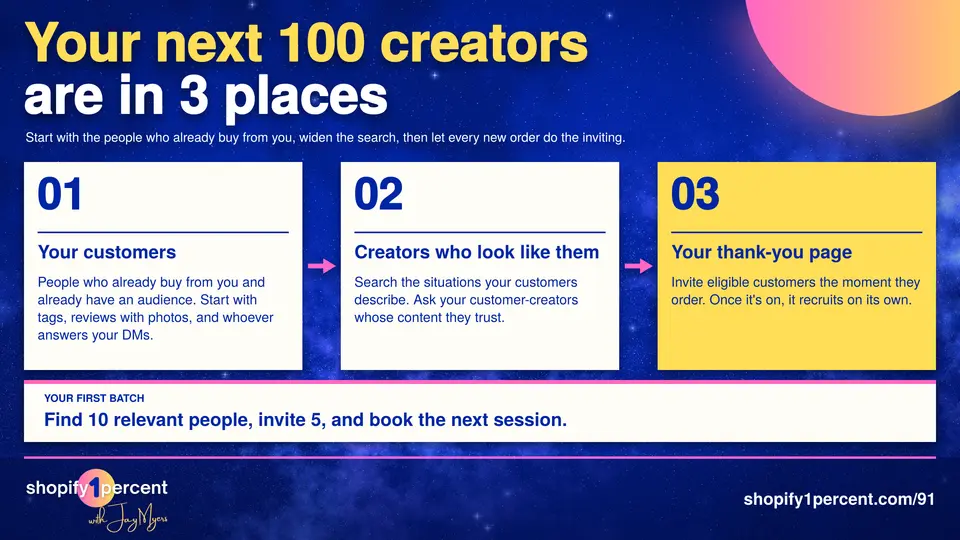
- The 3 places to find creators for a Shopify store, in this order: customers who already buy from you, creators who look like your customers but haven't bought yet, and new customers invited from your thank-you page right after they order.
- Run 4 checks before inviting any creator: would their audience have a reason to buy, can you serve those followers (location, shipping, price), are they active and on topic, and do they have an honest connection to the product.
- A first message to a customer should ask how the product is working for them, then offer to send affiliate details. Opening with commission rates and attribution windows assumes they're a professional affiliate, and plenty of people don't know what an affiliate program is yet.
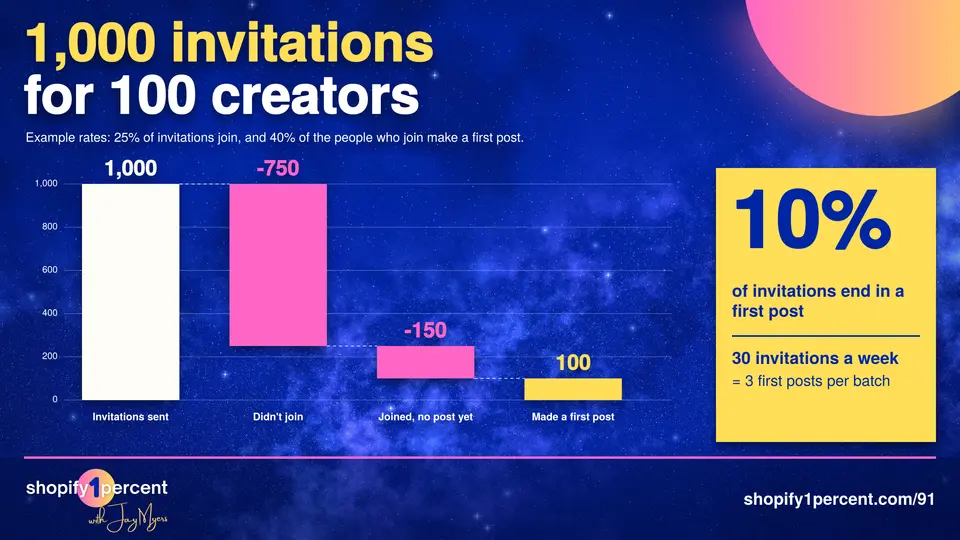
- Plan for volume: if 25% of the people you invite join and 40% of those make a first post, only 10% of invitations become posts, so 100 posting creators takes about 1,000 invitations.
- Small accounts can carry a program. immi's Ram Fam, run on Shopify Collabs, grew to 432 ambassadors and more than $200,000 in affiliate sales, and its top-selling affiliate has about 10,000 Instagram followers, according to Shopify's case study.
Some of the best people to recommend your Shopify store already have your order confirmation in their inbox, and you probably don't know who they are. In this episode I build the whole affiliate and creator pipeline: the 3 places your next creators are hiding, the 4 checks I run before reaching out, and the short message that actually gets replies. I also walk through how immi built a 432-person ambassador program, the simple invitation math behind getting 100 creators posting, and the weekly calendar that keeps it all running. There's a free Creator Recruitment Calculator with this one to help you run your first recruiting batch.
📖 Want the full playbook? Read my breakdown: How to Find Creators and Affiliates for Your Shopify Store
📁 Free PDF to go with this episode: Download the Creator Recruitment Calculator
What you'll learn
- Which of your Shopify customers already has an audience you've never noticed?
- What are the 4 checks to run before inviting any creator, whatever their follower count?
- Why does a short, honest first message beat a full affiliate pitch?
- How did immi's Ram Fam grow to 432 ambassadors?
- How many invitations does it take to get 100 creators posting?
- How do you keep finding new creators every week instead of once a year?
Our partners
Support the amazing partners who make this possible.
🎁 Remember to email AirPods@Shopify1Percent.com and tell me if you install one to win a pair of the new AirPods 5
SATHI
This episode is brought to you by SATHI, the best affiliate platform built for Shopify brands.
70% of influencer-driven revenue isn't showing up in your dashboard. Codes are leaking. Affiliates are ghosting. And you're paying commissions on sales that never should've counted.
SATHI fixes all of it. Built by the incredible team behind SARAL (200+ top brands, $59M in revenue with influencers).
🎁 Our listeners get early access at MySATHI.io and use code JAY for 20% off
Rewind
The undo button for Shopify. I’ve watched merchants lose entire catalogs to one bad import or an app update... Shopify’s own terms make your store data your responsibility. Rewind backs up your products, themes, orders, and customers automatically, and restores one item, or your whole store in a couple of clicks.
In my opinion, if you're actually serious about your Shopify business, you absolutely should have Rewind running on it. There are no excuses not to have it backed up. Rewind is trusted by 25,000+ businesses including Olaplex and Dr. Martens. Set it up once and have peace of mind forever.
🚨 Our listeners get an extra full month of FREE protection and backups: shopify1percent.com/rewind
Omnisend
I personally use Omnisend for email and SMS on every Shopify store I manage, and for this show too! I've tried them all, and it's hands down the best way to run every email and SMS automation and campaign you need, segment to personalize them, and A/B test everything to optimize conversion.
PLUS, you can now connect Omnisend to ChatGPT or Claude and just ask “where can my email and SMS be making more money?” It reads your actual store data and tells you, then builds the campaign for you right from the chat. It even writes in your brand's voice. Fifteen years doing this and it's the closest I've felt to having a full-time marketer sitting beside me. (Plus most merchants report paying about half the price of Klaviyo.)
🚨 Listeners (YOU) get an exclusive 30% OFF 3 MONTHS with code JAY30: shopify1percent.com/omnisend
Resources and links mentioned
- My blog post on this episode: how to find creators and affiliates for your Shopify store
- The Creator Recruitment Calculator (free PDF)
- Listener offer mentioned on the show: SATHI, the affiliate platform I use for finding creators, and a partner of the show. Start a free trial, and get 20% off with code JAY (or mention JAY when you sign up): shopify1percent.com/sathi
- SATHI Sherlock, finds the customers in your Shopify orders who have an audience
- SATHI Match, recommends creators aligned with your brand
- SATHI Inner Circle setup guide, the ambassador invite on your thank-you page
- Shopify Collabs, Shopify's own creator and affiliate app
- Recruiting creators in Shopify Collabs, Shopify Help Center
- immi's Ram Fam, Shopify's case study
Chapters
- 0:00 Your next creator might already be a customer
- 1:30 What a bigger creator program gives you
- 2:24 How immi built a 432-person Ram Fam
- 3:37 Why creator discovery has to be a recurring job
- 4:07 Source 1: the people who already buy from you
- 5:20 Finding customers with an audience using Sherlock
- 6:22 The 4 checks before you reach out
- 7:57 The first message, and the mistake that kills replies
- 10:15 Source 2: creators who haven't bought from you yet
- 12:15 Shopify Collabs, Match and why manual search doesn't scale
- 14:18 Why more creator content helps you show up in AI answers
- 15:20 The invitation that gets a reply
- 17:12 When they say yes: terms, gifts and one follow-up
- 18:16 Source 3: new customers as they order
- 20:41 The invitation math behind 100 creators
- 22:55 Your weekly recruiting calendar and peak season
- 24:17 Your 1% win and the 2 free downloads
- 25:34 Recap and the SATHI offer
Did you know leaving a ⭐️⭐️⭐️⭐️⭐️ review on Spotify, or Apple will give your shop gooood ecommerce karma? ❤️
Frequently Asked Questions
How do I find creators and affiliates for my Shopify store?
Jay Myers says to start with the customers who already buy from you, then find creators who look like your customers but haven't bought yet, then invite new customers from your thank-you page. Run the same 4 checks on everyone: audience fit, whether you can serve their followers, recent on-topic activity, and an honest connection to the product. Then send a short first message that asks about their experience before it asks for anything.
How do I find out which of my Shopify customers are influencers?
Jay Myers says to look for customers who tag you, show the product in their real life, or leave detailed reviews with photos, and ask whoever runs your support inbox and social accounts who stands out. Matching orders to social profiles by hand is slow, and common names send you to the wrong person. SATHI's Sherlock tool does it automatically, checking your Shopify order history against public social profiles and ranking the customers who have an audience.
What should my first message to a creator say?
Jay Myers says to keep it short enough that replying is easy, and ask about their experience before you ask for anything. To a customer: thank them, mention the post you actually watched, ask how the product is working, and offer to send your affiliate details. To a new creator: say why you chose them, what you're offering, and one small next step, like sending a product to try. Save commission tiers and sign-up forms for after they reply.
How many creators do I need to invite to get 100 posting?
About 1,000, by Jay Myers’s math, if 10% of the people you invite end up making a first post. That 10% comes from example rates of 25% joining and 40% of those posting, so track your own rates and adjust. At 30 invitations a week, that's roughly 3 new posting creators per batch, once people have had time to reply, get the product and use it.
Are micro-influencers better than big influencers for a Shopify brand?
Jay Myers says fit matters more than follower count. Several smaller creators showing your product in different situations reach audiences your ads might miss, and no single creator's bad month decides whether the program works. Big influencers can still be worth it alongside them. immi's top-selling affiliate has about 10,000 Instagram followers, and its ambassador program grew to 432 ambassadors and more than $200,000 in affiliate sales, according to Shopify's case study.
Can I recruit creators with Shopify Collabs?
Yes. Jay Myers explains that Shopify Collabs has a recruiting area where you can search Shopify's creator database by keyword, filter by location and social platform, sort by audience size, and invite creators with a welcome offer. It's free to install, and a 2.9% processing fee may apply to automatic commission payments. The limit is volume, because you still review every profile yourself.
How do I turn new Shopify customers into affiliates?
Jay Myers says to invite them on your thank-you page right after they order, and decide who qualifies: every customer, repeat customers, or customers above an order value or lifetime value. Anyone who accepts should get their own link and discount code, a clear explanation of how they're paid, and a real person to contact. SATHI's Inner Circle adds this invitation to the thank-you page automatically. Give new affiliates time to use the product before they recommend it.
How often should a Shopify brand recruit creators?
Every week, Jay Myers says, with one owner and a fixed time on the calendar. One example schedule: Monday for customer discovery and invitations, Wednesday for new creators, and Friday for replies, follow-ups and helping new partners get started. Keep one shared record of every creator (where you found them, why they fit and the next step) so nobody on your team sends the same person two different offers.
Somebody could be recommending products like yours every week and already have your order confirmation sitting in their inbox. You know them as a customer, but their audience knows them as the person they ask before buying, and you might have no idea that those two are the same person. And that's one of the opportunities I wanna talk about today because if you run a Shopify brand, I think there's a lot of value in building a much, much bigger community of people who can introduce your products to the right customers.
Dozens, and I would say eventually hundreds of people for the right businesses. But say you decide you want 100 creators. You might know the first three you wanna reach out to. Maybe you've got another seven names saved somewhere in a folder you've saved on Instagram, but where do you get the other 90?
And how do you keep finding them without spending your evening scrolling through Instagram and TikTok and have 47 tabs open and it just become a nightmare? Well, today we're gonna build a repeatable way to find those people. Three sources, an invitation that's worth answering, and some simple math that will make your recruiting target much more realistic.
Now, your first step is small. It's gonna be find 10 relevant people, invite five, and book one session.
Okay, let's get into it. Let's start with what a bigger program actually gives you.
Imagine we sell backpacks. This is gonna be our made-up brand for this entire episode. A bike commuter can show how they pack for work. A business traveler can show how quickly they get a laptop out at airport security. A parent can show what fits in for an afternoon at the hockey rink. Each person gives a very different reason to care about the same product, and that variety is very useful.
You're learning which situations matter, which people explain the product well, and which audiences respond. You're also giving the business more relationships to develop, so one person's ability doesn't determine the whole program. Now, a big influencer can still, of course, be valuable, but what I want is a reliable way to keep finding more relevant people alongside your few big influencers.
Now, here's an actual real example. Shopify had a case study on this. It was a r- a ramen brand called Immi, I-M-M-I, and it had what they called their Ram fam. It was the Ram fam community, and it reported 432 ambassadors, which drove more than $200,000 in affiliate sales. The brand sent creator samples, asked for feedback, and invited interested people to earn a commission.
Not overly complicated. They used Shopify Collabs, which is a native Shopify tool. It's not overly feature-rich, but it did the trick, and the case study also said that their highest performing affiliate s- seller had just only around 10,000 followers, so we're not millions of followers. So those are reported historical results, but what interests me is the approach.
Find people with a real connection to the product, let them experience, and build relationships from there. So hundreds of people brought together by noodles. You don't need to begin at that size, and you certainly don't need hundreds of people who have nothing useful to say about your product. But if you want to grow towards it, discovery has to become a recurring job.
Think about recruiting for a team. You need places to look, a reason someone would join, and somebody responsible for that conversation. You're recruiting people to your team. If the plan is, "Oh, we'll look for, for influencers down the road when things quiet down," like I got bad news for you. If you're running a Shopify store, things never quiet down, and as my kids would say, "You're cooked."
So, uh, , you need to make this part of a recurring system that you do all the time. So the first place I would look is the people who already buy from you. Now, some of them are, might already be making useful content. They might be explaining a problem that your problem solves without ever tagging you or your brand, And other people could be talking about you already, but the only person who noticed on your team was just the one person who answered the Instagram message. So start with the signals you have. Customer tags, product demonstrations, reviews where someone describes a specific use case, maybe they left a picture in the review, people who've sent photos showing off the product in their actual life.
Ask whoever handles your customer support or any social accounts. They may remember some people who you would never find by sorting a customer list by money spent. They might r- know these people who stand out. Now, buying from you is a starting point. You still need to find out whether they liked the product and whether their audience fits.
Someone might have bought the backpack as a gift. Someone else might carry it to work every single day and have a community of commuters asking them about their setup, and those are two very different people which need very different conversations. But the difficulty is finding the people that you don't already recognize.
So manually connecting orders to social accounts, it's possible, but it's very, very slow, it's very hard, and matching common names to social profiles can send you to the wrong person, and it's just overall time-consuming. The easiest, hands-down way to do this is with a tool called SATHI, and they have a, they have a tool within it called Sherlock, and what Sherlock does is it literally checks your Shopify order history against public social profiles to surface customers w- with a healthy audience.
And then what you get is profiles to review ranked by reach with a easy m- one-click invitation workflow through SATHI, or you can push it through Omnisend or another tool. So I... Like, I got the link in the show notes for this exact tool as well. Now, if I were building this program, that's where I would start.
It brings together two things you want to know. Who has bought from you, and who could introduce you to more people? That's what you need to know. Then I'd make my own decision about who to approach. The person with the biggest following doesn't automatically go to the front of the line. I would check four things.
First, audience fit. Would the people following this creator have a good reason to buy what we sell? So for the backpack, a community of bike commuters gives us something specific to talk about. And second, can we serve that audience? Where they live, can we ship there, the product's price, who it's made for, all of that.
If we can't sell to them, a big following doesn't help us. Third recent relevant activity. So look at a few recent posts, read the comments. Is it recent? Are people engaged? Are people asking useful questions? Does, does the creator answer them? Do they explain things clearly? You want recency and relevancy.
And then fourth, just an honest product connection. Have they actually used the product? What worked for them? What didn't? Audience fit and being able to serve those customers are just the basic requirements. I wouldn't waive either one though because somebody's videos look expensive and look amazing.
Those are two must-haves. Now, I can't give you a magic follower count here. I don't know. I, I'd wanna see the person, the content, the audience. A number on its own would not make a decision for me. Even if you told me someone had 100,000 followers, if it's not the right audience, if their last post was two years ago I still need to see the content they're putting out.
So audience count isn't everything. It helps, but make sure you look at the account. Now, once you find somebody relevant, open a conversation. Now, for our backpack brand, assuming we've confirmed that they're a customer and what we've watched their commuting video that they posted, it could sound something like this.
This is what I would message them: " Hey, thanks for giving our backpack a try. I saw your video about cycling to work and the laptop. How's the bag working for you? How is everything? We have an affiliate program for people who are enjoying it. Would you like me to send you the details?" Just that. Don't oversell it.
I wanna say this very clearly here. This is where most people make a big mistake. They reach out, they say, "I saw you post about our backpack. We have an affiliate program with a 90-day attribution window. We give 8% on the first 10 backpacks sold, and after that, it goes up to 20%. We have coockie-less tracking."
Like, you're assuming that this person is a professional affiliate and knows what all this stuff means. Keep it really simple. Just get them to reply. What you want here is you wanna get them, just pique their interest, and then get them to reply. Not everyone will even actually know what an affiliate program is, and also different brands have different definitions of how affiliate programs work.
Some of them are, like, commission only. Some of them are percentage of sales. Some of them are based off of they're, um, kinda like white labeled, where they, you, you co-sell with them. So very different programs. So don't assume any of that. Just say, "Hey, we have an affiliate program for people enjoying it.
Would you like me to send you the details?" That's it. You can explain all the details once they're interested. That's really important. And you notice we're asking about their experience before asking them to recommend anything, because what if the zipper broke? Or what if they had a bad experience?
Deal with that first. So always ask, "How is it going? How did everything work out? We do have an affiliate program. If you're interested in that, let me know. I can send you more details." Keep it super short. And don't open by telling them too much about what you know about them. I always say, you know, say, "Hey, I've noticed you've spent ten thousand dollars and had seventeen orders with us in the last year."
You don't need to make them creeped out that you're watching them. Just, "Hey, I saw you bought our backpack and posted about it. How is everything going? Did you know we have an affiliate program? Would you like to learn more?" And then keep a note of why each person fits and what you've already discussed, and then that will make messaging the next time much easier.
So when they reply, you can just look up their email and see what you've sent. Okay. And then the second source is people who haven't bought from you. So with Sherlock, that's that tool by SATHI that I used. It that will find everybody who buys from you. It's just always running. It's gonna find you your customers who you m-may never know that they might have a good following, they're posting relevant content.
It's gonna show you who they are. That's the number one source. It's just gonna find you good people steadily ongoing, so you're not having to search for them every night. But now what about people who don't buy from you? They might already be speaking to your customers, and they're great people that you wanna have pushing your products.
They've just never bought from you. Now, before opening another app or any tool to do this, finish this sentence: People use our product when blank. Now, for the backpack, maybe it's when they're cycling to work, or to work on, on their laptop, or when they're traveling for three days with only one bag. Get those situations from reviews, support conversations questions people ask you before buying and support tickets, and then use the language that customers use.
Those phrases are gonna give you a much better search than lifestyle influencers. You're looking for very specific situations. Now, I'd pick two or three of those situations and search for people already making content about them. Watch the posts, read the questions underneath, look at the relevant collaborations and the creators who, who they mention in them.
Your customer creators can help here too. Ask whose content they find useful in that category. So people might already be following these people. And a good introduction or a recommendation will give you another good place to look. Now, I always say keep a time limit when you're doing searches like this. Your goal might be find 10 more people worth reviewing, 'cause it's very easy to go down rabbit holes on these. So set a goal and set a time limit. Otherwise, you start looking at dog videos or whatever it is and not actually recruit anybody.
So if you already use Shopify Collabs, its recruiting area is a decent place to find and invite content creators. Um, you can start there if you're using it. , Where it gets difficult is repeating it at a, at a significant volume. So suppose you want to review 500 profiles and each takes 10 minutes.
That's more than, if you do the math 83 hours of research before you even start a conversation. And I know these are just illustrative numbers, but you can see how the work piles up. So what I do instead is I use SATHI's Match tool. So Match is another tool within SATHI. It uses your website to understand your brand and then recommend creators. You can filter all the recommendations it finds. You can review their content, their audience demographics, engagement, and then you can actually see the contact email and information for that specific creator.
And then you can use your invi-in-invitation template that you made have AI help personalize it, and then review the message and send it through SATHI. It does it all for you. Now, the practical benefit is having discovery, the information you need to evaluate someone, and the invitation in one place.
As far as I'm aware, SATHI is the only way to do that. So you're doing less of the work assembling these in all different places. Like I said, you can do some of this in Shopify Collabs. It's pretty good, but it's not the full comprehensive picture. So Sherlock helps you look inside your customer base.
Match helps you go beyond it, and that's why, , SATHI would be my starting point for this particular job. Now, I'd still apply the same checks. Does the audience fit? Can we serve them? Is the content useful? Is it current? Is there a believable reason that person would try the product? With somebody new to the brand, you need to give them that experience before asking for a recommendation. I'd also look for gaps. If every person you've found makes airport packing videos, use the next search session to find commuters. You wanna cover more reasons people buy. Now, this is good, of course, to reach more people, but it's also great for AI.
All of this content gets picked up by AI, AI, and when people then go to ask ChatGPT, "What's a great backpack for... that I can keep my laptop in for biking to work?" Or, "What's a great laptop I can keep my... " Or sorry, "backpack I can keep my laptop in that I can also put food, store cold food in for my kid's soccer game?"
If there's content on the social platforms, it gets picked up by that as well too, and videos are great. AI always surfaces them. So many reasons you want lots of different types of content. Now, watch how the creator explains something. A clear demonstration of getting a laptop out on a crowded train might be more useful to a buyer than a beautiful shot of a bag on a rock.
Those are okay, but what you want is something that really shows clearly the question you're trying to answer. The rock doesn't have any questions about the laptop pocket Okay, so you found a good person. Now make sure you give them a reason to answer. Your invitation should explain why you chose them, what you're offering, and what the next small step is. Don't overcomplicate it. One small next step. So here's an example. And again, this is for our fictional backpack brand.
You can of course change this, but this would be an example. I would say, "Hey, I saw your carry-on packing video, especially the bit about getting your laptop out at security and how fast it was. We make a backpack with a separate laptop compartment, and I'd l- be interested in your honest take, what you think about it.
We actually offer, a commission for suitable affiliate partners. Would you like me to send you details? Can I send you a backpack to play around with and to see?" That's it. , One answer. "Yes, I'd love to see your backpack." "Sure. Send me the affiliate details." That's enough to start. You haven't sent them a full application, here's a link where you can sign up.
None of that. Just compliment them on the video, tell them a little bit, one-liner about your product and, "We have an affiliate program. Would you like me to send you details? And can I send you one of our backpacks for you to see?" That will get replies. An overwhelming long email will not. Now, only mention the video as well if you've actually watched it.
There's nothing worse than getting fake comments about content that you've seen, and I get this every single day, especially on like platforms like LinkedIn. Like people will reach out and say, "I really like your post about this," or, "I really liked your episode about this," and you know they didn't listen to it, 'cause what they're referencing has nothing to do with what they're asking about.
So if you didn't watch the video, don't mention it. Just b- be real and be sincere, and you will get replies. If it's fake and you're using a template where it's you didn't actually look at any of the content, you won't get replies. So, I, I always say fake familiarity is a terrible opening f- for any relationship.
Then, okay, so when someone does say yes, reply while the conversation is still fresh as fast as possible. Send the commission details, the payment terms, any expectations, and a clear next step. Don't make them wait. Be right on top of it. As fast as you can send it, send it back to them. Now, some creators, they'll expect different things.
Some want a fixed fee, some want commission, some want a combination. Factor in product shipping and your team's time as well. Now, commission doesn't make the whole program cost-free, and sending a gift doesn't create an agreement for them to post anything just because you send them something. If you need a specific deliverable by a specific date, agree to that with the person.
If they don't reply, I would try one brief follow-up roughly a week later and then leave it, and this is a suggested starting approach.
It's not a magic guideline or magic timing rule, you know, but use appropriate business sense and contact routes here and respect a decline or an opt-out. Just standard human good practice here. Okay, now the third source keeps changing as new customers keep coming through your store. So we've got existing customers, people who've ordered before, people who've never ordered, and new ones coming through your store.
Now, you might check your existing customers today and find some great ones, but you're gonna miss everybody who orders next week, and you wanna make sure that you're constantly finding them. So SATHI has a third tool called Inner Circle. Like, I love SATHI for this kind of stuff, and yes, this is why I chose them to be a sponsor of the show because I don't know any better way to do that.
I'll be totally honest. So SATHI has a tool called Inner Circle, and it's its customer to ambassador feature. Basically o- on the thank you page, it turns customers on a daily basis, every order, there's a full flow to turn customers into an ambassador. It's the part that I'd look at for making this program visible to every single customer in the future going forward as they buy.
Sherlock is their tool that actually scouts the customer, finds their social profiles, followers. Inner Circle is what turns them into an ambassador right on the spot. So you can decide who the program is for, explain what joining involves, and make it an completely optional next step.
You should also put a clear application page on your website. Someone who wants to recommend you should be able to find the program and understand it easily on their phone. Now, there's an important timing distinction here. A person can express interest right after ordering. They still need to experience the product before recommending it.
And a customer who refers a couple of friends can be valuable without becoming a regular content creator. Keep those distinguishable, and when you're measuring the program, understand the difference. Now, the invitation may run in the background. The relationship, though, still needs someone paying attention to it.
When a person joins, check their link code works, explain how they'll be paid, and give them a real contact for questions.
Also, I always say test the customer journey yourself before asking someone to send their audience through it. Just click through, go through everything, click a purchase, make sure it tracks. After you develop a few good partnerships, ask those people if they know anyone else that might be a good fit. Say, "Who makes useful biking, commuting content that you know?"
Is much easier than, "Hey, know any influencers?" Ask them other people in their space. Okay, let's come back now to that target of 100 creators we talked about in the beginning. You need to decide what you're counting. Someone on a shortlist hasn't been invited. Someone who accepts an invitation hasn't necessarily promoted anything. And someone who posted once last year might not be participating now.
So for a simple example, let's count new creators who make a first promotional post after joining. So say you send 100 suitable invitations. Imagine 25 people join, and 40% of those people make that first post. Well, that's 10 people. 25% join, 40% of that group post, 10% of the original invitations get all the way through.
So in that example, reaching 100 first-time posters means about 1,000 invitations. Now, those percentages are made up, but they are very realistic, and the calculation explains why sending 12 messages and then waiting will leave you disappointed. At those example rates, 30 invitations a week would produce an average of three first-time posters per batch once people have had time to join, receive the product, and actually use it. So maintaining 100 people who promote you every month is another target again. You need to keep existing relationships active as well as recruit new ones.
Now, we've actually made a calculator to help you work backwards from your goal. You can start with assumptions if you have to, and then replace them with details and results from your own program. So measuring the sources separately, customer invitations m-may behave differently from external outreach.
A thank you page invitation has a different starting point again. Give each group time to respond before judging it. An invitation sent yesterday shouldn't be compared with people you've been working with for a month. Now, if nobody replies, look at the people you're choosing, the messages, and the offer. If people join but never start, look at what happens after acceptance.
There's a break somewhere. That tells you what to improve before you send the next bigger batch. I'd give this one owner and a recurring place on the calendar. Monday could be customer discovery and invitations. Wednesday could be external creators. Friday could be replies. It's a re- a reasonable follow-up and helping new partners get started. Choose a weekly invitation target you can support, and if it's 30, that might mean 15 customer invitations and 15 external ones where you have enough suitable people.
If you don't, just change the split or lower the target, but keep the standard for fit
You need time for thoughtful review and replies. Three calendar blocks won't necessarily cover all the work as the program grows, but it's a very good start. Keep one shared record, the person's profile, where you found them, why they fit, whether they're invited, and what the next step is. That also prevents two people on your team from sending the same creator different offers or different, different content.
So for peak season, work back from when you need the creator ready. Allow for replies, shipping, actually trying the product, and preparing content. A discovery tool can shorten the reach, but it can't make a backpack arrive yesterday . So the useful weekly question is who do we find, who do we invite, and what needs to happen next?
Then keep learning from the people who respond. So here's your one action from this episode. Run your first recruiting batch. Write down one situation your products he- help with, find 10 relevant people, beginning with your customers and using an external search tool to fill the gaps. Check the fit, send five personal invitations with a clear offer and an easy next step, and then book the next session before you close out that list.
10 prospects and five invitations are starting targets. Use a smaller batch if that's what you can properly support. Whatever works here, but set a target. There are two downloads in the show notes that I wanna make sure you get. If you, wherever you're listening to this, go into the show notes, they are completely free, and they will help you with all of this.
The discovery worksheet helps you choose where to look and includes messages that you can actually adapt, and you can use them. You'll see them. They're on the PDFs that you can download for this episode. The recruitment calculator helps you set a realistic invitation target and track results from each batch.
Use it. It will work. Follow it. It is designed for this. Start with the worksheet. You don't need to fill out both before sending your first thoughtful invitation.
That's how I'd begin building towards a much bigger creator community, a repeatable search, a clear offer, and enough attention to help the right people get started. So just to recap, your 1% win is your next 100 creators are in three places: your customer list, which is honestly where the best ones are, the creators who look like your customers but haven't bought yet, and your thank you page, which just recruits on its own once you turn it on.
1,000 invites for 100 active users, which is why this has to be a machine and not something you try to do in your evenings. Now, the free tools get you started. Immi got to 400 of them, but Sherlock, Match, and Inner Circle are how I'd actually run it and scale it. And there's a free trial link in the show notes, so you can make sure you click on that if you wanna try any of those tools and we actually have a special offer from them as well.
So make sure you grab the worksheet and the tracker as well in the show notes. They are very useful to do exactly what we talked about today. Send your first 10 invites and follow Shopify 1% anywhere you listen if you got any value from this, and make sure you leave a five-star review. That's how other people find out.
Thank you so much and, tonight, before you spend the evening scrolling for somebody to recruit, just go check who already bought from you. See you on the next episode.