Play Stupid Games, Win Stupid Prizes: Which Shopify Metrics Actually Matter?

Every year around Black Friday, the same screenshot makes the rounds on X and LinkedIn. The Live View globe in someone's Shopify admin, lit up like a Christmas tree, captioned "biggest day ever."
I've seen that post hundreds of times. A lot of the people posting it weren't actually making any money.
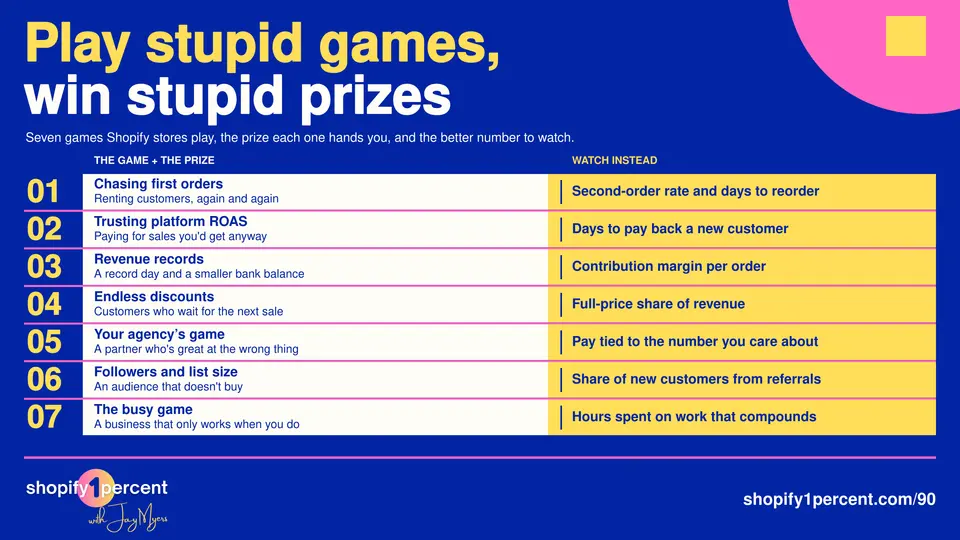
That's the idea behind episode 90 of Shopify1Percent. Play stupid games, win stupid prizes. Nobody running a Shopify store sets out to build a business that looks great in a screenshot and terrible in the bank account. But the numbers you stare at every day quietly decide which game you're playing.
Short version: the Shopify metrics that matter most measure two things, whether customers come back and whether orders make money. That means second-order rate, days to pay back a new customer, contribution margin per order, the share of revenue sold at full price, and the share of new customers who came from a referral. Revenue records, platform ROAS, discount-driven sales and follower counts are easier to chase, and every one of them can go up while the business quietly gets worse.
What did MySpace and Facebook teach us about picking the right number?
In 2006, Google agreed to pay MySpace's parent company at least $900 million in guaranteed revenue share, with the payments tied to hitting traffic commitments. MySpace was, pretty literally, getting paid to play the pageview game.
A little later, Facebook's growth team got fixated on a different number: get every new person to seven friends in ten days. Once you had seven friends, you stuck around.
One company played for clicks. The other played for people coming back. We all know how that ended.
There's a name for the trap. Goodhart's Law says that when a measure becomes a target, it stops being a good measure. Fun detail I found while prepping: Goodhart never said it that neatly. His 1975 version was about monetary policy and a lot wordier, and the tidy line everyone quotes came from anthropologist Marilyn Strathern in 1997. Even the quote got optimized.
Are you renting customers instead of keeping them?
The most common stupid game on Shopify is the first-order game. All the budget, all the energy, all the creative goes into getting someone to buy once. Then the order ships, and nothing happens. Maybe a review request. Maybe a discount code two weeks later.
That's an expensive habit, because the first order usually loses money. SimplicityDX found merchants were losing an average of $29 on every new customer acquired in 2022, up from $9 in 2013, while repeat sales generated $39 on average. I went deeper on that math in what number predicts if your Shopify store survives.
You pay full price to rent them, they leave, and then you pay again to rent the next one.
The better game is the second-order game, and it comes down to two numbers: the percentage of first-time buyers who come back, and how many days it takes them. I'd encourage every merchant to know their second-order rate. It's the most important order in your business.
Your store has its own version of seven friends in ten days, a point where someone stops being a one-time buyer and becomes a customer. For a lot of brands it's the second order. For some it's the third. I honestly don't know what yours is, and I'd be suspicious of anyone who tells you there's a universal answer. Coffee runs out in a few weeks. A mattress doesn't.
You can find yours. In your Shopify admin, go to Analytics, then Reports, and open the Customer cohort analysis report. It groups customers by the month they first bought and shows how many came back after. Or ask Sidekick in plain English: "What percentage of my first-time customers placed a second order within 90 days?" If your repeat rate looks suspiciously healthy, read the repeat rate Shopify doesn't show you before you celebrate.
Once you know when people come back, build everything around getting them there faster: your post-purchase emails, your thank-you page, the note in the box. If most of your second orders happen around day 40, a reminder on day 60 is too late. Land it about a week before that window, while they still remember why they bought. I broke down how to time reorder reminders to how customers actually buy in the Repeat Commerce series. This exact problem is why we built rePete at Bold, because every customer reorders on their own schedule. You can also start with the post-purchase flow in the email tool you already use. Either way, get order number two.
Is your ad platform grading its own homework?
Game two is ROAS, return on ad spend as reported by the ad platform. The platform decides which sales it gets credit for. So a retargeting ad finds someone who already had the product in their cart, or who's bought from you three times, they buy, and the dashboard says 6x.
The prize is scaling your spend on customers who were probably coming anyway. Your dashboard looks amazing. Your bank account doesn't.
Researchers have checked this. When a team from Northwestern and Facebook compared 15 large Facebook ad campaigns run as true randomized experiments against the standard ways of measuring ads, the standard methods generally overestimated how well the ads worked (Marketing Science, 2019).
The better game is payback: how many days it takes a new customer to earn back what you spent to get them.
Start with your real cost to get a new customer. Add up everything you spent on ads in a month (Meta, influencers, all of it) and divide by the number of first-time customers in Shopify's First-time vs returning customer sales report. It won't be as pretty as your ROAS. That's kind of the point.
Then work out what an order actually makes you after product, shipping and fees. A made-up example: it costs $60 to get a new customer, and their first order makes you $20, so you're down $40. If every order after that makes you $25, you're paid back on the third order. If that takes four months, great, you can grow on your own cash. If it takes two years, you've got a financing problem dressed up as a marketing problem. I ran a full version of this on a whiteboard in the Shopify ad budget math nobody runs.
One test worth running: turn off retargeting to your existing customers for two weeks and watch total sales. If they barely move, those ads were taking credit for people who were already on their way.
Why can a record Black Friday leave you with less cash?
Back to that screenshot. Game three is the revenue record game, and the prize is a record sales day and a smaller bank balance. Revenue doesn't care whether you made any money. Thirty percent off sitewide, ads that get pricier right when everyone else is bidding too, free shipping, extra hands in the warehouse. It all comes out of the same order.
The better game is contribution margin: what's left from each order after product cost, shipping, payment fees and the ads it took to get it. That's the money that pays your rent, your team, and you. If profit-first thinking is new to you, my conversation with Mike Michalowicz on Profit First for Shopify stores is a good place to start.
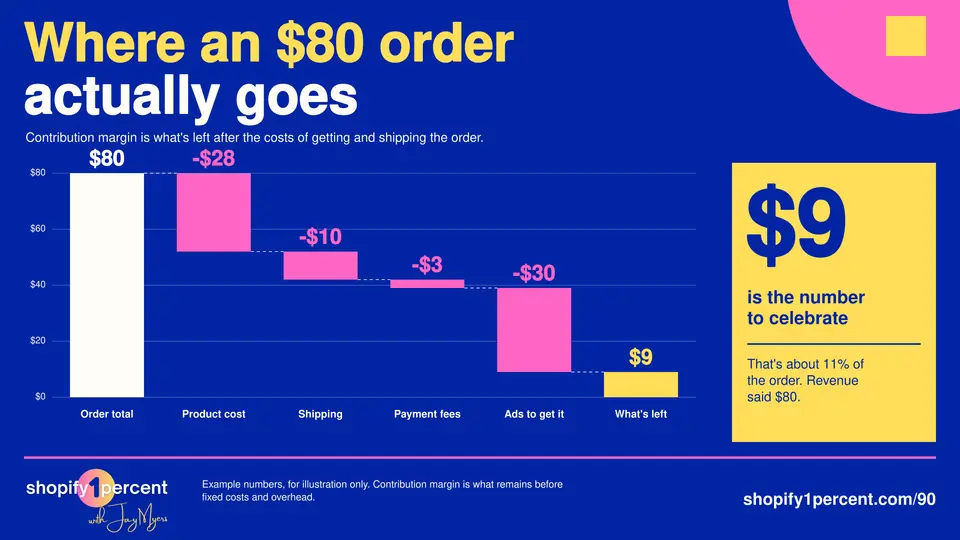
Take an $80 order with $28 in product cost, $10 in shipping, about $3 in fees and $30 in ads to get it. You keep $9. That's the number you should be celebrating.
The first step is boring, and most brands haven't done it. Open each product in your Shopify admin and fill in Cost per item in the Pricing section. That's what powers Shopify's profit reports. The catch nobody mentions is that profit only shows up for sales made after the cost was entered, so every day that field sits empty is history you never get back.
Then, before your next big sale, run the math on one order at the sale price.
If the answer is negative, you're not actually running a sale. You're running a fundraiser for your customers.
How much does a 20% discount really cost your Shopify store?
Twenty percent off in the welcome popup. A sitewide sale every month. A code for every holiday of the year, including a couple I'm pretty sure we've invented. Every sale feels like a win while it's running, and the prize is customers who've learned to wait for the next one. Your list price turns into a suggestion.
The math is worse than it feels. Say your gross margin is 50%, so a $100 product costs you $50. At 20% off you sell it for $80 and keep $30. You went from making $50 to making $30, which is 40% of your profit gone on a 20% discount. To make the same money, you'd need about two-thirds more orders.
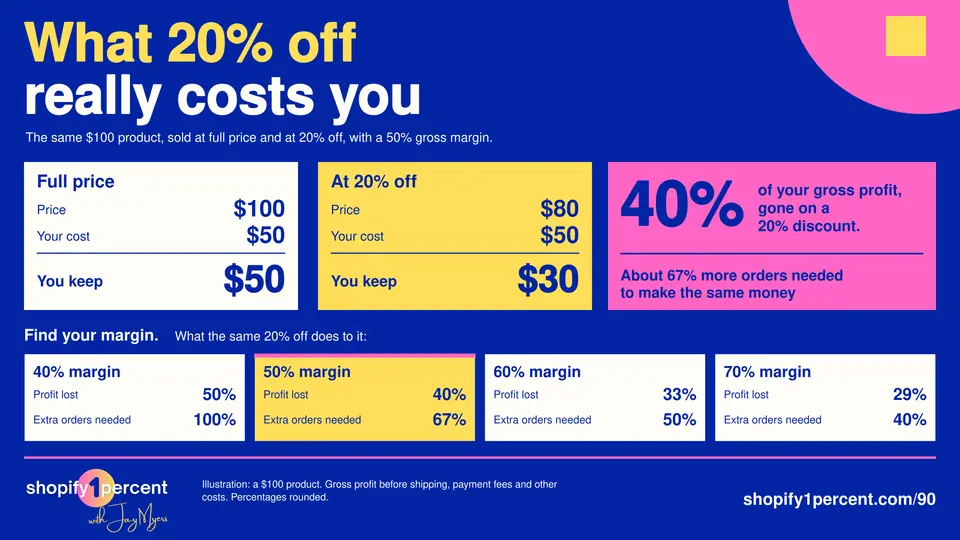
The better game is full-price share: the percentage of your revenue from orders with no discount at all. If it climbs over time, your brand is getting stronger, because people want the thing enough to pay for it. If it's sliding, you're training your customers one code at a time. Ask Sidekick: "What percentage of my sales last quarter came from orders with no discount code?"
Then try swapping one discount for something that doesn't cut the price. A free sample in the box, a gift with purchase, or first access to the next product drop.
Which number does your agency get paid on?
This one's sneaky, because you might not know you're playing it. There's a line usually credited to Charlie Munger: show me the incentive and I'll show you the outcome.
If your agency earns a percentage of ad spend, the easiest way for them to make more money is for you to spend more. If they're judged on platform ROAS, they'll find ROAS, usually in your existing customers, which takes you right back to game two.
I don't want to make agencies the villain here. Most of them are good people doing exactly what you asked. That's kind of the problem. They're winning the game you set up, and the prize is a partner who's really good at the wrong thing.
Tie their bonus to new customers at a cost you can afford, to contribution margin, or to the numbers in your Shopify admin instead of their dashboard. Then ask them out loud: which number do you get paid on? If the answer surprises you, you just found your stupid game.
Are your customers bringing you customers?
The first of two bonus games goes back to Facebook, whose whole game was people bringing in other people. In ecommerce, that's word of mouth.
The stupid version is the follower game. Likes, followers, a giant email list that mostly never gets opened. Numbers that feel like an audience but don't behave like one.
People trust each other far more than they trust your ads. In Nielsen's 2021 Trust in Advertising study, 88% of people said they most trust recommendations from people they know.
When I ask brands what share of their customers came from a referral, most can't tell me off the top of their head. So start by knowing. Add one question to your thank-you page, "How did you hear about us?", with any of the survey apps that do this or a bit of your own code. Then watch for answers like "a friend," "my sister," "a coworker."
If that bucket is close to zero, it's worth asking why nobody's talking about you. That's usually a product or experience problem (the unboxing, the support, the product itself), and no amount of ad spend fixes it. When someone does say a friend sent them, that friend is one of your best customers. Thank them. I'd send a handwritten note every single time. If you want to turn this into a system, we covered how to build a referral flywheel on Shopify with ReferralCandy.
Are you playing the busy game?
The last one is the game I think most founders are losing without knowing they're in it. Answering every support ticket. Tweaking ads at midnight. Rewriting the same product description for the fourth time. It feels like progress because you're exhausted, and the prize is a business that only works when you're working.
This one's personal for me.
There are lots of days where I mistake what's urgent for what's important.
Without direction, the day takes over. You open your inbox, the emails and Slacks pile in, and suddenly it's 5pm. My advice: list the three big, important things you need to get done each day and do them before you open your email.
Think about the most important things you did for your business last year. You can probably name a handful. Thousands of other hours didn't change much. The compounding work is often the stuff in this post: the second-order email that runs while you sleep, the cost per item fields, the conversation with your agency.
I live by my calendar, so this is where I'd start. Pull up last week, circle the hours that will still be paying you in six months, and if you can't find any, that's your answer.
What's the one Shopify metric to track this week?
Pick one number from this list: second-order rate, days to payback, contribution margin per order, full-price share, or the share of new customers who came from a friend. Find out where it sits today. Then put it where you and your team will see it every week, whether that's the top of your Monday stand-up or a Slack channel.
Whatever's on your scoreboard is the game you'll end up playing, so pick it on purpose and get it 1% better. One percent a week works out to roughly 68% better over a year.
The full episode walks through every one of these games, including exactly where to find each number in your Shopify admin. Search Shopify1Percent anywhere you listen to podcasts, and hit follow so you catch the next one.

Co-Founder @ Bold Commerce // Host Shopify1Percent
Jay Myers has been in the ecommerce game for over 25 years. First as a merchant, then a service provider, and today a software provider. His company, Bold Commerce, has helped over 800,000 online stores sell more on Shopify. Their suite of apps help brands maximize LTV (Customer LifeTime Value), and AOV (Average Order Value).
Bold has been ranked one of Canada's Top Medium Sized Employers, ranked in the top 50 fastest growing companies in Canada by Deloitte multiple years, a Top Growing Company in Canada by the Globe and Mail, and winner of the Ernst and Young Entrepreneur of the Year award.

The $3 Box Insert That Kept Bringing Shopify Customers Back