Your Shopify Store Is Ready for AI Agents. Your Approval Process Isn't.
At SubSummit a few months ago, I forwarded one email to an AI agent called Echo. Ten minutes later it sent back a full campaign built around that email, ready to go. And it was better than the one I'd sent.
My next thought was probably the same one you're having right now. Is this AI slop? How hands-off can it actually be?
So I asked the guy who built it. Andrei Rebrov is the co-CEO and co-founder of Finsi, which gives ecommerce brands a team of six AI agents. Before that he co-founded Scentbird and spent 11 years as its CTO, with 45 engineers behind him. His answer surprised me. The agents, he said, are the simple part. "The hardest part is always between the monitor and the seat."
AI agents for Shopify can do real work, like building email campaigns, checking your SEO and flagging revenue leaks, but they only pay off if you cut the approval steps around them. Andrei Rebrov of Finsi says to keep your ad spend and your calculations out of an agent's hands, and to start by connecting your store, Meta, Google and email data and asking for a 12-month review. That's the playbook from episode 99 of Shopify1Percent.
What makes true AI agents for Shopify different from a scheduled report?
AI agents are already moving real money. Salesforce's 2025 holiday shopping data says AI and agents influenced 20% of all retail sales last season, fueling $262 billion in revenue. The same year, Gartner predicted that over 40% of agentic AI projects will be canceled by the end of 2027, and estimated that only about 130 of the thousands of agentic AI vendors are real.
So which one are you buying? Andrei's line: an AI agent "is a little bit more than your Claude code query that runs at 9:00 a.m. every morning and brings you a report." It's closer to "an autonomous entity with a goal, with a context about your organization, with ability to make decision, bring you work, and constantly improve."
Finsi's six have names, which I love: Scout for revenue, Pulse for ads, Forge for creative, Echo for email, Beacon for SEO and AI search, and Sage for customer insights. Every brand gets the whole team. Andrei's reason is pure Scentbird: you can have a rockstar VP of growth sending amazing traffic, but if the site doesn't convert, there's no revenue.
The part I'd steal for any AI setup is what he calls governance. Tell it you never discount, and every new email and creative gets checked against that rule. He says it's how you teach agents not to do crazy things and to hallucinate less.
Why is the approval process the hardest part of AI for Shopify brands?
Andrei walked me through how most brands build an email today. Someone writes the copy. A designer builds it in Figma. Then you either slice the images or hand it to an HTML coder. (He prefers coded HTML, and says he sees 30% more click rate that way.) Then it goes through the design committee, the copywriting committee and the approvals.
With agents, you go from the idea to the final HTML in one jump. While Finsi renders a campaign, three other "judges" review it against the governance rules and the brand book. Andrei gets three versions, picks one and clicks Send to Klaviyo. He says Omnisend works pretty much the same way.
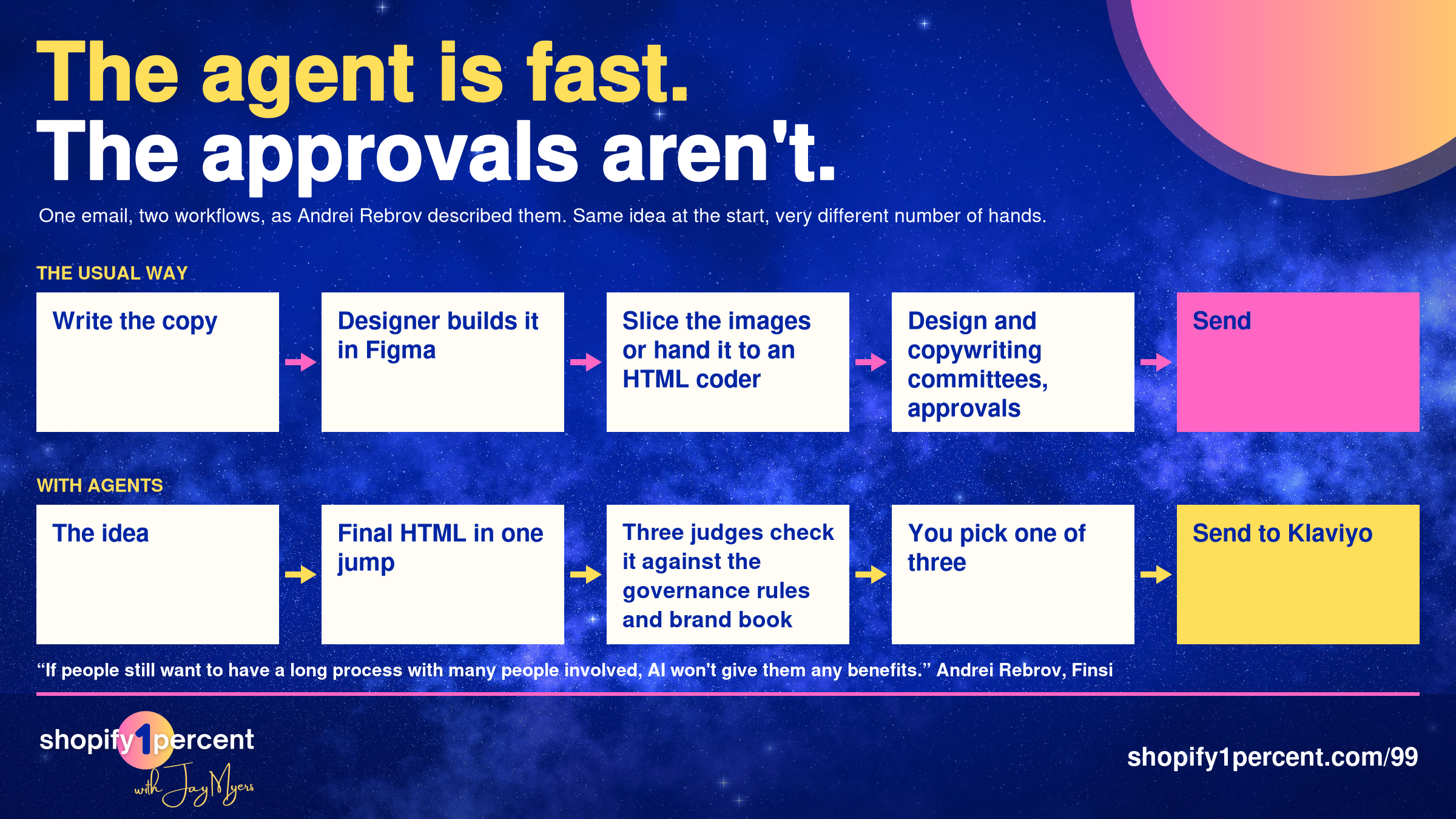
What he needs from the old team is good, actionable feedback, like "I don't like how the hand is presented on this picture." That's it. And if a brand keeps the long process anyway? "AI won't give them any benefits."
That line has been rattling around in my head ever since. We spend all this time asking whether the AI is good enough, and almost none asking whether our process is. Andrei even screens Finsi's partners for it: not size or vertical, just an operator who's hungry to try new things.
Should an AI agent change my Shopify ad spend?
Andrei thinks media buying is a commodity now, closer to high-frequency trading than an art. For a smaller brand, it's noticing your acquisition cost or CPM moved and reacting on time. "It's not rocket science," says the man I introduced as almost a rocket scientist.
But Pulse won't touch your budget. "We don't automate media spend." It sends you an alert and explains why something should change, and you make the change.
His reason: a few people had just reported their Facebook ad accounts banned or temporarily blocked. They'd been using Facebook's official MCP, but their Claude agent read the account too aggressively, maybe every minute or two, and Facebook has a policy around automation. If you're wiring Claude into your ad account yourself, read that twice.
Forge, the creative agent, mostly writes briefs from your past ads and your competitors'. Finsi only makes static ads itself, because Andrei says real UGC beats AI UGC.
What revenue is my Shopify store leaking that AI can find?
Scout ties your marketing and site activity to the money, so it can rank fixes by impact. Some of what it finds is embarrassingly simple, like the leaks I wrote about in where your Shopify store is leaking money. One merchant's promo discounts are supposed to live two weeks, no more, and codes still leak. Or nobody ticked the one use per customer checkbox in Shopify, so people abuse the offer.
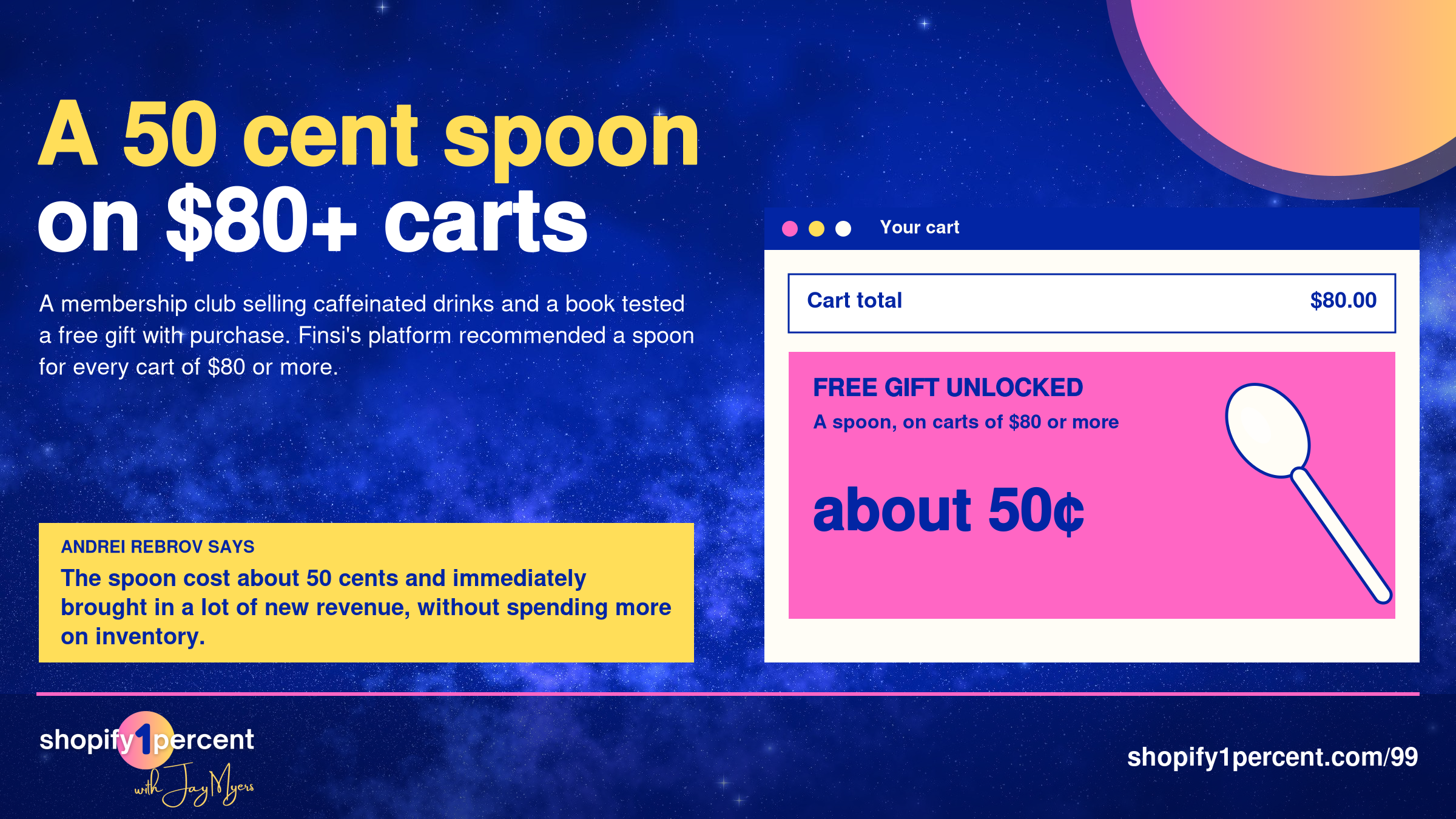
My favorite was a spoon. A membership club selling caffeinated drinks and a book tested a gift with purchase, and Finsi's platform recommended a spoon on every cart of $80 or more. Andrei says the spoon cost "I don't know, 50 cents or so" and "immediately brought a lot of new revenue." No new product, no new inventory. A spoon.
Your support inbox is the other gold mine. I told Andrei about the luxury brand from my Siena AI episode. The humans reading the tickets thought the price was the problem. Scanning every ticket showed shoppers just wanted to confirm their size before buying a $1,000 leather jacket, so the brand started sending a cheap replica sample first. Andrei added that around 20% of all support tickets are "Where is my order?", and that across his merchants, orders without tracking numbers go hand in hand with more complaints, more refunds and lower LTV.
Why shouldn't you let AI do your Shopify math?
I asked Andrei what a brand shouldn't use AI agents for. He answered in one word: "Analytics."
Then he split analytics into two jobs: the calculations, and the analysis of what the numbers mean. "Never use AI to do the calculations. Use AI to create formulas, review the formulas, make sure they're correct, and then just run them and feed the numbers into the agent."
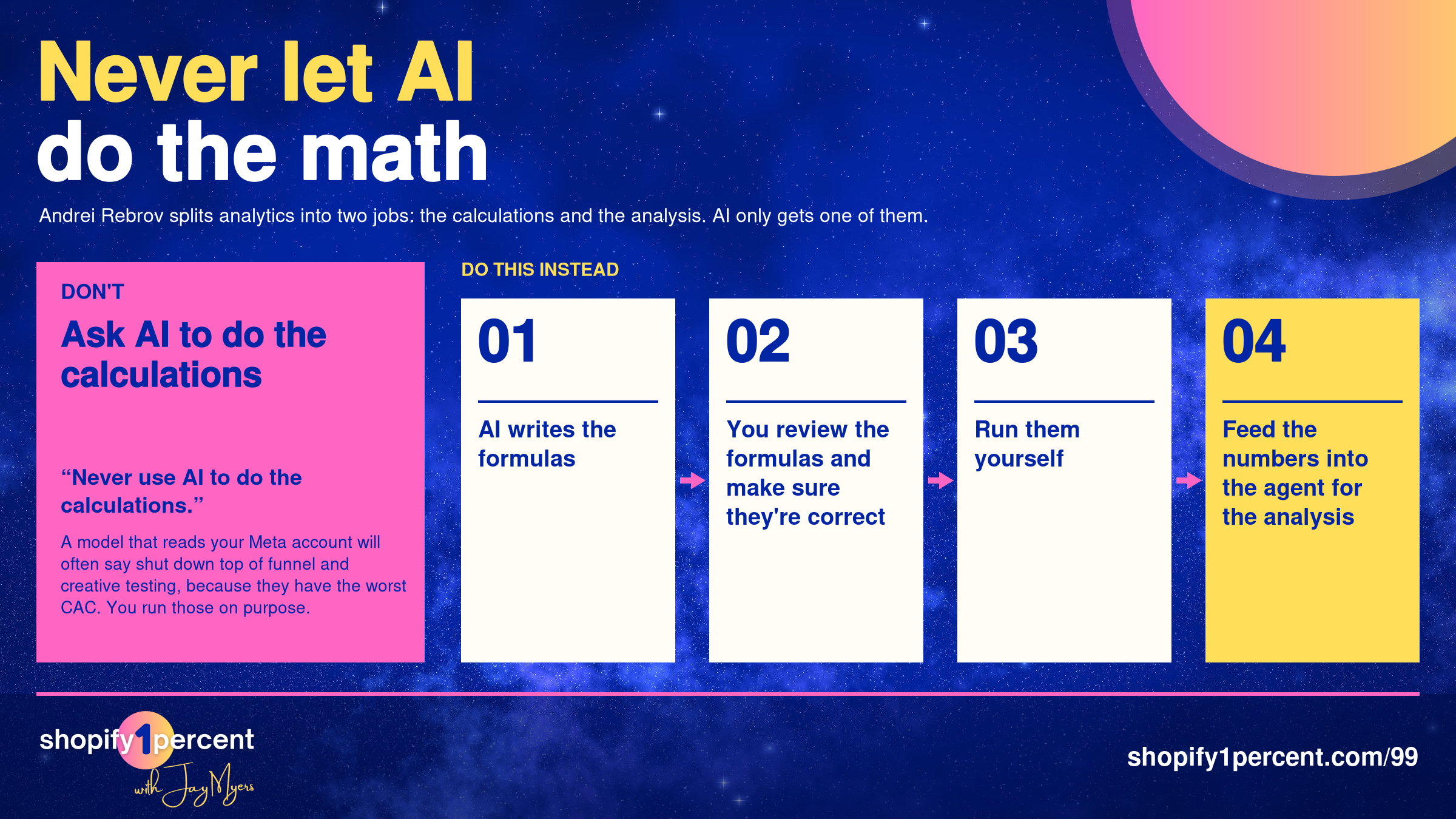
For the analysis, you have to teach the agent how you read that data. His example: connect Claude to your Facebook account and it will usually tell you to shut down top of funnel and creative testing, because they have the worst CAC. You run those on purpose. If ecommerce is just math, you want to know exactly who did the math.
How can I use AI on my Shopify data before buying a tool?
Start with Shopify itself. You can connect Claude, and Andrei says Shopify is putting a lot into Sidekick. Then ask what you'd never check row by row. Who's abusing my discounts or refunding a lot? What discount brings in customers with better LTV, 15 or 25?
His minimum setup is your store, Meta, Google and your email platform (he named Omnisend). Connect them and ask it to review your last 12 months, which covers seasonality. "Tell me, what did I miss? What did I wrong, and how should I prepare myself for the next three months?"
Then don't trust the first answer. Ask the same model to review its own work a couple of times, then run it past others. His usual three right now are Claude, Codex and Google's Antigravity. And if Claude gets wordy, steal his Margin Call trick: tell it to explain things like you're a golden retriever.
The 1% takeaway
Before you buy an AI agent, count the people who touch one email between the idea and the send. If the answer is a committee, fix that first, because no agent can beat it. Then give AI the formulas and the analysis, and keep the calculations for yourself.
With Black Friday coming up, Andrei is offering Shopify1Percent listeners a free audit: Finsi will analyze your last 12 months and your last Black Friday, plus a cash and inventory forecast with a good and a bad scenario. Request it on the Finsi site or find Andrei on LinkedIn. And if your list still isn't ready for the weekend, start with how to segment your Shopify email list for Black Friday.
🎧 Search #Shopify1Percent anywhere you listen to podcasts to get the full episode. And if you're not subscribed yet, fix that before you hand an agent your Meta account.

Bold Commerce co-founder
Jay Myers hosts Shopify1Percent, a Shopify podcast for established merchants and operators.
Jay Myers has been selling online since 1998. First as a merchant, then a service provider, and today a software provider. He moved one of his ecommerce businesses to Shopify in 2009, and in 2012 he co-founded Bold Commerce. Bold apps have 900K+ merchant installs and help brands maximize LTV (Customer LifeTime Value) and AOV (Average Order Value).
Bold has been ranked one of Canada's Top Medium Sized Employers, ranked in the top 50 fastest growing companies in Canada by Deloitte multiple years, a Top Growing Company in Canada by the Globe and Mail, and winner of the Ernst and Young Entrepreneur of the Year award.
What I Learned As a Competitive Archer That Grows Shopify Businesses