Your Shopify Support Data Is Worth Millions | Siena AI
Your Shopify Support Data Is Worth Millions
A CPG brand kept seeing the same request come through their support inbox. Customers wanted to try the product before committing to a full-size version. Not a discount. A smaller size.
So they built one. A sample version of every product they sell.
Andrei Negrau, co-founder and CEO of Siena AI, told me that one decision generated millions in sample sales in 2025. And that number doesn't include the people who tried a sample and then came back for the full size.
No survey. No focus group. No agency retainer. The answer was sitting in tickets they were already closing.
The short version: most Shopify brands treat AI customer service as a way to reduce headcount. The brands actually getting something out of it are using it as an intelligence layer on their product, their inventory, and their marketing. Your support conversations are the cheapest customer research you will ever own, and almost nobody reads them.
Why do most Shopify brands get AI customer service wrong?
I opened the episode by saying that most brands I talk to think AI in CX is a cost question. How do we put in AI so we need fewer people on support.
Andrei's answer reframed it for me.
He told me about a brand that came to Siena about a year ago doing $25 million a year, and has since scaled to hundreds of millions. They didn't come to cut costs. They came so their support team, their processes, and their overhead wouldn't have to grow at the same rate as the business.
That's a different thing entirely. One is subtraction. The other is removing a ceiling.
He was also blunt about what "AI native" means. It isn't a tool you install. It's a decision about how the company runs and who owns it internally. When it's a side project nobody's accountable for, the deployment fails. When there's a real target and a named owner, it works.
What is your Shopify support inbox actually telling you?
Here's the part I hadn't thought hard enough about.
Support data is a mess. Most of it is repetitive. Someone wants a tracking number. Someone typed the wrong address. Andrei described Siena's core technical problem as threading the signal out of that noise, which is a much harder job than it sounds like when you say it fast.
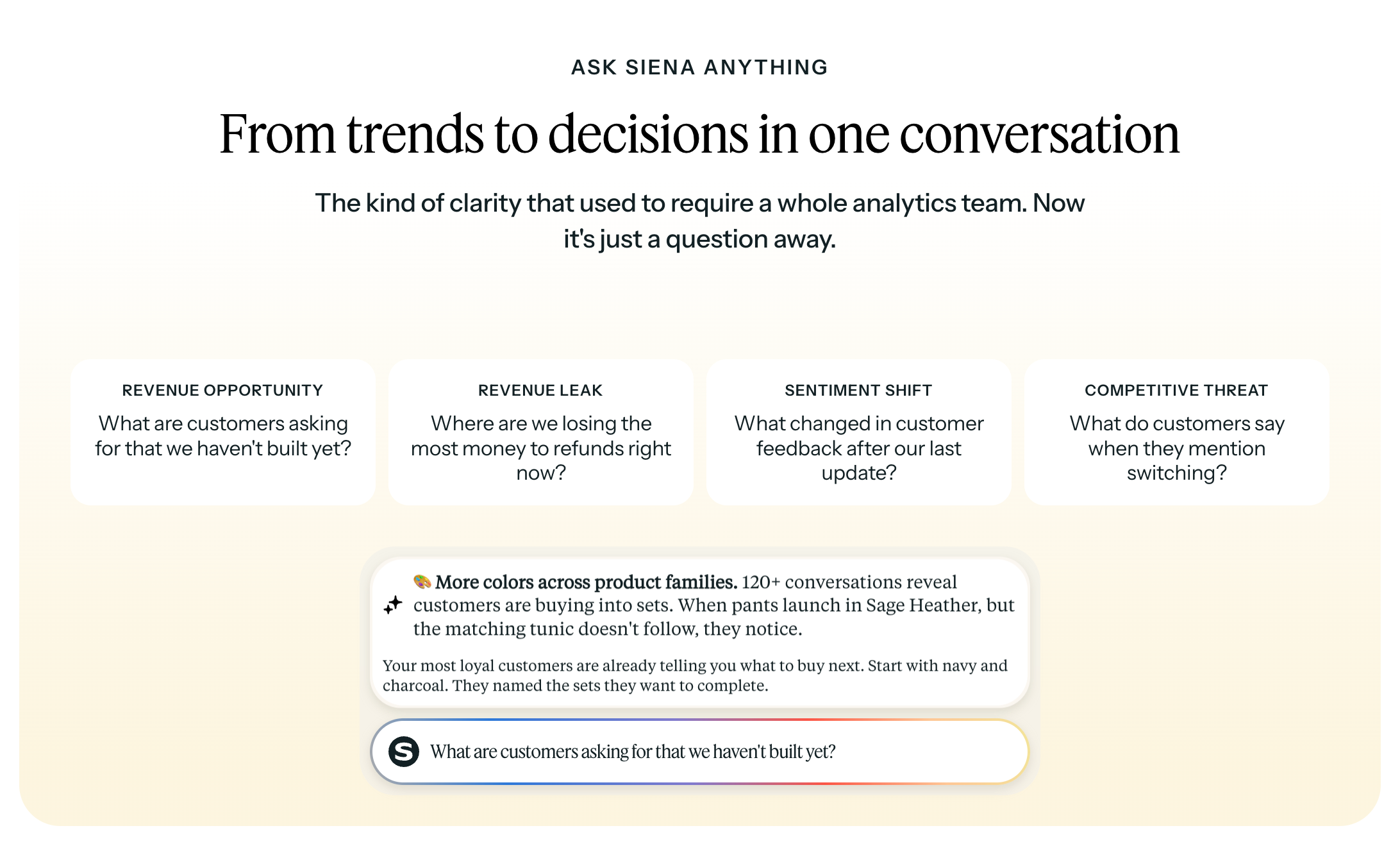
Once that's solved, you can ask questions you couldn't ask before. Not "how many tickets did we get," but "give me everyone who reached out to cancel in the last seven days, and categorize them by the reason they gave."
When Andrei sits with CX teams and shows them their own topic trends, he says the most common reaction isn't surprise. It's relief. Teams already sensed something was happening. They just never had the data to prove it, and nobody was going to spend three months tagging tickets in a spreadsheet to find out.
That tracks with where the wider industry is heading. In Zendesk's 2026 CX Trends Report, 82% of CX leaders said this kind of promptable analysis surfaces in seconds what used to take weeks. The report is based on more than 11,000 consumers and business leaders across 22 countries, so this isn't a fringe view.
Andrei gave me his own starting sequence, and it's the most useful thing in the episode. Three questions, in this order:
What do my happiest customers love most about the product, and why?
What's the constructive feedback, the stuff they don't like as much?
What are the biggest business and product opportunities here?
Then you schedule it. Daily, weekly, monthly. You write the prompt once and it runs on its own.
That third question is where the sample-size story came from.
How do you write a win-back that isn't "Hi {first name}"?
You know the email. Someone cancels their subscription, a flow fires, and out goes a discount code addressed to a merge tag.
Andrei walked me through the version that replaces it. You pull everyone who cancelled, you look at each person's full conversation history and their Shopify orders, and you generate a message per person based on what they actually said.
If someone cancelled because they had too much product sitting at home, that's a different message than someone who found it too expensive. Obvious when you say it out loud. Nearly impossible to do manually at a few hundred cancellations a week.
The detail that got me was smaller than that. He said when the original conversation happened over SMS, the system writes it short, and adds the legal opt-out language on its own without being asked. Nobody prompted it to do that. It just knew the channel.
If you've been building your retention plays with Shopify Flow automations, this is the layer that sits above them. Flow decides when to fire. This decides what the message says.
Worth saying: Siena's preference is to push these out through Klaviyo, Omnisend, or Attentive rather than rebuild what you already pay for. Andrei said they only build a channel natively when the existing tool architecturally can't handle the one-to-one version.
Shopify Sidekick or a CX tool? Andrei's rule for choosing
I pushed him on this, because merchants keep asking me. Shopify has Sidekick. Where's the line?
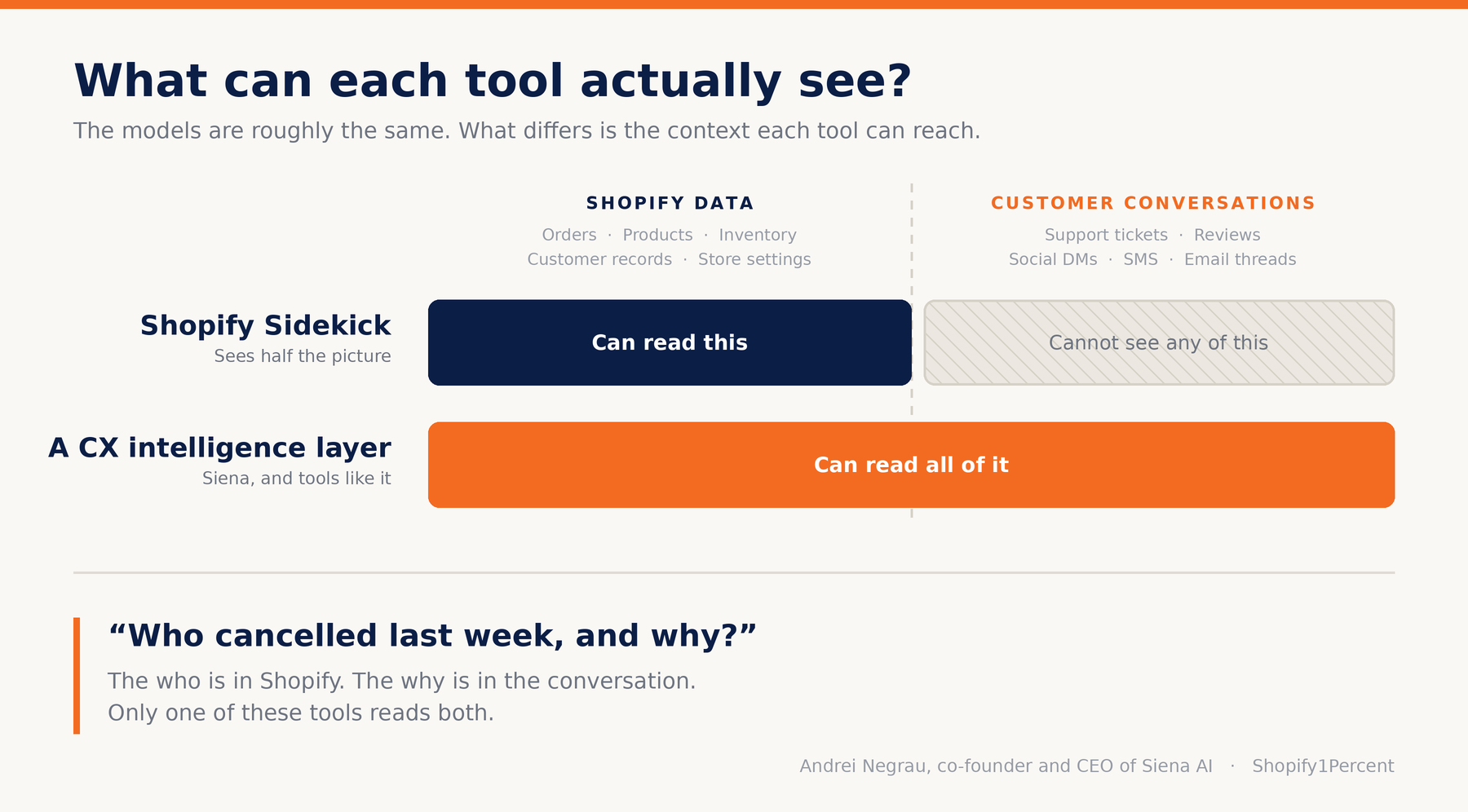
His answer was cleaner than I expected. The underlying models are all roughly the same intelligence level now. Different frameworks, similar tools, similar capabilities. So the models aren't the differentiator.
The only thing that matters is what context the tool can see.
Sidekick sees your Shopify data, so for anything inside Shopify, that's your tool. I've used it exactly that way to find the repeat rate Shopify doesn't show you, and it's good at that. What it can't see is your customer conversations. That's the missing layer, and it's a big one.
Same test applies to your reviews, which are another conversation channel most brands treat as a rating instead of as data. It rhymes with why review quality now beats review volume.
He also mentioned Siena can now process video. A customer records the crack in the pan instead of describing it, and the system reads it and makes the call. Zendesk's same 2026 report found 76% of consumers would pick a company that lets them use text, voice, and visuals in one conversation without starting over.
So I asked the obvious follow-up: can it tell when someone generated a fake video of a broken product to get a refund? His honest answer was that if a human could spot it, the AI probably can, and that there's no watermarking system today. They're building an anonymized cross-brand fraud signal, so a person filing seventeen returns across different stores stops being invisible. I'm not sure how well that works in practice yet, but I want it.
The tangent I couldn't help myself on
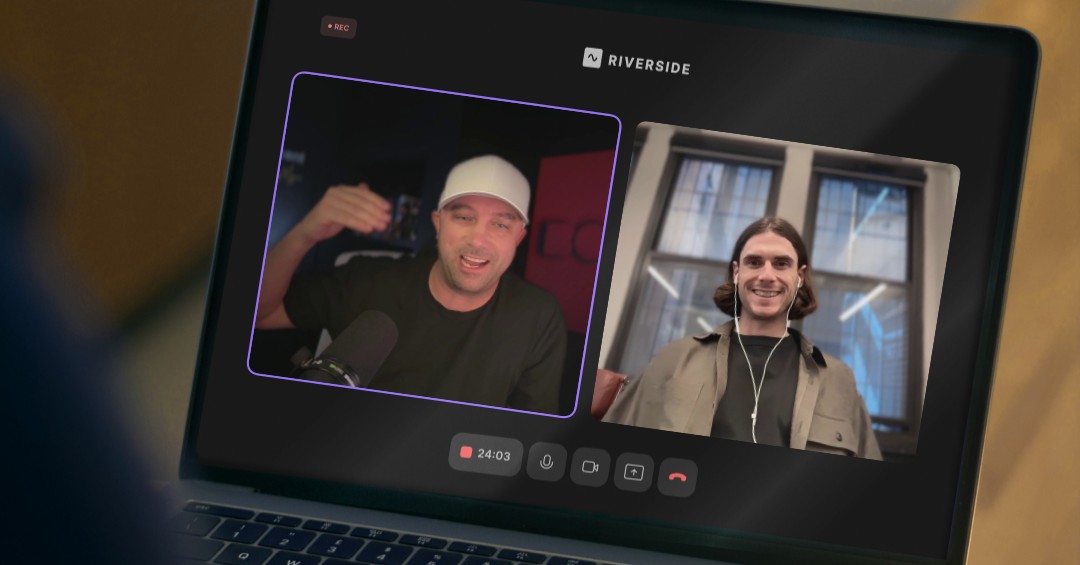
Halfway through, I went completely off my own outline.
There's this idea about true fans that I keep coming back to. Most brands try to solve for everyone. Different customers complain about different things, you try to fix all of it, and you end up with a product that's fine for nobody in particular. The alternative is to find your actual super fans, the ones leaving five-star reviews and defending you in comments and referring their friends, and go learn everything about them. Maybe you only have seventeen of them. Then you go find more people like that.
I told Andrei I want a true fan module. Find every customer who's ordered more than a certain number of times, left positive reviews, and taken specific actions. Then tell me everything about them so my marketing can go get more.
He got quiet for a second and said his wheels were spinning, and started working out loud how much of it Siena can already do.
I don't know if it ships. But that's the moment I realized the intelligence layer isn't really about support at all.
Your 1% this week
Your customers already told you what to build, fix, and sell next. It's in your support conversations, and you closed the ticket.
So go read them. Pull the last 30 days and run Andrei's three questions in order: what do the happy ones love and why, what's the constructive feedback, and where are the biggest opportunities. You can do a rough version of this today with whatever tool you already have.
Find one pattern. Ship one change.
One more thing Andrei said that I keep thinking about. He works with brands doing $20 million and brands doing billions, and the one constant across all of them is that the faster you start, the better. In five years this is table stakes. Right now it's an advantage.
If you want the ground-floor explainer on what Siena is, Lisa Popovici was our very first episode ever. This was the strategy layer on top of it. For the opposite argument, the case for real humans on abandoned carts complicates the picture in a useful way.
It's siena.cx, with one N. I have typed it wrong more times than I want to admit.
🎧 Search #Shopify1Percent wherever you listen to pods for the full episode, and hit follow so the next one shows up on its own.

Co-Founder @ Bold Commerce // Host Shopify1Percent
Jay Myers has been in the ecommerce game for over 25 years. First as a merchant, then a service provider, and today a software provider. His company, Bold Commerce, has helped over 800,000 online stores sell more on Shopify. Their suite of apps help brands maximize LTV (Customer LifeTime Value), and AOV (Average Order Value).
Bold has been ranked one of Canada's Top Medium Sized Employers, ranked in the top 50 fastest growing companies in Canada by Deloitte multiple years, a Top Growing Company in Canada by the Globe and Mail, and winner of the Ernst and Young Entrepreneur of the Year award.
Play Stupid Games, Win Stupid Prizes: Which Shopify Metrics Actually Matter?