What I Learned As a Competitive Archer That Grows Shopify Businesses
When I was 13, my parents and I started an archery store and I was a competitive archer most of my life. One of the things we always did with arrows was to balance each one on one finger, mark the balance point with a Sharpie, mark the middle, and measure the gap. That gap told you the FOC (Front of Center) balance, which would tell you how the arrow would fly at 90 meters.
My first online store, back in 1998, was an archery store. And I think most Shopify owners need to take a Sharpie to their calendar the same way.
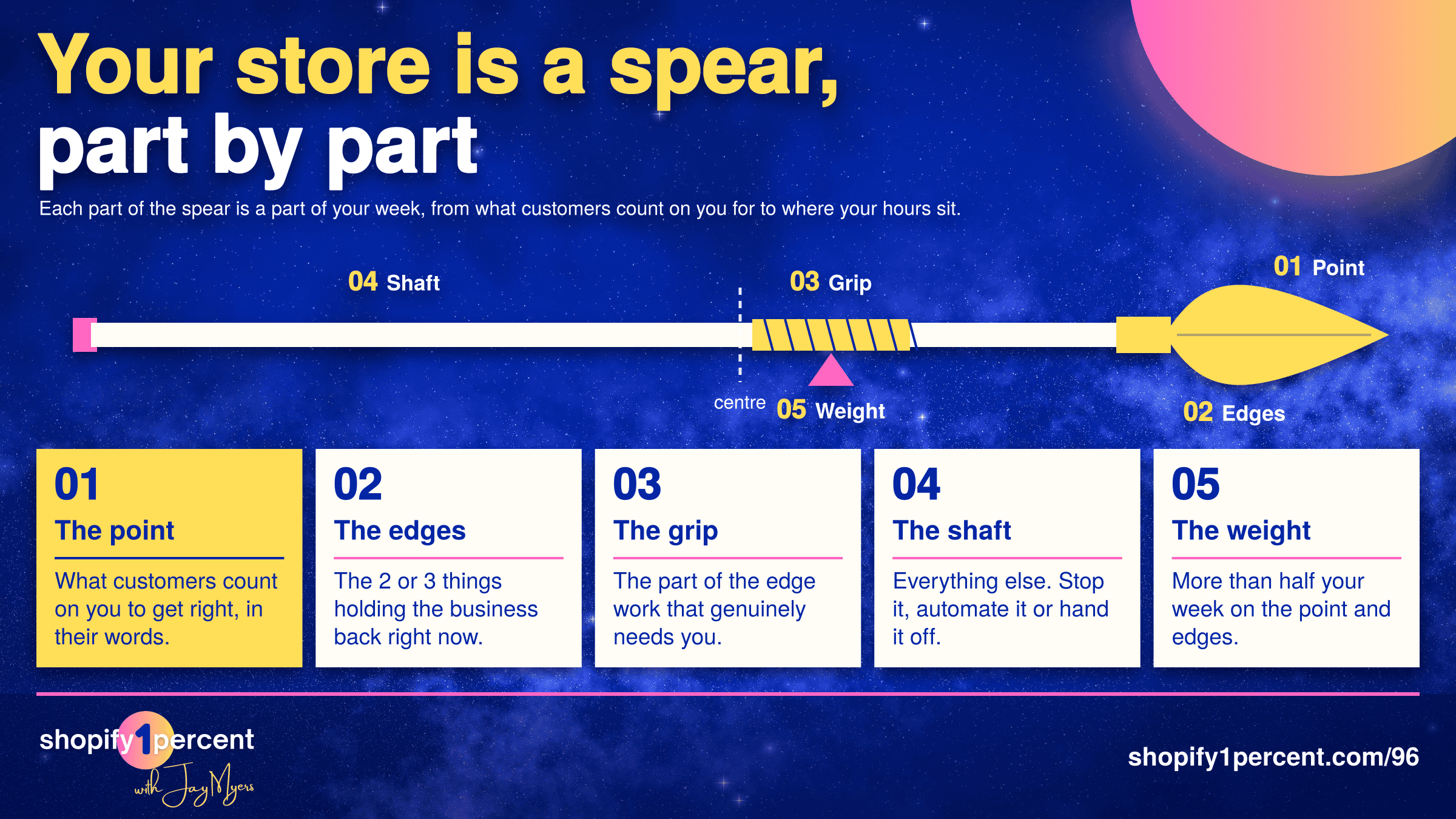
The tip of the spear is the small amount of work that actually grows a Shopify business: the thing customers count on you to get right, plus the 2 or 3 things holding it back right now. Everything else still matters, but it should be stopped, automated or handed off. And if less than half your week goes to the tip, your weight is sitting behind center. I walk through all of it in episode 96 of Shopify1Percent.
Knowledge workers spent an average of 41% of their time on work that didn't satisfy them and that someone else could have done perfectly well (Birkinshaw and Cohen, Harvard Business Review, 2013). I couldn't find that study done on store owners, so I don't know our number. I'd bet it's close.
What is the tip of the spear in a Shopify business?
The point is what your customers count on you to get right. Alex Hormozi said it years ago on Ryan Daniel Moran's podcast: the offer is really the tip of the spear. The catch is that the point usually isn't what you think it is.
Procter & Gamble launched Febreze as an odor killer, and it flopped. Their researchers visited a woman outside Phoenix with 9 cats. Spotless house. Smelled exactly like 9 cats. She couldn't smell a thing. What they found instead was people spraying it after cleaning, as a finishing touch. P&G added a scent, relaunched in 1998, and the next year it did over $230 million (Charles Duhigg, The Power of Habit, 2012). P&G thought the point was "kills smells." Customers were buying "my room feels finished."
So write your point in one sentence, the way a customer would say it to a friend. You're not allowed to write "great products." Every single person I talk to says that. I started a company in a basement, so no judgment. I said it too.
P&G had to send people into living rooms. You don't. Your customers have already told you in writing, in your reviews, your support data and your post-purchase surveys. Export them as CSVs, drop them into ChatGPT or Claude, and paste this:
"Read every one of these. Ignore generic phrases like 'I love it' and 'great quality.' What do customers say they count on us for, in their own words? Give me the top 5 themes, how often they show up, and 3 real quotes for each."
You'll get in minutes what used to take a weekend and a highlighter. Always ask for the quotes so you can check the AI's work. Then look at your homepage. If the first screen doesn't say your point, you've got a sharp point aimed at the wrong target.
Which bottleneck is holding my Shopify store back?
A spearhead widens out behind the tip, and those edges make the hole big enough for the rest to follow. In your store, the edges are the 2 or 3 things that most need attention right now. Not 11.
For almost every store I talk to, it's one of 6: the offer, traffic, conversion, the second order, margin or supply. People show up and don't buy? Conversion. They buy once and disappear? The second order. Busy and still broke? Margin. Selling out while people wait? Supply.
To get specific, connect Claude, ChatGPT or Grok to your store through Shopify's AI connectors and ask it to compare the last 90 days to the 90 before: traffic, conversion rate, average order value, returning customer rate. Then ask which one, if it got 20% better, would make the others easier.
And the edges move. Fix a bottleneck and the next one shows up, as Eliyahu Goldratt showed in The Goal. What holds you back at $400,000 a year probably isn't what holds you back at $8 million. Put 30 minutes on your calendar every quarter called "Is the tip still the tip?" Yes, name the meeting that.
What should a Shopify founder actually be working on?
What your business needs most and what you should personally be doing aren't automatically the same thing. When we started Bold in 2012, there were 4 of us: me (the ecommerce guy), 2 developers and a designer. None of us assumed we were the best people to run a company. Today Peter Karpas is our CEO, and my title is Chief Brand Ambassador. Yes, that's a real title, and I love it. My tip is being the face of Bold: merchants, partners, events and this podcast.
So of everything that touches your edge, which part genuinely needs you? Not which part you enjoy. Which part needs you. If your edge is supply, the honest answer might be a plane to the factory. The TikToks can wait.
What should I stop, automate or hand off in my Shopify store?
Everything else is the shaft, and it matters. Dr. Ed Ashby's arrow research shows the mass of the shaft is what pushes the point through. (You could hunt with just an arrowhead. You'd just have to get extremely close to the deer.) So the shaft stays. It just comes out of your hands. List every recurring thing you did last week and give each one a fate. "I'll just do it myself" isn't an option.
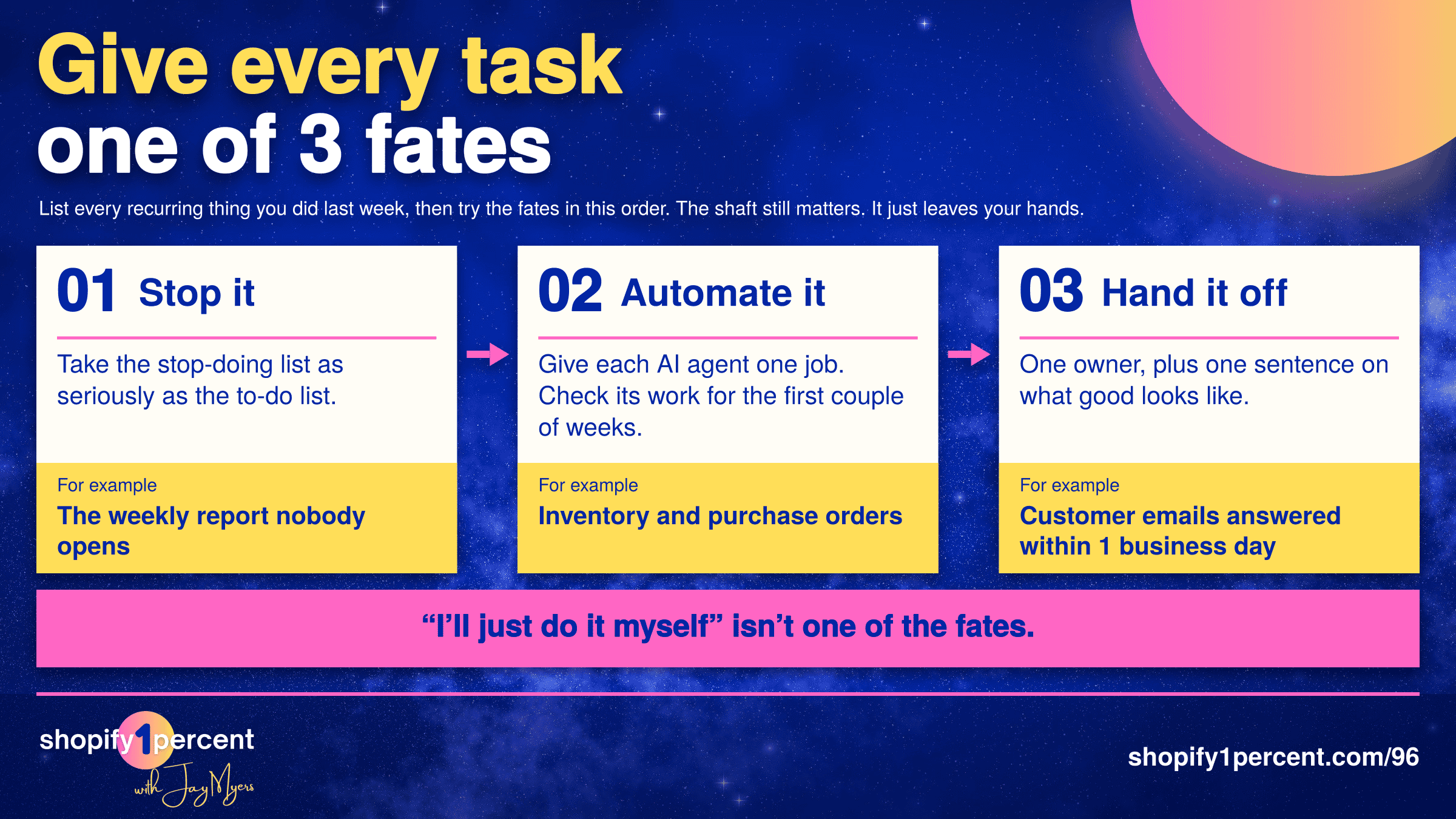
First, stop it. Jim Collins found great companies took a stop-doing list as seriously as a to-do list. The weekly report nobody opens. Nobody's tombstone says "replied to every DM in 4 minutes."
Second, automate it. In May, Shopify launched official connectors for ChatGPT and Claude, and in October it added Grok and Grok Bot. I've been using Grok Bot lately, and it's been kind of insane how much I've automated. The sharpest stores I'm seeing give each agent one job: inventory and purchase orders, customer email drafts for approval, product pages that match what customers actually buy. Treat each like a new hire and check its work for the first couple of weeks.
Shopify won't let these agents refund paid orders, touch payment settings or publish to your live theme. Good. Nobody needs an AI publishing a new homepage at 3 in the morning. Before you hand any tool that much access, know what happens when AI or a Shopify app deletes your data.
Third, hand it off. Dan Martell's Buy Back Your Time says start with admin, inbox and calendar, because they're cheap to hand off and they'll eat you alive. Whatever you hand off, to a person or an agent, needs one owner and one sentence on what good looks like: "Customer emails get answered within 1 business day, and refunds under $50 don't need to come to me."
If you can't write a sentence like that, you're not handing it off. You're just moving the worry to a different inbox.
How much of my week should go to the tip of the spear?
Back to that Sharpie mark. A 30-inch arrow that balances 3 inches in front of the middle has 10% FOC (front of center). Ashby called up to 12% normal, 12 to 19% high, and anything over 19% extreme. More weight up front means a truer arrow that holds steady in the wind. At 90 meters, the ones without it drift off course.
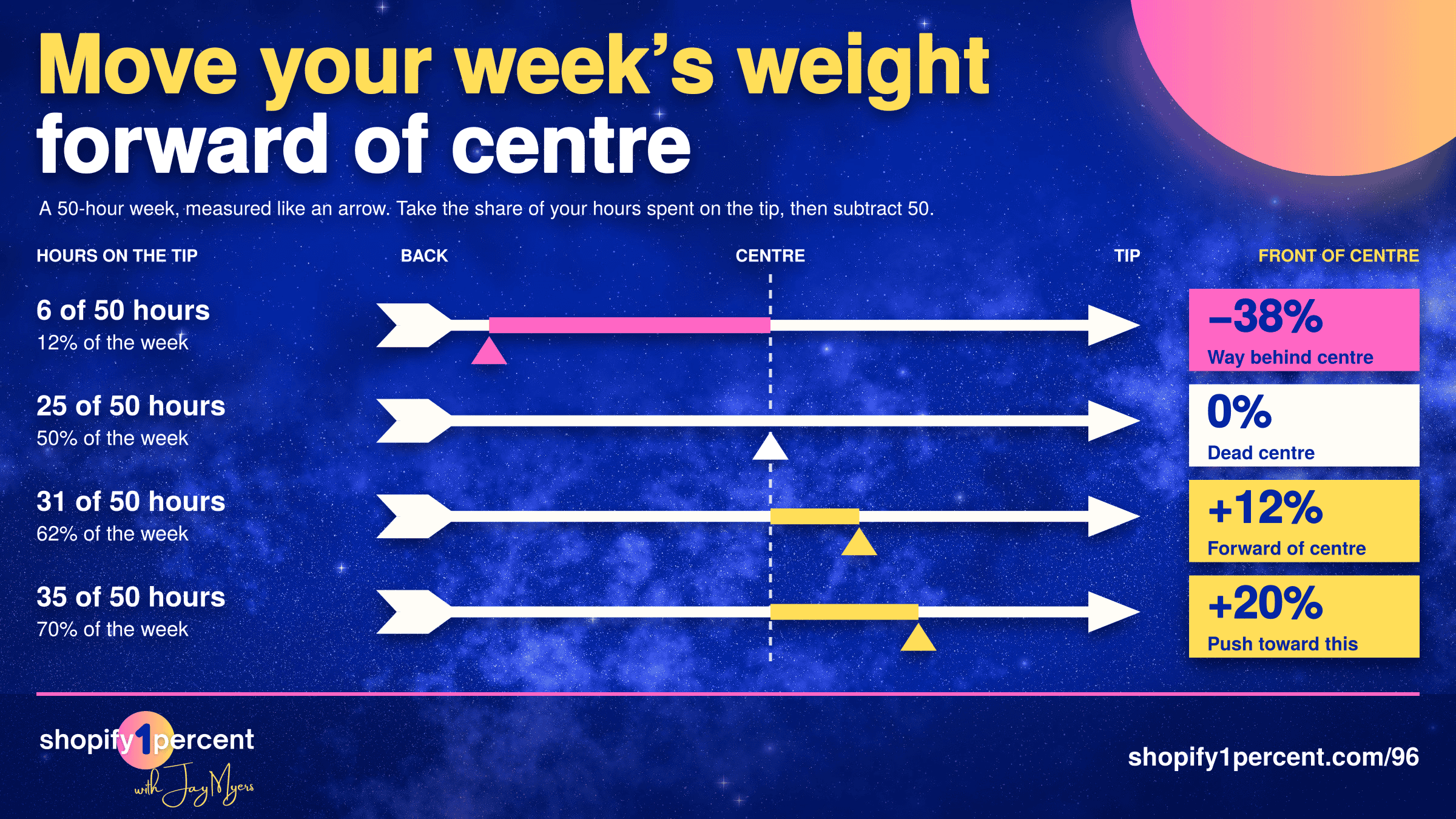
Now treat your week like an arrow. Hours on your point and edges are weight at the front. Every other hour is weight at the back. Half and half balances dead center: zero FOC. Work 50 hours with 6 on the tip, and you're way behind center.
The quick math: take the share of your week spent on the tip and subtract 50. 62% of your hours is 12% FOC. Push toward 20 if you can. You'll never hit 100%, and that's just life. If you're at 5% today, make 10% next quarter's goal.
Every hour you move forward comes from the back, and then it needs protecting. Gloria Mark at UC Irvine found people average 47 seconds on a screen before switching, and about 25 minutes to get back into an interrupted project (Attention Span, 2023). Microsoft's 2025 Work Trend Index found its most-pinged users get interrupted every 2 minutes during core hours.
Nothing that starts with "quick favor" has ever been quick.
When your tip block starts, close Slack and put your phone in another room.
What's the one thing to do this week?
Open next week's calendar, find one recurring block and rename it "Tip of the Spear." Then pay for it by stopping, automating or handing off one recurring task, with an owner and one sentence on what good looks like.
Tomorrow morning, ask 2 questions: What's the tip of the spear? Is it on my calendar today? The tip moves every few months, so you shouldn't need a new answer every morning. The daily part is just checking your aim.
The free Spear Map puts all of it on one page, FOC math included. 🎧 Search #Shopify1Percent anywhere you listen to podcasts to get the full episode. Then hit follow, and send this to the person who keeps getting your quick favors.

Co-Founder @ Bold Commerce // Host Shopify1Percent
Jay Myers has been in the ecommerce game for over 25 years. First as a merchant, then a service provider, and today a software provider. His company, Bold Commerce, has helped over 800,000 online stores sell more on Shopify. Their suite of apps help brands maximize LTV (Customer LifeTime Value), and AOV (Average Order Value).
Bold has been ranked one of Canada's Top Medium Sized Employers, ranked in the top 50 fastest growing companies in Canada by Deloitte multiple years, a Top Growing Company in Canada by the Globe and Mail, and winner of the Ernst and Young Entrepreneur of the Year award.
Your Shopify Store Is Hiding Its Best Subscription Offer