How to Use AI Agents on Your Shopify Store Without Losing Control
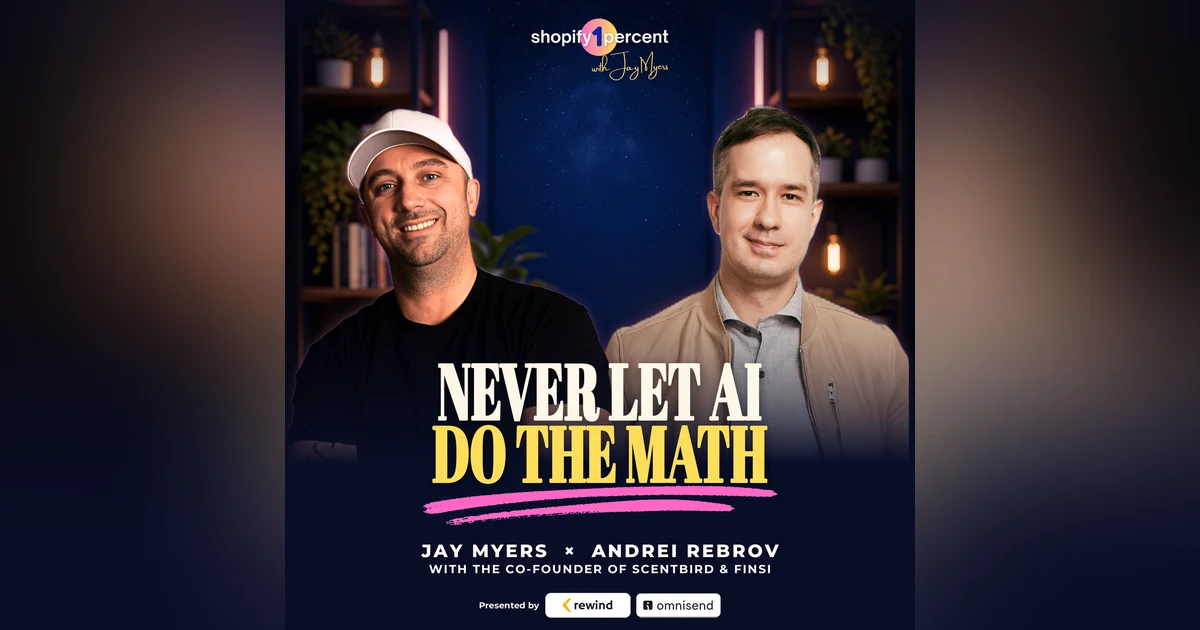

Andrei Rebrov co-founded Scentbird and spent 11 years as its CTO. Now he’s co-CEO of Finsi, a team of AI agents for Shopify brands. On this Shopify podcast episode he explains what a true AI agent is, why you should never let AI do your calculations, why his agents won’t touch your Meta budget on their own, and how a free spoon worth about 50 cents brought one brand a lot of new revenue.

 Apple Podcasts

 Spotify

 YouTube

 Amazon Music

 Audible
Can AI agents actually run part of my Shopify store? Andrei Rebrov co-founded Scentbird and spent 11 years as its CTO, with 45 engineers behind him. Now he's co-CEO of Finsi, which gives brands a team of AI agents instead. His rule for analytics is blunt: never let AI do the calculations. His agents flag changes and explain why, but they don't touch your Meta budget on their own. And Finsi once suggested a free spoon on carts of $80 or more. Andrei says it cost about 50 cents and immediately brought in a lot of new revenue.
So if you're asking yourself "what can an AI agent actually do for my Shopify store?" or "can I trust Claude with my sales numbers?", this episode is for you. Same goes if you've ever forwarded an email to an AI and gotten back something better than what you sent. That happened to me at SubSummit.
💡 KEY TAKE-AWAYS:- What Andrei says separates a true AI agent from a Claude query that sends you a report at 9 AM.
- Why he says never to let AI do your calculations, and the two jobs he gives it instead.
- The free gift that cost about 50 cents, and what Andrei says it did for one membership brand's revenue.
- Why Finsi won't change your Meta ad spend on its own, and what Andrei heard happened to merchants whose Claude agents read their Facebook accounts too aggressively.
- Why the hardest part of AI is "between the monitor and the seat," and the approval habit that cancels out the benefit.
- The revenue stage where Andrei sees brands hire their first data analyst and data engineer, and why he says they hope those two never get sick or go on vacation.
🎁 Remember to email AirPods@Shopify1Percent.com and tell me if you install one to win a pair of the new AirPods 5
⭐️ SATHI ⭐️This episode is brought to you by SATHI, the best affiliate platform built for Shopify brands.
70% of influencer-driven revenue isn't showing up in your dashboard. Codes are leaking. Affiliates are ghosting. And you're paying commissions on sales that never should've counted.
SATHI fixes all of it. Built by the incredible team behind SARAL (200+ top brands, $59M in revenue with influencers).
🎁 Our listeners get early access at MySATHI.io and use code JAY for 20% off
⭐️ REWIND ⭐️The undo button for Shopify. I’ve watched merchants lose entire catalogs to one bad import or an app update... Shopify’s own terms make your store data your responsibility. Rewind backs up your products, themes, orders, and customers automatically, and restores one item, or your whole store in a couple of clicks.
In my opinion, if you're actually serious about your Shopify business, you absolutely should have Rewind running on it. There are no excuses not to have it backed up. Rewind is trusted by 25,000+ businesses including Olaplex and Dr. Martens. Set it up once and have peace of mind forever.
🚨 Our listeners get an extra full month of FREE protection and backups: https://www.shopify1percent.com/rewind/
⭐️ OMNISEND ⭐️I personally use Omnisend for email and SMS on every Shopify store I manage, and for this show too! I've tried them all, and it's hands down the best way to run every email and SMS automation and campaign you need, segment to personalize them, and A/B test everything to optimize conversion.
PLUS, you can now connect Omnisend to ChatGPT or Claude and just ask “where can my email and SMS be making more money?” It reads your actual store data and tells you, then builds the campaign for you right from the chat. It even writes in your brand's voice. Fifteen years doing this and it's the closest I've felt to having a full-time marketer sitting beside me. (Plus most merchants report paying about half the price of Klaviyo.)
🚨 Listeners (YOU) get an exclusive 30% OFF 3 MONTHS with code JAY30: https://www.shopify1percent.com/omnisend/
🛠️ RESOURCES & LINKS MENTIONED IN SHOW:- Finsi: https://www.finsi.ai/
- Finsi free audit and demo requests: https://www.finsi.ai/demo
- Finsi on the Shopify App Store: https://apps.shopify.com/finsi
- Misha AI: https://www.getmisha.co/
- Andrei Rebrov on LinkedIn: https://www.linkedin.com/in/andrebrov/
- Andrei Rebrov on X: https://x.com/andrebrov
- Beyond the Box: A Step-by-Step Guide to Building, Marketing, and Growing Your Subscription Box Business (Andrei's book): https://www.amazon.com/Beyond-Box-Step-Step-Subscription/dp/1948382873
- Scentbird: https://www.scentbird.com/
- Pomelli by Google Labs: https://labs.google.com/pomelli/about/
- NotebookLM: https://notebooklm.google.com/
- Shopify Sidekick: https://www.shopify.com/sidekick
- Klaviyo: https://www.klaviyo.com/
- Recharge: https://getrecharge.com/
- Fairing: https://fairing.co/
- Lovable: https://lovable.dev/
- Riverside: https://riverside.com/
- Descript: https://www.descript.com/
- Siena AI: https://www.siena.cx/
- My episode with Andrei Negrau of Siena AI: https://www.shopify1percent.com/guests/andrei-negrau/
Andrei's offer for listeners: with Black Friday coming up, Finsi will run a free audit of your last 12 months and your last Black Friday, plus a cash and inventory forecast with a good and a bad scenario. Request it at https://www.finsi.ai/ or find Andrei on LinkedIn.
More from Andrei, including his bio and where to find him: https://www.shopify1percent.com/guests/andrei-rebrov/
Did you know leaving a ⭐️⭐️⭐️⭐️⭐️ review on Spotify, or Apple will give your shop gooood ecommerce karma? ❤️
00:00 - Are AI agents real or just rented chatbots?
02:57 - What Finsi is and what makes a true AI agent
04:30 - Meet the six agents and the 12-month audit
14:07 - How the SEO agent works every day
21:24 - The luxury brand that thought price was the problem
24:07 - Ads agents, and why Finsi won’t automate your spend
34:11 - Scout, a 50 cent spoon and fixing churn
45:33 - What a brand should never use AI agents for
51:40 - Quick wins with AI before you buy a tool
56:42 - Andrei’s free Black Friday audit
0:00 Shopify1Percent Last year, AI agents had a hand in $262 billion of online sales. It's wild. We should make it simple for merchants, because what I had myself when I was a merchant, set up fees and the long implementation process, like that was always killing me. Is it an AI agent that's going to be your best hire you never have to pay, or is it the most expensive chatbot that you're just renting? Andrei Rebrov co-founded Scentbird and as CTO for 11 years, scaled it past a million subscribers with 45 engineers behind him. Most Shopify brands will never have a team like that. So he built them one. Finsi is a fractional AI marketing team that finds the revenue you're losing.
0:44 Siena had a really interesting story. There was a really high end luxury brand and customers had complaints, they didn't want to order, and their customer service agents thought it was related to price because it was too expensive. First, you need to be transparent to clients that you actually process their orders. Someone might consider this as a spam, but other people actually see this as a transparency. They feel like they're in control. So you said 70% of subscription churn is decided in the first 14 days, and you found at Scentbird the first retention touch from day 30 to day three, you saw cutting churn by 25%. Never use AI to do the calculations. But what are some quick wins brands can do on their own?
1:31 In the 2025 holiday season, so last year, AI agents had a hand in $262 billion of online sales. It's wild. So rough that means one in every five dollars spent, an AI agent touched. Now, retailers that deployed agents grew 59% faster than the ones that didn't. And in the same year, this is what's crazy is Gartner said that more than 40% of agentic AI projects will be canceled. By 2027. So, well, and then on top of that, of the thousands of companies selling something called an AI agent, there are only roughly 130 real that are the real thing. And so which is it? Is it an AI agent that's going to be your best hire you never have to pay, or is it the most expensive chatbot that you're just renting? that's not actually an agent. And my guest today, I I would say has the best seat to answer this question more than almost anyone.
2:25 Andrei Rebrov is the well, he co-founded Scentbird. He spent 11 years as its CTO. He literally built everything from the storefront to the warehouse. He scaled it past a million subscribers. And then he just walked away and started building AI agents for e-commerce brands. and the thing I love about Andrei is he is almost a rocket scientist as well, too, which we'll get on to into a little bit. But and he posts awesome memes about retention on LinkedIn. You should follow him on LinkedIn. Andrei, welcome to the show. Thank you so much for being here. Thank you so much, Jay, and thank you for having me here. you're working on an awesome project called Finsi, which Mm-hmm. is a true AI agent tool. Yes. Not that one but tell me what it is, and then I'm excited to dive into some of the some of the topics I want to get into today.
3:08 Tell me about Finsi. Mm-hmm. Happy to. So what my previous 11 years at Sembra taught me that in order to get to specific revenue point and in order to continue to grow, in many cases, what you need to do, you need to follow specific process from time to time. You need to improve this process, make it better, and like don't do stupid things. and You need to use right data to make the right decisions. So not not just the gut feeling how unfortunately a lot of people in our industry operate. and then I realized that yes, we had the benefit of 45 engineers building Sandwich, but a lot of companies don't. So Mm-hmm. then AI happened, and that gave me an idea, okay.
3:51 Let's build something in between AI, in between automation, and between data. And this is how Finsi got started and what it is right now, because it Constantly keep changing keep changing the same way as AI keeps improving. We now have a team of AI agents, and AI agent is a little bit more than your quote quote query query that runs at nine AM every morning and brings you a report. AI agent is almost an autonomous entity with a goal, with a context Mm-hmm. about your organization, with ability to make decisions, bring you work, and constantly improve. This is what I call a true EI agent and this is what we are doing for e commerce companies. Yeah, and if you go on the site, I'm just pulling it up right now.
4:32 You've got well, there's six agents. You've got your do they actually go by these names? Scout, Pulse, Forge. They do. Yeah, okay. So those are the names of the agents. you've got a revenue intelligence agent who is responsible for finding revenue you didn't know you were losing. You've that's a high-level detail. It does a lot more, but then you've got Pulse, who his job is to make every ad dollar produce customers who are actually sticking around. Then you've got Forge. He's responsible for your ad creative. I love this. Echo. I love the names by the Mm-hmm. way too. so I would if you want to get an idea of their actual agents, each with a different role. So when someone uses Finsi, they they get the suite of agents or do they pick which ones or they always come as a suite?
5:16 Yeah, they they get a team. And this is another thing that we often answer when we do the demo of the product, people I ask, why do you have so many features? Like you have everything from email marketing to financial intelligence. Why? Mm-hmm. And the answer is simple. And like I that's another learning from Sembert for which I'm super grateful. I was able to work very close with people from different departments and You cannot isolate one function, make it good, and hope that business will grow. You can have, I'll give you an example. Yeah. You can have a rock star with P of growth who will nail every odds. So you'll have a lot of amazing traffic on your website.
5:59 But if your website doesn't convert, no revenue. if your Mm-hmm. cannot predict your inventory stock status, you will run out of inventory. You lose a lot of money. If you don't have a good forecast, not forecasting, if you don't have a good RPL provider or good warehouse, you won't be able to ship in time, everyone is upset. Yep. you're losing money. If your finance is not controlling how much money your VP of growth is spending out of like I saw that happens. on meta, you're And like this is actually Yeah. one of the things that we actually teach a lot of merchants how to look at the PL. How to read cash, how to do the cash forecasting and limit yourself in in order to have enough money to spend on inventory that you have to ship.
6:40 That's why we have a suite of agents. We don't feature gate them, we gave them all, we give the whole platform for for the same price. And like this is the new reality of the SAS. like Yeah. Yeah. you need to give the product, you need like what is the big differentiator right now is the service that you give on top. and ability to fine tune the product towards each custom. And this is awesome. So you're you're basically taking all the learnings that you developed at Scentbird, growing that company to a million subscribers, and everything now you've you so you you've taken that and built out Finsi, which is a suite of agents. Mm-hmm. what does that look like if I'm a brand and I say I want to use this? I some.
7:22 Mm-hmm. connect Finsi to my store, and Mm-hmm. do I have to train each of these agents individually or does it analyze and is there like Mm-hmm. a starting point that it it can figure out most and then it like w what would that Mm-hmm. look like if I wanted to use this suite of agents? So one thing that we also said as a kind of a motto initially, like we should make it simple for merchants because what I had in myself when I was a merchant, setup fees and long implementation process. Like that was always killing me. so we said, okay, let's make it simple for merchants. Let's make it 15 minute integration. We always guide merchants through the integration because Google is not very user friendly.
8:04 So it's sometimes it takes time to find out how to give approval or something, and that's it. then what happens? we always start with a twelve month audit. That is an opportunity first for us to let's call it show off and figure out what we can find out about the company based on Only pure data. And in many cases, we find interesting revenue leaks, interesting revenue opportunities. but also when we do the discussion of this report, we also extract a lot of information from the merchant and the transcript of all this conversation with the merchant, they keep getting into the memory of the platform. So eventually Mm. we have all the context about about the merchant, about their history, about what they want to do, what they don't want to do.
8:47 Let's say we are discussing the way how we want to build email emails and flows and campaigns. So we discuss okay, what do you like? Do we want to give any discounts or not? How many images we want to have in the in the email? How many products we want to feature? Do we have specific product per month per specific promotion and so on and so forth? All of that goes into the we actually separate these two things. They go into the memory. So Mm-hmm. Agents have shared memory that they access for their needs. But also, what we recently introduced, and I believe this is becoming more and more important thing, a layer of governance. That sounds like Mm. enterprise-level feature, but this is actually the way to teach agents don't do crazy things and hallucinate less.
9:29 So, for example, if we are saying we are not giving any discounts, it goes into the governance. So every new creative. Every Mm. new email is being verified against it to ensure that no discount is given. This is one of the easiest examples here. So you showed me something when we were at Sub Summit, this was Mm-hmm. a few months ago, where it was actually awesome. I entered a no, I took another email. I'm trying to remember, I took a I'm I took a marketing I I so I I I'll like we recently email and I forwarded it to your to one your agent. I guess that would have been Echo. Mm-hmm. Mm-hmm. Echo Echo Agent. And then it created a full a a full campaign.
10:09 around I was actually Mm-hmm. blown away. It only took 10 minutes for and then it sent back a full a full campaign ready to go based off of the content in there. Mm-hmm. and it was actually it was actually better than the the what I had sent. Yep. Okay, so like I I I know what goes through people's minds when it goes through my mind when I look at something like this like okay, Mm-hmm. i are these gonna be like AI slop. Is this is this not Mm-hmm. like can this actually work? How hands Mm-hmm. off can this be? So what what can these agents actually do for for merchants? And is it what what's the Mm-hmm. level of the quality it puts out? Mm-hmm. brilliant question. So, what we did for Sub Summit, what we recently did for Ecom Elevate, is a kind of a way to show off and gather people's attention and just explain what AI can do. what it can do in reality depends on a few things.
11:00 First, it depends on, let's say, the tooling that you have. what do I mean? the reason one reason why I really like clavio and omniscient. Because they are very open for integrations. And with Clavio, we can basically tell an agent, hey, let's build a campaign. for example, for one of our merchants, what we like what we built today and we'll launch tomorrow morning is let's send a promotion for watermelon and melon juice. let's give 20% discount and it should go to the entire database. Mm-hmm. That's enough. It produces the body. It produces the expected outcome of this campaign based on the previous history. If I approve the copy, it then renders me a few options to review.
11:40 It actually renders them in iterations, while it renders three other judges look at it, give the feedback if something is off, if something is goes against the governance rule or the brand brand book. Mm-hmm. So at the end I have three versions rated very well. I pick one of them, click send to coefficient, and that's it. with Omnisend it's pretty similar. With some some other brands it's not possible, so they end up with a nice HTML that will be supported by the platform, but they still need to c copy paste. That's one thing. Yeah, om Omnisend just opened up their MCP to Claude OpenAI. So you can fully create within there too. Yeah. All right. And they're a sponsor of this show. So we're good. We could let's use OmniCend going for it. But yes, yes. No, that okay. So and so it's completely hands off.
12:24 Yeah, that's the simple part though. The hardest Yeah. part is always between the monitor and the seed. Because not not everybody is ready to change in many cases change the process. Because what they have is they have a design committee, they have copywriting committee, approvals, workflows, and so on and so forth. AI forces you to change this. another example, usually the way how it's all created. You first write a copy. Then you have a designer who creates it in Figma, and then you either size the images and put it in your Omnisend account, or you have an HTML coder who creates an HTML, put it there, and this is my preferable format because we see 30% more click rate in this case, and then you send it. That's the usual workflow.
13:09 With AI, you actually go from the idea to the final HTML in one jump. And it's cheap to iterate on the final result and you don't like and what you need from these people who were participating before a good actionable feedback. Let's say, hey, let's change like I don't like how hand is presented on this picture, let's make it more open, or let's turn it. Something like this that agent can use as a feedback and update the result. If people are ready to sh change the process to this one, there will be no problem. If people still want to have a night a long process with many people involved, AI won't give them any benefits. And this is actually one of the criteria when we look for a partner.
13:49 It's not about their their size. It's not about like their product vertical. It's about the operator who is hungry to try new things and who is hungry to grow. Yeah. So what can I I I the these even weren't on my question list, but I want to go through these because this is like for my own curiosity here. So Beacon, the the SEO and the AI search Mm-hmm. agent, what what can that agent do? Like can it actually change the the markup on your on your pages ad schema Mm-hmm. and like what what is the extent of its capabilities?
14:32 Mm-hmm. Sure. I'll start with my previous experience again. and it actually a lot of merchant can relate to this. every year you're looking for SEO agency who can analyze your website, give you recommendations. They usually end up giving you two hundred page audit report that you then hand off to your engineers and like in all day misery they go through all the pages, update H1 text, create new pages, No one is happy, maybe except of SEO agency who earns some money just running a bunch of tools like HRAPs or CMrush. Great tools. And now I'll get back to the SEO tooling. So that's how it used to be. Unfortunately, with SEO, you need to constantly update this thing.
15:12 You need to monitor it. So you might end Yeah. up with a team that is doing this. So, yes, there are a lot of automation, but someone still needs to monitor this. and it's again it's monitoring what's going on, update doing some changes. Launching them, monitoring the result, learning from it, and doing this in constant change, especially if you're talking not just technical SEO, which means proper HTML code, but actually appearing in Google results more often. That requires you launch new pages, see how you rank, and so on and so forth. A lot of iteration, very long-term strategy. People only start investing this at some point. So it's like retention. Yeah. but people don't like to do it. But it actually gives amazing results. You have to do this, what Echo does. Sorry, not Echo, Beacon.
15:56 So Beacon does Beacon. constantly check your website against all the proper SEO rules to see that you have a proper description. So a lot of governance, so a lot of technical SEO. Yeah. It constantly goes to Google Search Console, another Google platform that is not great for people, but actually great for agents. And based on what it sees there, it then gives recommendation: okay, you can appear better, like you can do better for. know be using B through juice for hard conditions. And then it Mm-hmm. pro and then it actually communicates with the copywriting agent. And interestingly enough, so far Google Gemini is much better than anyone else on copywriting to create a new article, new page for your blog, for example.
16:37 Then it runs through judges, it and then publishes a draft of a new blog post and then you we still require people to look at it and change it. Same for the Shopify post because Shopify Shopify pages, because Shopify pages is what? It's a code that you can post, you can review and then make make it public. So that's that's that is the capability of beacon for the SEO. That's amazing. And it's just running every twenty four seven. Like it's not like you have to manually get it doing this job. Will it keep running? It's running constantly. It based on the dynamic of the merchant side, it will pick the proper schedule. So for example, if you have like a thousand thousand of people within your website, if you constantly change your website, you if you have thousands of SQUs, then yes, it will run more often daily.
17:27 if you Mm-hmm. don't do change often, if you only have one product, then it will run maybe twice a week, maybe once a month to give you some updates. Launch them and then you'll it will need some time to see where we settle. Yeah. Amazing. It's almost it's like an unfair advantage, to be honest. For it feel well, which which goes back It is it is an unfair advantage. to why they the stat that I read in the opening. Like the the brands using AI agents grew fifty nine percent faster than the ones that aren't. Like this is literally why. Engines are a great way to install I lost the word. install not the process and accuracy, but install discipline in your organization. Yeah. Because again, a lot of these things they require discipline on doing like what's called PD like plan, do, check, act cycle when you constantly measure the outcome.
18:14 People are always busy. People depart the company, new new people join the company, spend a lot of time teaching people. one of the biggest benefits of AI agent, they record the memory of everything that happened in your organization f forever, and they can all Mm. can always access it and use it for a good Tell me about Sage. I'm interested. Mm-hmm. So your customer intelligent agents. I had Siena on the pod. Are you familiar with Siena AI? Yeah. Yep. Mm-hmm. So I had same, same name actually. That's crazy. So Andre from Siena. Yep. What's with Andre's an agents? It's it's a good name. we have another Andrew Ha ha ha. we we know that is actually c recently converted into EI adopters, so he's also super happy now building his own agents.
18:58 You take all the letters out of your name except the first and the last, and it's AI. Yeah, yeah, there we go. It is it is, So, anyways, he, so Siena is a little bit different. It's not, it's a full Mm-hmm. support system, but one of the things that brands are using it for is also surfacing insights from support tickets. So Sage, Mm-hmm. Sage is just the insights, not actual support, correct? It is insights and it's using few places where it goes. So inside Finsi, we have and actually let me st step back a little bit. One thing that is critical for successful work of the agent is the tooling. So agents need to have tools that they use, and it could be tools to read some information, I don't know, web search or API to access database, but also tools that you create to make them specific to your company. So for example, When we initially started, we were super focused on subscriptions only businesses, and we did a lot of analytics and reporting around redemption.
20:01 So involuntary return, card failures, and so on and so forth. The problem is people don't necessarily like aside from some data nerds, allow sit inside data reports and look for interesting partners. So naturally we taught beacon, not beacon, we taught Sage. How to use these tools, where to look for? Constantly go and research your cancellation reasons, totally go and research your new patterns in in the literature and so on and so forth. And this is what it brings. Mm. but because it's something that usually requires a lot of changes in what you do, it cannot act on it necessarily. Like we we present it as a 360 view.
20:41 Hey guys, this is what a recent example was. We analyze a lot of data from fairing and we connect it to the customer LTV and overall customer journey. And we can say, hey, you have a cluster of people who spend a lot of money with you. They are specifically complaining about these issues. and this is like top three issues that you need to improve in order to win these customers and make them from detractors Hm. to people who recommend you. And as everything with retention, it's not that easy. It might change the way how you ship, for example. You need to need to ensure that your I know tracking number is always presented or make sure that people can cancel easily. So yeah, like they present results, they do an honest estimate of the impact, and then it's up for people to make a decision and do the implementation.
21:25 Yeah. I heard a r so Siena had a really interesting story. There was a really high-end luxury brand and customers had complaints they didn't want to order, and their their customer service agents thought it was related to price because it was too expensive Mm. and they they they didn't want to order in case it was the wrong size, they didn't want to take the risk, and basically The humans reading the tickets said, Well, it's too expensive. It's too much of a high risk, Mm-hmm. high risk order. But anyways, when scanning through all of the tickets, there was mentions and it it figured out that what they really wanted Mm. was a sample to be sent to confirm the size. So imagine you're ordering a, a thousand dollar jacket.
22:09 Mm-hmm. They they what they did was they built out samples that were cheap, Nice. that were a twenty dollar, Mm-hmm. Just a sample size, a Replica. Mm-hmm. replica, a replica, but wasn't the real jacket. But if you Mm-hmm. tried it on and this fit, then they would send out the thousand Beautiful. dollar leather jacket. The customers didn't have an issue with the price. They just Mm-hmm. wanted a sample. It found that out and they ended up they've it I think it was 2024 or 25. Mm-hmm. They ended up sending out a million samples that year. It was insane. Whoa. And that's all customers that would have been lost. Yeah, lost otherwise. Not that they didn't want to pay, they just wanted These are high-end customers who don't want to deal with returning and that. So they would they don't mind paying fifty dollars for a sample.
22:50 Try it. Mm-hmm. Or I think they actually sent a sample set. So they would send the three sizes and you try and then Mm-hmm. order the right one. Aura Ring does that with their rings. Yep, Warby Parker. They send out little little sample. Yeah, exactly. Exactly. So, anyways, I I think there's a huge opportunity for data. there's there's so much in your support Mm-hmm. tickets. It's one of the areas that most brands just try to. close them as fast as possible Mm-hmm. and and my tickets are closed, but actually harvesting the the data from it is insane. There is also an another interesting outcome of this. we all have our biases and sometimes we prefer to ignore certain things. AI agents also have biases because all the models were created by people.
23:32 plus you can give your agents personalities. So sometimes like what where I experiment, I also can give different agents different personalities, so they will look for different things. That's why one model doesn't like doesn't review itself. There are other models who review it result, and sometimes I believe that it could be some not jealousy but competitive part of it. and it the AI will present you the situation as is. Like, we actually saw sometimes that the AI, like, even critiqued our own work. in a full agency mode with immersion, be like we are keeping this in in the report anyway because like we want the system to be honest and we know that everyone appreciates honest part. Yeah. Okay. I'm gonna go through the whole list here because we talked about these three. I I can already see our video team what they're gonna do with the trailer intro for this. They're gonna show the pictures of the people you have on the website.
24:20 Echo, beacon, sage, forge, pulse. I I'm excited to see what the trailer for this episode looks like. But tell me about Forge and I I imagine Forge and Pulse work together because Forge is the Mm-hmm. Mm-hmm. ad creative and pulse is growth and ads. description, make every ad dollar produce customers who actually stick around. So Forge is doing the creative and then Yep. Mm-hmm. Pulse is managing the campaigns and optimizing them. So yes, and I'll start with Paul's. one thing that we keep repeating over and over again, media buying right now sh is a commodity. It means that in many cases media buying is not an art. Yes, it might it it c it's actually closer to I would say even like frequency trading or high frequency trading, like your ability to react on specific signals right on time and adjust your audience, your budget.
25:07 So it's actually getting more into the realm of math, modeling, things like that. But if you're a small merchant, what you need to do, you need to like when you see that your cost of acquisition goes up or CPM is changing, react to it and react on time and do the proper change. So it's not a rocket science, I know it. it's just ability to follow the Yeah. process well. And for that you like and for that you shouldn't be charged by the percentage of your ad spend because that that's the reality where most Yeah. Yeah. of the agency leave, and we okay, we'll have a simple agent, it will do everything for you. It won't manage it for you. Because one thing that I actually saw two days ago, a few people reported that their Facebook ad account was banned or like permanent temporarily blocked because they've been using, and this is the most ridiculous part on Facebook side, actually, they've been using Facebook official MCP, but Their cloud agent was too aggressive on read, reading the information.
26:06 So basically, maybe they were they were checking information every minute, every two minutes or so. And despite having API and despite having MCP, Facebook has a policy around automation. So they ban them. And like what we do is like we bring you all the results, like we have like different ways to sync information and like few fresh information for freshly launched ads to see that they actually become live. Facebook starts to spend money. We have a daily things for the something that is older. And we don't change like we don't automate media spend. We bring you alerts right when we think that something Mm. needs to be changed and ex and we explain why it should be changed so people like can discuss it or debate it. and then there is a button or they can go into Facebook account and do the change there. So it will it will be completely proper things to do. That's on PAL side.
26:57 With Forge, it's two-way thing. On one way, once you get to specific size, what you do in order to make your creative program cheap, you reutilize same videos, but you try different hooks, different angles, different offers. And what you need to do when you do this is to analyze all the previous videos and To see what works and what doesn't and apply it over to future videos. So that's Mm. one part of the job that Forge is doing. It's analyzing your previous creatives, both statics and videos, to give you ideas of what you need to try. It brings in new angles, so you keep it trading on new things. And on the other side, what it does, we have a competitor intelligence block inside Finsi.
27:38 So you can monitor what's going on with the Is your competitors' homepage, catalog, Facebook ads, Google Ads, and email. So it brings some new ideas, it brings ideas that have been working for a very long period of time for competitors. Add them into the mix. So you constantly, Mm-hmm. like whenever you like it can tell, hey, based on the dynamic of your ads, in a couple of weeks you will need 10 new creatives. These are creatives that we prepared for you. Look at them, give the feedback. or send them them to your creative team so they can actually produce the results. So they work hand in hand.
28:23 Does it create them from scratch or do you have to give starting assets for a lot of the creatives? So we are mostly doing creative briefs. For create for creative themselves, we are limiting ourselves only to some static ads. and for the videos, we actually I won't say we are debating itself, but we see better results for real UGC than the EI UGC. there could be some internal banning there, and in general, like I Yep, I agree. I believe Snapchat did it a few weeks ago. They actually started to I believe ban AI videos because they said we want to promote our relationship with creators. And I Mm-hmm.
29:04 think this is the right thing to do. Right. So it'll build out the the the the brief, the strategy, the yeah, okay. The con yeah, makes sense. I and I agree on that. actually on that topic, at some point I realized that I'm I'm personally not producing enough content in I the form of the video, because in many cases it's not only about having a good idea to to talk about something. But also you need to record the video, you need to give it to the editor, like you need to make it interesting, you want to enter screenshots. So basically, you won't have like I want to have shorts of like reels that looks like what you produce, but I don't have a team behind me. So what I did, I actually created a let's call it a content pipeline.
29:45 It's a set Mm-hmm. a set of skills for quote quote. and what I do, it helps me to let's say I have an idea for something. I send it to like do a research and find interesting facts for me, articles. I then ask it to help me with the script. So then I Mm-hmm. use Riverside to record the video. I give the video video, I give the transcript to it, and it creates a video, it cuts it, it ensure it it integrates with service called the script to ensure that my eyes are always Mm-hmm. Yeah, yeah. pointing the camera, that there is no egg and Yeah, stuff. Cut it, insert the email screenshots of the articles, insert the captions, and then I post it into into LinkedIn. But for we did something interesting, more interesting for Instagram.
30:26 So we actually have another agent that we call Misha AI. And Misha AI is an agent that sits in your Slack, it has a different website, getMisha.co, and like we like I actually finish in update for FinCI website that will introduce Misha AI. and I Mishayai sits in Slack, it actually communicates all findings and the work of other agents to the Slack Slack crew, like actual people. and Mishay has an Instagram account, and actually Mishii started to post a video over there. So, one other thing that is happening once the script is ready, like for LinkedIn I read the script. For Instagram, Misha AI Avatar reads the script, and there's the same logic of cutting the video, posting there. ensuring that midsha is looking the same way, it's speaking with the same voice, it's lip syncing and all the stuff. So Yeah.
31:13 this is where I use AI, this is mostly for fun. Yeah. Yeah, yeah. And like I actually set set the checkbox that this is AI, AI creator. It's great. It's I actually this morning I I don't know, I just had this thought. my daughter reads a lot of books and then she's like very excited for the movie to come out and and Mm. you know, right now you can you can create a fairly short like clips, but like you you to create a full movie, there is a there's a flow for Mm-hmm. it where you give it like to keep characters' faces consistent and everything. But like it's not far where we should be able to just give the book to AI. And then generate a movie from this book. And like I almost thought you know cause I do that with stories for my kids.
31:55 Like I'll Mm-hmm. I'll give them content and I or sorry, I'll give the AI content and I'll say, create a story or create a po I use like notebook LM and for my daughter for learning and I'll say, Create a podcast that my daughter can listen to to to learn about this topic or subject. And I think we'll be doing that with movies soon. there is a great service, actually a great service from Google. It's interesting that Google has a lot of interesting services. For example, I don't know. Have you heard of service called Pameli? No, I haven't actually. So check it out. Pameli is a service from Google that allows you to create How you spell it? P Pameli. And what it does, it creates a static ads based on your website. So what you do, you give it to the website URL, it scans and checks all the assets, and then you can tell it, hey, I want to have a campaign for the Labor Day, and it will give one for you that will look very authentic.
32:47 Mm. And they hide it somewhere. Anyway, they have the service called Notebook LM. And like Mm-hmm. when you don't want to read something, you actually want to listen to a podcast. This is what you can do. You can either tell it to research something or give it a lengthy document. it will consume it, process it, and give you back a nice podcast that you can listen, and it will be like two, three different persons talking to each other. So it's a nice way to consume content. On the movie side, I'm a big fan of Warcraft, Warcraft's game and Someone actually fed the entire narrative of Warcraft three game to AI and created a YouTube series that goes through the all the events of this game, so you can watch it as a T V show.
33:32 Is that using I Go Flow? Google Flow, I imagine. Could be, yes. Yeah, that's crazy. I you know, yeah, it's interesting. Google's like their labs. I hadn't played with Pumele, if I'm saying that the right way, Mm-hmm. but I they they've got a bunch of other tools in here that I've used, and it's I think like most people don't know what Google's doing. Like it's it's Exactly. wild. You know, Google makes amazing products, but they're horrible marketers. Like they don't know, nobody knows about some of some of their tools. And then they either kill them, feed reader, or they ruin them. So what happened with Google Analytics, for example. Like G four is something that I cannot still like comprehend how did it happen and why. Yeah. How did it get so bad? Crazy. okay, I want to get the last agent here.
34:12 Mm-hmm. We gotta talk to because then I took so Scout. So actually he was one I was interested in because you've got a case study on Scout. It it found forty two hundred dollars a month for one of the brands that's using Finsi already, right? Of lost Mm-hmm. of lost revenue from from a bug that nobody noticed. So tell me what Scout does. So this is where we connect all the marketing activities and website activities to the financial part of it. And this is what allows us to estimate the financial impact and rate all the recommendations based on the financial impact. So what kind of revenue leaks I'm talking about? One of them could be you using discounts that should not be accessed.
34:55 So for example, with one one merchant we agreed on the policy that all the discounts for promotions like Father's Day or Labor Day should leave for two weeks no more. And we all know that all this all these discounts they eventually leak out, so that's a good thing to do. Sometimes people make a mistake and instead of one use per customer, they they don't use this checkbox checkbox in Shopify settings and people can abuse the offer. so that's Mm-hmm. another thing that could be covered. In many cases, we find things around churn Mm-hmm. that could be hey, it could be settings in your recharge account, or for example, what was also interesting there. I'm trying to remember one thing I believe was I think for this particular sometimes it could be new opportunities. So, for example, Mm-hmm.
35:42 one of the first things that we did, like it was not like yet scout scout yet as an agent but overall platform they give a recommendation it found that if you give people gift is purchase something small and it was a like a membership Mm. co-op they sell caffeinated drinks and a book so the idea was let's let's do a test of a gift use purchase something small but meaningful and it actually recommended a spoon so if if if Items for more than eight. If your card is $80 or more, you'll get a spoon. you add And I believe like that brought immediately brought a lot of new revenue. Like the and the spoon costed, I don't know, 50 cents or so.
36:23 So that was one of the recommendations how to increase LTV without spending more on inventory. And like there are a lot of things like this where you don't have to reinvent your business, you should use what you do. like I believe one other thing was around Loyalty programs. A lot of merchants have loyalty programs because every other guy does it too. Not necessarily everyone understands what it brings it, what it brings to the table. So Scout find out that people who actually get into the loyalty program, the LTV is twice higher. for what one of the reasons. And we started to introduce it into every email. Again, like we just added a couple like a small widget in the email. And we saw an uptick in people in LT programs, so long term there was an effect on L T V.
37:06 Well, that was I don't know where I had somewhere in my notes I had this to ask you. but that was one of the things that you really leaned in on with Scentbird was acquiring customers is easy, but people aren't focusing their attention enough on retention. Mm-hmm. and you really spent a lot of time focusing on w at what point do you need to t touch the customer again? And it was like what it what did you what did you say? You you You went from a 30 day window down to a three day window and you found certain certain things drastically affected the LTV. yeah. You this was here. I had you okay. I had it somewhere here. I'm gonna find it in my notes. So you s you said 70% of subscription churn is decided in the first 14 days, and you found at Scentbird the first retention touch from day 30 to day three, you saw cutting churn by 25 percent.
37:56 We str this is something that everybody is doing right now. but two things that you need to do in order to prevent churn. First, you need to be transparent to clients that you actually process their orders. So like when you send an email notification about hey, your order is processing, your order is out of our warehouse, your order was picked up, someone mo might consider this as a spam, but other people actually see this as like customers see it as a transparency. They they feel like they're Yeah. in control. Yes. Another thing that is helping quite a lot here is educational parts. So one issue that we always had with Scentbird, it was really hard to explain, it's still hard how much fragrance people get and how often to use it.
38:36 So I believe like w we introduced the first touch saying, Hey, you got your fragrance up like due to two sprays on your body, this is enough. Go out, check it out, get get f feedback from people around you, how do you like the smell or not? instead of just regular email notification prior to the charge, hey, your charge is upcoming. So that like that was a pretty significant improvement for the churn. I was just Googling this stat as you were talking because it reminded me of something I read a few months ago and I didn't want to misquote it. But y you know the Domino's pizza tracker? yeah. You know that that's actually not real at all. It's completely time based, but it it it doesn't like when you order a pizza, it says like making it, putting it in the oven, cooking, Yep.
39:23 whatever. Like if the orders Mm-hmm. g if the order is gonna be thirty-five minutes, it's it's really just a progress bar. Yeah. But it feels like it's making progress. Mm-hmm. So their customer complaints dropped 28% when they introduced that, drastically reducing anxiety related to unknown wait time. Mm-hmm. their repeat orders increased 12%. Mm-hmm. they had a ton, I don't have it on the screen here, but also cancellations dropped. So, like people ordering and then wanting to cancel after 30 minutes or whatever. So just showing Mm-hmm. I agree 100% with that. Data point that you said about your orders being boxed, your order is now being shipped, your order is on the road. I I I think that's huge.
40:03 Twenty percent usually around twenty percent of all the customer support tickets is what's called Vismo. Where is my order? And as soon Yeah. as you can nail it, as a and if you we actually see it more very often. we see correlation between orders without taking numbers and customer complaints and refunds and lower LTV. It's like one thing that we see across all the merchants we work with. It's crazy. So okay. I just circling back to to Finsi, what does that Mm-hmm. all look like anyway when what how do you bill for this? Because this is using AI. Is it credit based or is it this is the most interesting part here.
40:44 So right now it's it's a flat fee. for like two two scenarios. for the let's call it off-the-shelf product, even though it's not off-the-shelf, we still spend time to fine-tuning the the context and the memory of the agent. It's a flat fee based on your revenue, because revenue usually correlates with the amount of data we need to process, unless you sell five thousand dollar rings, in this case. Slightly different story. Anyway and that works towards company below 50 million because after 50 million, actually let me step back here. Like we spoke probably to like 200-250 merchants in the past 18 months, and like there are a few evolutionary steps that we detected.
41:27 Like, usually you need to get to one or two million dollars in annual revenue to prove that you have a product market fit with your product. Mm-hmm. Then between two and ten, you need like is a moment when you learn how to do the marketing and like usually utilize one, one, maybe two channels like aside of emails, of course, like Facebook usually it's like faith, Facebook, Google, and emails. Unless you are a celebrity and you already have a crazy following, in this case, you just skyrocket. Then between 10 and 50, two things happened. First, you start to do more things and you start to hire. So it's the job of owners changes. And second, you start to rely on data more and more and more.
42:08 Once you reach 50 million, you realize that the data and reports that you are getting from different platforms is not enough. They don't give you enough depths, they don't connect, they are not connected to each other. This is when people invest into their own data analytics. They buy Looker, they buy Snowflake, they hire data engineers. They they hope that data engineer like they they usually hire one data analyst and one data engineer. They hope these people will live forever and never get sick and never go on a vacation because otherwise they're screwed. and then it's beyond hundred, beyond usually like three hundred different steps. So below fifty, it's a flat fee, because people like what we are giving them out of the box. After fifty, we usually get in into the conversation around building custom AI agents because people have different processes, people have slightly more complicated setup, they have what they need a deep a depth, and this is where we sit together and discuss okay, what makes sense for both of us.
43:02 Is there well so that's pretty cool in my opinion. So there's no cause you can use it the agents as much as you want as a store under I there's a flat fee under fifty, or is there st some cap of usage? There is this flat fee, under fifty. like we put you know, it is similar to Amazon Prime pricing. So for everyone, it's the say the same pricing, but there are people who are like me who purchase like a single item every other day from Amazon, and there are people who make a purchase once in the quarter. So on a mix of things, you are profitable. That's on one hand. On second hand, it actually forces us to be more cost efficient. And don't use code opus for everything because it does make sense. So we constantly do a lot of experimentation with open open weight models, as they called, to see how we can achieve the same quality of the result with a cheaper model.
43:51 We constantly we compare different models for different tasks, and we s sometimes we find out that like, I don't know, Google Gemini is better for copywriting. I know JLM five point three is better for short analysis because it it makes the same amount of mistakes as sonnet but cost twenty times cheaper. For email email coding, JLM is also better. But when we cut when it comes down to review the result, the output of image generation, we need three top models to ensure that everything is consistent. So a lot of experimentation, a a lot of tests of different models to ensure that we keep it efficient but also cost efficient. And is there any is there a a trial or if someone wanted to try it, what would they do? Or So there is a trial. We understand that is in many cases.
44:35 there is. Sorry, there's a big button on your site that says free trial. I didn't see that. Exactly. So there are t two two steps in the trial. first is the twelve month audit, where we are usually trying to impress the merchant to highlight them what we can learn about the business in a in two days. Basically, we need two days to download the data, run the report. The report takes what thirty minutes to do twelve months audit. it also includes some recommendation and some tempo enting, hey, this is how your welcome series could look like. This is what we recommend to you for different pop-up. This is what we recommend for the PDP chip PDP change. if people are interested in this one, then we get into the trial when we enable all the agents, daily digest Michia, we we invite them into Slack, we see how they communicate, we see how they react, what kind of questions they ask, and that lasts for months.
45:26 After that, we can actually connect our performance to the revenue impact and after that we either continue conversation or not. What shouldn't a brand use AI agents for? analytics. I l let me expand because like I I wasn't exactly clear when I was talking that we do analytics. Analytics means two things that you need to do. You need to do calculations and you need to do analysis of the the of the metrics that you got and understand what do they mean. Mm-hmm. Never use AI to do the calculations. like use AI to Create formulas, review the formulas, make sure they're correct, and then just run them and feed the the numbers into the agent.
46:10 That's one. Second, for the proper for the proper analysis, you need to explain an agent, basically create a skill how to do the analysis of the specific data vertical. Let's say how to analyze your meta numbers. Because like one thing that happens often when you connect your quote code to your Facebook account. in most of the scenarios, it will tell you shut down your top of the funnel and it will tell you to shut down your creative testing because they produce the worst CAC. And you do this intentionally because you need to do the creative testing and you need to do the top of the funnel. So this is this is why it's worked. Mm-hmm, mm-hmm. Mm-hmm. everything like everything else, so EI is good in expanding your horizon and highlighting things that you might not know, you might not know how to set up, you might not know how to exist.
46:54 For example, a lot of let's call them not legacy, but older players on the market might have a ton of configuration. Let's take recharge. Like it takes a lot of time or clever, it's take a lot of time to figure out all the capability of the platform, what it can do for you. But if you let's say go somewhere deep in the settings and able enable some checkbox in case of I don't know, chart let's say you want to you you can go and be more aggressive in your dining strategy you cannot you can recover every other day for for the duration of months your involuntary churn will be much much better but unless someone tell you told you how to do this where to go what to enable how to monitor you won't do this anyway so EI is very good at optimizing the situation where you are in that's the second thing and the third one is like I don't know what I don't know so The it helps you to learn about things that you never th never knew existed in the universe of e commerce.
47:52 Do you just s an aside, we were just debating this actually with with when Mm-hmm. it's very there's a lot you can do in it. a product at bold with with our memberships product. Like there is Mm-hmm. about 20 different benefits or perks that you can give members like credit every month, free shipping, access Mm-hmm. to products, change pricing via add to cart, gated content, and like to to configure it. Mm-hmm. Where where it's a real challenge because and and then higher loyalty point earning or higher loyalty point redemption. there's just like all everything you can imagine that you could give to a member, you can Mm-hmm. do. But to configure it all could take hours because there's so much that you can turn on or not. And we were just thinking we should just have an MCP for it that they could tell Claude.
48:42 This is the type of membership program I want. Maybe even throw in a screenshot of a brand that they like, that they like their membership program, and say, configure bold memberships to do this. Do you see that as the the future UI of software? yes, if you go right now to Finsi AI, if you scroll down to the footer, in useful links section you will see four AI models. So this is basically for every AI agent, let's say you have your open core or Grogbot, and you wanted to find a tool that will improve help you with retention strategy and like zero or SEO, it will get to the website, it will find out this link.
49:23 It will read it and it will get it will understand I how to learn more about Finsi and what it can do for me and how easy it is to use, what does it cost, and so on and so forth. So I believe it is a future. We already see it happening. So one of our customers, they have they use Lovable, where we where they design and actually run their front store. It's Shopify on the back end. Yeah. You said lovable for building it. So Lovable, yeah, yeah. Yeah, yeah, yeah. So h had this Shopify store. So what is happening like we like we have our agents creating a backlog of tasks for the allowable agent. And like we basically like back and forth send these documents to each other.
50:03 We actually like we just we just need to like connect them directly so they can talk to each other and like work as a team. Yep. Yeah. It's it's just it's fascinating. it once you do it somewhere, with one software, it feels archaic. I was clicking around in a actually in in Google workspace. I mean I had to configure some stuff in for my my SPF settings and stuff for an email. And I literally like there's a hundred different things in the menu. Yep. Yep. and I I couldn't find where the setting was. I ended up going to Claude asking it. And I just thought you what the the interface is just gonna be cause once Yeah. It it you use it anyway, it's just I I I was curious your thought.
50:44 You I if you're I'm on that, I'm in that camp too. I am by hundred percent that I really love the moment when Claude introduced their Claude plugin for Chrome. Because sometimes Yeah. you need to do a lot of things in Chrome. Let's say what was I doing recently? For example, simple tasks of parsing something, or I have a website, I have a service that tracks and de anonymized people who visit our website, and obviously we get like Visitors, we want to communicate together, people who work in e-commerce, but we also have a lot of other people. And it has this huge list, and eventually we hit the limit of how many persons could be identified. So we need to remove all thousands of records. Like I only can delete one by one, by one, by one.
51:25 So I said, okay, I don't want to do this. Hey, quote, find out the company, check out, like make sure it is an e-commerce company of specific size. Otherwise, just like click here and delete it. And I I left it running and it did the whole job for me and it saved me me a lot of time. Yeah, it's wild. Okay. If someone's not using Finsi and they what advice would you give someone the best way to use AI right now for the store? Let's say they like they export all their orders, they have all their data or something. What's what would you do if you're you really wanted to look for opportunities in your store? like if you were dumping it into into Claude or some Mm-hmm. Mm-hmm. and hopefully people use it, but What are some quick wins France can can do on their own before they maybe take the step way like outside of Finsi. Of course, that's awesome to do something like Finsi?
52:12 Mm-hmm. it's a good question. I think you can start as small as Shopify. Shopify invests heavily in there a sidekick. Mm-hmm. not sure if sidekick sidekick can do this thing for you, but if you connect quote quote, it will do this for you. So there are a few things on the financial side. For example, you want to like you need to ask, do I have people who are abusing all my discounts or people who are Mm. who are doing a lot of free funds, like should I ban them? So like sometimes it might require you to go row by row by row. Yeah I can do this better. You can ask for like what is the best find me the best amount like the best discount that gives me higher customers with better LTV because then and Shopify. But The beauty of it comes once you introduce more data sources.
53:09 you know is it fifteen or twenty five? So this is will be just between your AI system The minimal setup that we usually recommend is your store, Meta, Google, and your email service, Omniscent. Connect them and ask AI, hey, like please review what happened with me in the last 12 months, because like in this case you cover the seasonality aspect of this. Tell me what did I miss, what did I wrong, and how should I prepare myself for the next three months? Because there are a lot of things that I can do. And you'll get a decent decent answer. I wouldn't trust it right away. I will actually ask the model itself to review it a couple of times and it will find some issues. we'll do the same with different models, let's say, like the usual three right now are quote, codex.
53:52 And anti-gravity, Google, Google's COI service, or like for people who like extreme things, grok as well. and together they will find other interesting results. It doesn't require you to be an engineer, it doesn't require you to know a lot of technical skills, is basically install, ask for the question, it will give you like one thing that I actually started to do because code code specifically is very talkative. And people make Mm-hmm. a lot of fun about it. So there are a few skills that I use myself. I think one of them is called I Have ADHD. It actually forces Claude to be very concise in the amount of ch characters it produces. Mm-hmm. Mm-hmm. But sometimes I just like, hey, like and I actually took it from one of my favorite movies.
54:36 There's another there's another cloud skill. I think it's called caveman. It makes it makes it Caveman, yes, is one of them. makes it talk like a caveman. Exactly. One of my Yeah. favorite movies is Margin Call. And like somewhere in the middle of the movie, there is a moment when the CEO of the bank, like if you haven't seen I I won't I won't spoil spoil it, but it's about events of 2008, it says like explain me, and talk to me like I'm three year like five years old or golden dude golden retriever, because I can tell you I got to this position not because I was the smartest person in the room. Mm. And actually started AI to to explain me things like I'm a golden golden retriever. Ha ha ha. And it it talks in simple English, English that I can understand really quick and I like Yeah.
55:18 it. Coupon abuser. No good. No good. Exactly. That's awesome. Andrei, this is we could go on forever. I've I I'm we're okay. I would is there anything you want to leave our listeners with related to to Finsi? I I I've been following you build this for about a year. It's been awesome to see your passion. I see you at all the shows, I see you posting on social. I know you have been living and breathing this for at least close to a year now or more than a year. It's probably 18 It's eighteen months, eighteen months. months. Yeah. So, whenever you see something surface, there's always time before that. I feel like it's one of those things that it's because it does so much, it's hard to get the message across. Like when Mm-hmm.
56:03 something is a one-trick pony, it's like, we do SMS this or we do this. Finsi is a suite of these agents that really does a lot. Fractional AI marketing team. That's the that's the that's the elevator pitch, yeah. Yep, it is. is there anything you wanna offer listeners if they are interested in trying it or where should they go? What should they do? Give them some guidance. I think like I always like whenever people come to me with a question, I always answer because like I was extremely lucky in my whole career by being surrounded by very smart people who were just capable of sharing their knowledge, who were ready to ask to answer my questions at any given point of time. So I'm trying to do the same. because we have BFCM coming up.
56:44 One thing that we do right now and with all our clients, but also in with people who we offer this free audit. Like let guys, let us analyze your past 12 months. Let us analyze your last Black Friday scenario and prepare you for things that you might experience this year. Let us like do some cash forecasting, inventory forecasting for you. It's not Mm. a hard thing to do in most of the cases, but like let us give you a couple of scenarios Positive scenario, negative scenario, so you would be aware of them. So at least you'll do some good for the industry. If you like what we did for you, if you like the way how we communicate, because as someone who is coming from Russia, I'm very direct.
57:25 And if you see that people are doing stupid things, we usually will tell them, hey guys, you're doing stupid things. A lot of people appreciate it. Some people don't. In this case, unfortunately, maybe actually fortunately, we'll be part our ways, but we're always direct, we're always honest. And yeah, if you want to see what might happen for your brand in this year and what to prepare to. Find me on LinkedIn, Andrei Rebrov, go to finsi.ai, leave a request for the free audit and we'll get in touch pretty quickly. I'll make sure all the links are in the show notes as well. Andrei, thank you, Thank you. Thank you. thank you so much. This has been it's been a ton of fun. We'll we'll have to do it again. Thank you so much, Jay. Shopify1Percent