Become the Store AI Recommends (Before Your Competitor Does)
I just got off the mic, and I can't stop thinking about a chair called "The Hugger."
Let me back up.
Right now — not someday, right now — there's a shopper asking ChatGPT to find them the best product in your exact category. And the AI is going to do what it does: confidently hand them three stores. Here's the part that should keep you up at night. Whether you're one of those three has almost nothing to do with how good your product is. It has everything to do with whether the AI can read your store. And most of them can't read yours yet.
That's the whole ballgame now, and I don't think enough merchants have clocked how fast it happened. Over 700 million people are in ChatGPT every week. AI-referred traffic to retail sites is up something like 800% year over year. Morgan Stanley thinks AI agents will steer roughly a quarter of all consumer spending by 2030. The AI is becoming the shelf and the salesperson at the same time. If you're not on the shelf, you don't exist to that customer — they'll never even know you were an option.
And here's where I'll be a little contrarian, because somebody has to say it. For the last year everyone got obsessed with the wrong shiny object: buy directly inside ChatGPT. Instant Checkout. Stores scrambled to be one of the places you could check out without leaving the chat. Then in March, OpenAI quietly pulled that whole experience back and repositioned around discovery. So all those people chasing the checkout gimmick? They were aiming at the wrong target. The real game was never selling inside the AI. It's being the store the AI recommends in the first place.
Now, the chair.
I was looking at one of our brands recently — an eight-figure home-goods company, genuinely great products, the kind of brand you'd recognize and respect. And they could not figure out why ChatGPT kept recommending a smaller competitor. They were beating this company everywhere else — Google, SEO, all of it — and still losing in ChatGPT. So we looked at how the AI was actually reading them. And honestly? It was almost funny. Their best-selling chair was named "The Hugger." That's it. Beautiful brand voice. Total mystery to a robot. The competitor's product was named with the material, the size, and what it actually is — boring, descriptive, and completely readable. The AI wasn't deciding their chair was worse. It literally couldn't tell what the thing was. So it skipped them and recommended the store it could understand.
They cleaned up their titles and specs, added real FAQs and detailed spec sections, and started getting recommended ahead of that competitor within two or three weeks. Try doing that with traditional SEO. You'd be grinding on backlinks for months. This was just… telling the robot what they sell.
That's the whole lesson in one sentence: the AI isn't grading your taste. It's reading your data. And if it can't read you, it can't recommend you.
So here's the test I want you to run — I call it the AI Mirror Test, and it's three steps.
Step one: look in the mirror. Open ChatGPT and Google's AI Mode (throw in Claude, Perplexity, and Copilot if you want the full picture). Don't type your brand name — your future customer doesn't know it yet, that's the point. Type the need. "Best couch to sleep on under $999 — give me three stores." "Most trusted brands for [your category]." Then the one that stings: "Compare [my store] to [my competitor]." One critical thing — do it signed out, in incognito. ChatGPT will brown-nose you if you're logged in, and that's not what your customers see. Read what comes back, out loud if you can stand it. Are you even showing up? Is the description accurate? What's it saying about your competitor that it isn't saying about you? Screenshot it. That's your baseline.
Step two: make sure you're even in the room. This is the Shopify setting almost nobody knows about — and credit where it's due, Shopify has done a ton of the heavy lifting here. They built Agentic Storefronts, and Tobi's goal is to make every store agent-ready by default. Shopify Catalog takes your product data — hundreds of fields, not just size and color — and syndicates it out to ChatGPT, Copilot, and Google AI Mode for you. You don't integrate with each platform one by one. But "on by default" is not "on for sure." Eligibility is still rolling out, and — this is the one that kills me — a bunch of merchants got nervous and turned it off. That's showing up to the trade show and hiding your booth under a blanket. Go into your Admin, Settings → Sales channels → Agentic, and confirm you're switched on.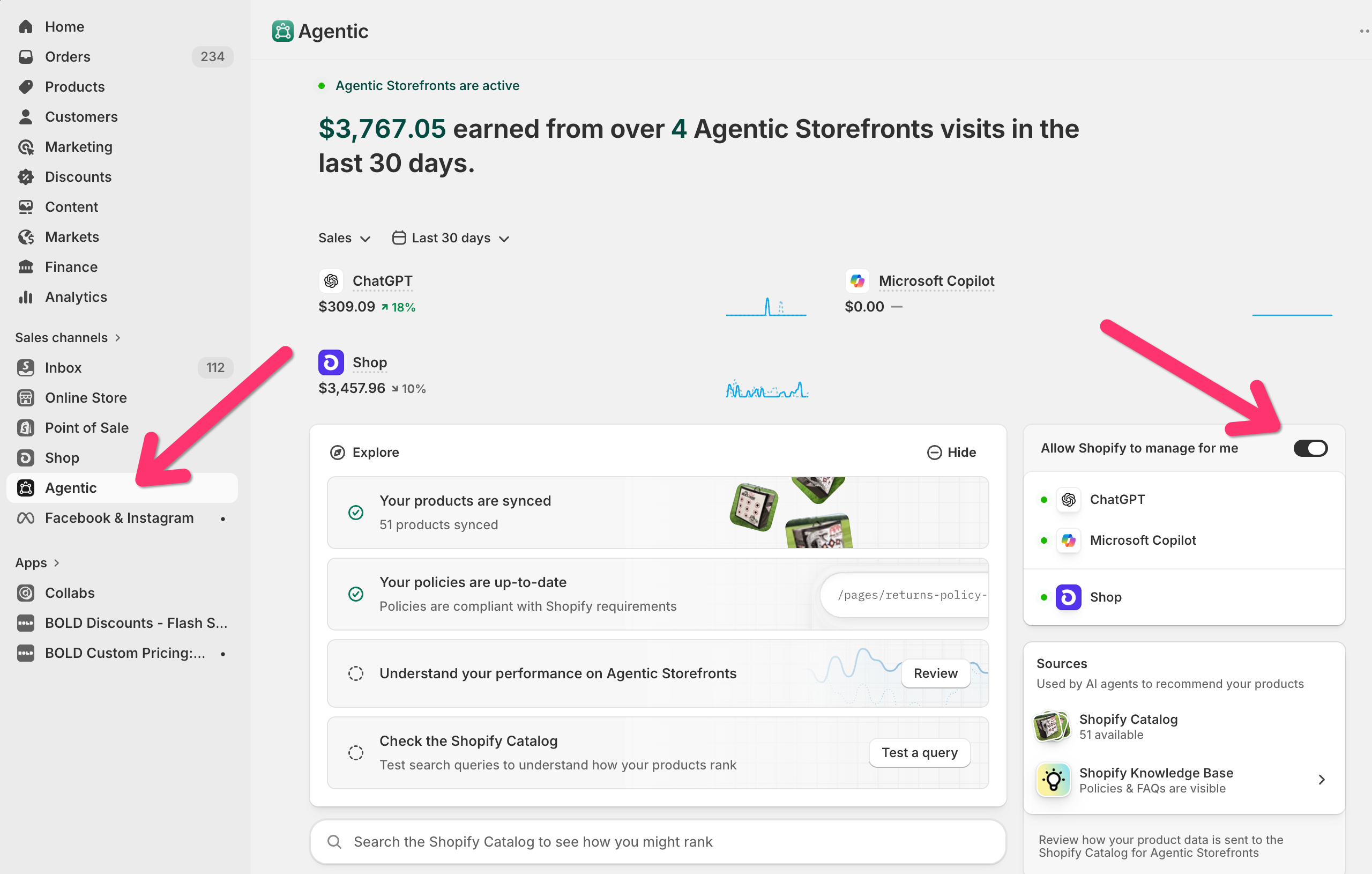
Step three: feed the machine. Start with your top 20% of products by revenue — don't boil the ocean. Fix six things: titles that say what the product is (not "The Summit"), complete factual descriptions, every structured attribute field filled in, accurate price and availability (break trust once and AI stops recommending you), reviews that explain why people love you, and real FAQs — at least 10 per key product, plus your category pages. And when you ask for reviews, stop accepting "OMG five stars." That does nothing for AI. Ask customers why they bought, what problem it solved. "I needed a backpack that didn't hurt my kid's shoulders and this was the only one that worked" — that's the review that gets you recommended when someone asks an AI that exact question.
Here's the reframe I want you to walk away with. We all like to think AI is smart — we ask it for parenting advice, relationship advice, which couch to buy. It's not judging whether your product is good. It's judging whether it can understand it well enough to recommend it confidently. Good product with unreadable data — you lose. Decent product with crystal-clear data — you win. And that gap is completely in your control.
The store AI recommends isn't the biggest one. It's the most readable one. The deck just got reshuffled — for once, a small brand can out-rank a giant without a decade of backlinks. So go be that store. Before your competitor does.
That's your 1% for today.

Co-Founder @ Bold Commerce // Host Shopify1Percent
Jay Myers has been in the ecommerce game for over 25 years. First as a merchant, then a service provider, and today a software provider. His company, Bold Commerce, has helped over 800,000 online stores sell more on Shopify. Their suite of apps help brands maximize LTV (Customer LifeTime Value), and AOV (Average Order Value).
Bold has been ranked one of Canada's Top Medium Sized Employers, ranked in the top 50 fastest growing companies in Canada by Deloitte multiple years, a Top Growing Company in Canada by the Globe and Mail, and winner of the Ernst and Young Entrepreneur of the Year award.

How to Find Creators and Affiliates for Your Shopify Store