How to Find Creators and Affiliates for Your Shopify Store
Somebody could be recommending products like yours every week and already have your order confirmation sitting in their inbox. You know them as a customer. Their audience knows them as the person they ask before buying. Nothing in your Shopify admin tells you those are the same person.
Wanting more creators is easy. Finding them is the part with no system, so it happens in the evenings, in Instagram and TikTok, with 47 tabs open. I spent episode 91 of Shopify1Percent building that system, and this is the written version.
What's the fastest way to find creators for a Shopify store?
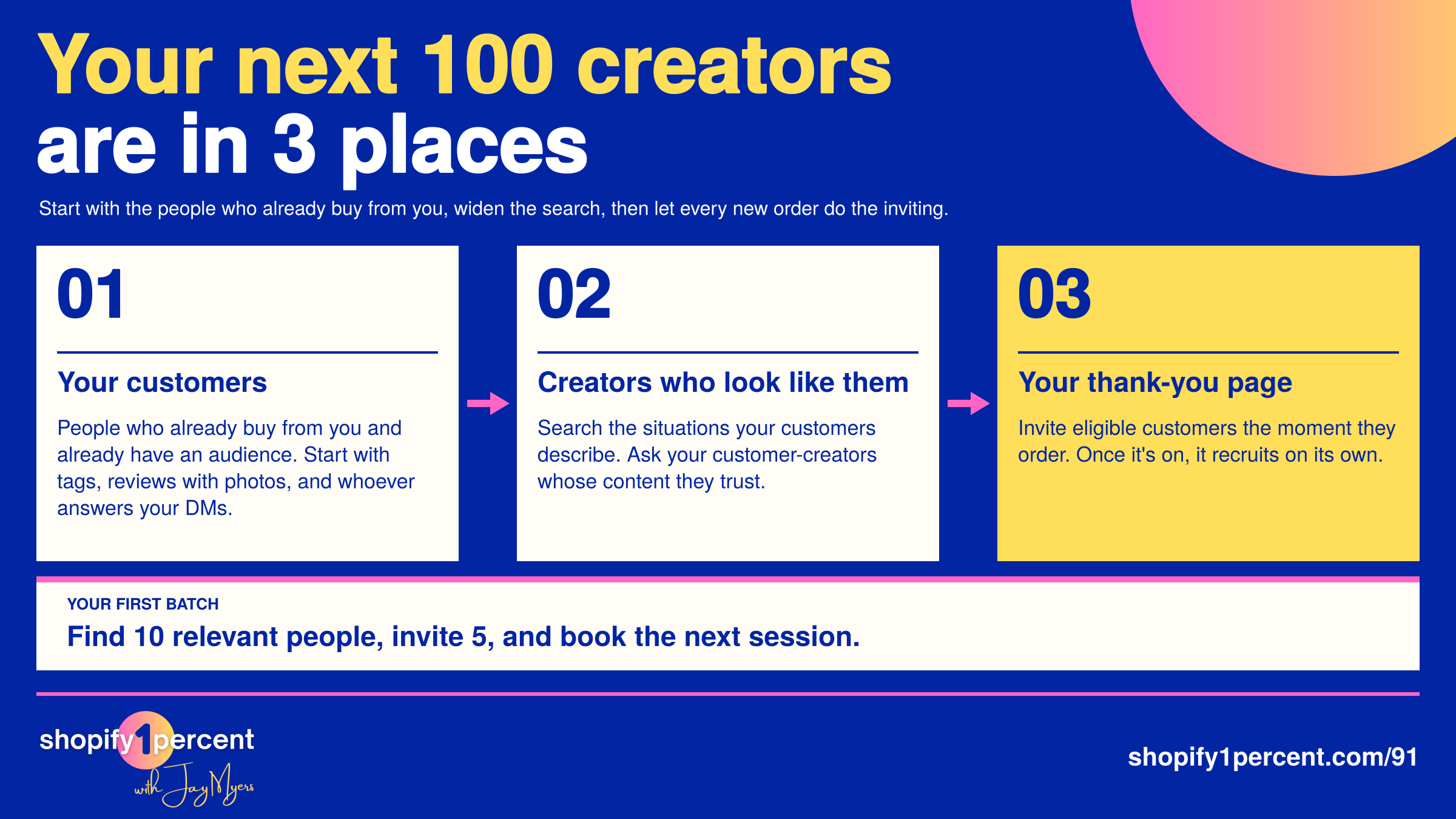
Look in 3 places, in this order: the customers who already buy from you, creators who look like your customers but haven't bought yet, and the new customers coming through your thank-you page every day. Run 4 checks on every person (audience fit, whether you can serve their followers, recent activity and an honest connection to the product), then send a short message that asks about their experience before it asks for anything. And send more invitations than you think you need. At the example rates I used on the show, getting 100 creators posting takes about 1,000 invitations.
Why does a Shopify brand need dozens of creators instead of one big influencer?
Say you sell backpacks. A bike commuter can show how they pack for work. A business traveller can show how fast they get the laptop out at airport security. A parent can show what fits for an afternoon at the hockey rink. Same bag, 3 different reasons to care, and 3 audiences your ads might never find.
You also learn which situations matter, which people explain the product well and which audiences respond. And no single person's good or bad month decides whether the whole program works. A big influencer can still be worth it. I just want a reliable way to keep finding relevant people alongside them.
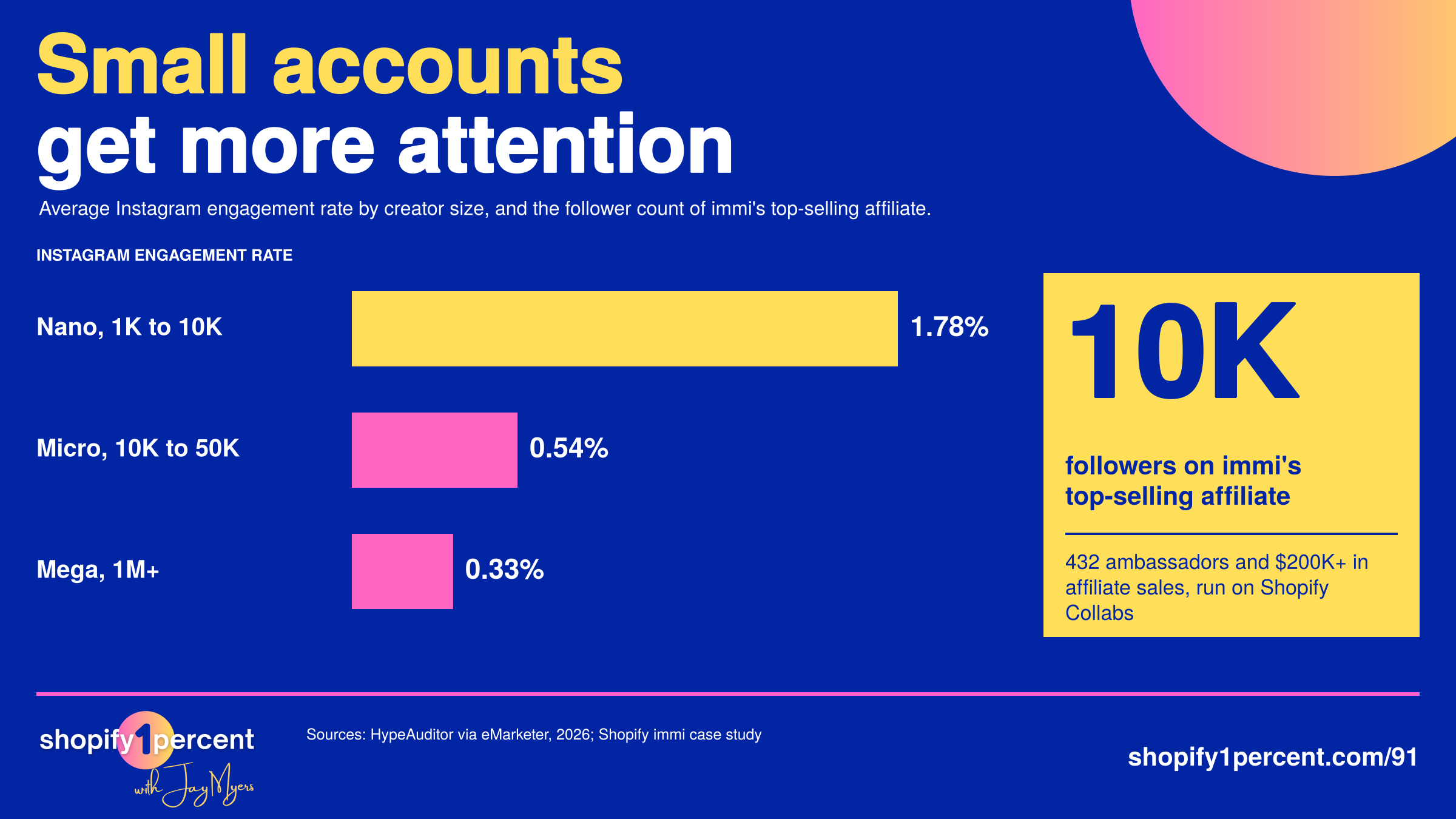
For a real example, look at immi, the ramen brand. According to Shopify's case study, they sent hundreds of ramen samples to creators, asked for feedback, and invited the people who liked it into a community they called the Ram Fam, with a commission on what they sold. It grew to 432 ambassadors and more than $200,000 in affiliate sales, run on Shopify Collabs. Their top-selling affiliate has about 10,000 Instagram followers.
Hundreds of people brought together by noodles, and the best seller is a small account. What interests me is the approach: find people with a real connection to the product, let them experience it, and build relationships from there.
The data points the same way. HypeAuditor's 2026 State of Influencer Marketing report, as reported by eMarketer, found nano creators on Instagram (1,000 to 10,000 followers) average a 1.78% engagement rate. Accounts with over 1 million followers average 0.33%. Small accounts are also most of the market, at 81.5% of Instagram creators.
Brands are shifting with it. In Influencer Marketing Hub's 2026 benchmark report, 87% of brands expect their influencer budgets to grow, and about half plan to add more nano and micro creators, versus about 1 in 5 for macro creators. Rising creator costs were the top challenge they reported.
If you want to see how the tiers fit together, Yash Chavan's breakdown of how Shopify brands are using the Influencer Pyramid is a good companion to this one.
Why is finding creators the hard part?
Going from 10 names to 100 means finding people, checking profiles, tracking down contact details and deciding whether there's a reason to work together. Some quick math with illustrative numbers: review 500 profiles at 10 minutes each and you've spent more than 83 hours before a single conversation starts.
That's why I'd treat it like recruiting for a team. You need places to look, a reason someone would join, and somebody responsible for the conversation. If the plan is to look for creators when things quiet down, I have bad news.
If you're running a Shopify store, things never quiet down. As my kids would say, you're cooked.
So it has to be a recurring job, with a time on the calendar and a name next to it.
Where do you find creators who already buy from you?
Start with the signals you already have. Customers who tag you. People showing the product in their actual life. Reviews where someone describes a specific use, especially with a photo. Then ask whoever handles your support inbox and your social accounts, because they'll remember people you'd never find by sorting a customer list by money spent.
Buying from you is a starting point. You still need to find out whether they liked the product and whether their audience fits. Someone might have bought the backpack as a gift. Someone else carries it to work every day and has a community of commuters asking about their setup. Those are two very different conversations.
The hard part is finding the customers you don't already recognize. Matching orders to social accounts by hand is slow, and common names send you to the wrong person. I use SATHI for this. Their Sherlock tool checks your Shopify order history against public social profiles and gives you a ranked list of the customers who have an audience, with a one-click invite. SATHI is by far the best tool I'm aware of that does this, and it's why I asked if they would partner with our show.
I still make my own call on who to approach. The biggest following doesn't automatically go to the front of the line.
What should you check before you invite a creator?
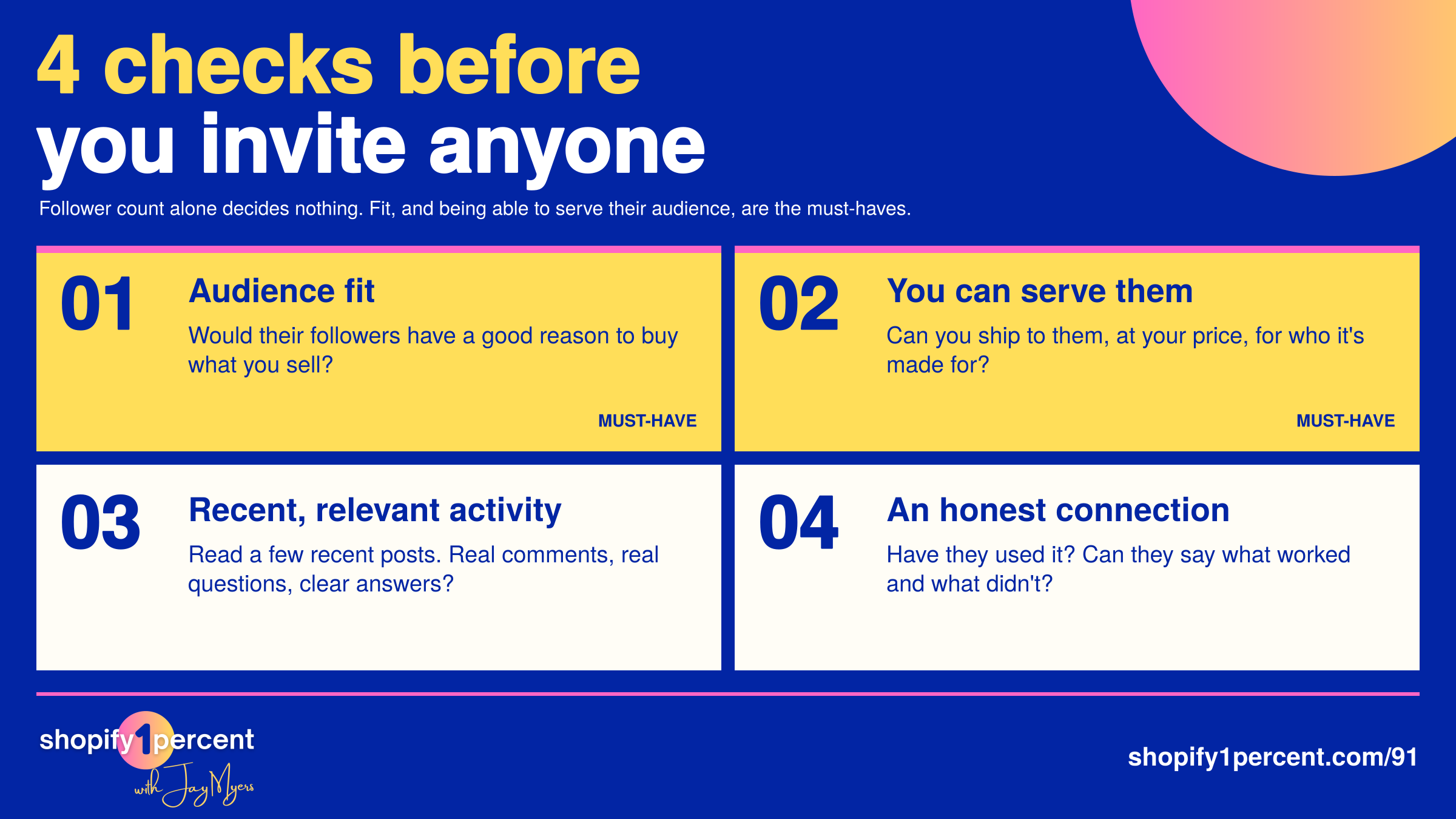
I run the same 4 checks on everyone, customer or not.
- Would the people following this creator have a good reason to buy what you sell?
- Can you serve them? Think about where they live, whether you ship there, your price and who the product is made for.
- Are they active, and on topic? Read the comments on a few recent posts. Look for real questions, useful answers and a creator who explains things clearly.
- Do they have an honest connection to the product? Have they used it, and can they tell you what worked and what didn't?
The first 2 are must-haves. I wouldn't waive either one just because somebody's videos look expensive. The fourth is what audiences respond to: in Sprout Social's 2024 survey of 2,000 consumers, 64% said they're most likely to engage with genuine, unbiased influencer reviews (Sprout Social).
And no, I can't give you a magic follower count. Even if someone has 100,000 followers, if it's the wrong audience or their last post was two years ago, the number does nothing for you.
What should your first message to a customer say?
Short enough that replying is easy. For the backpack brand, once you've confirmed they're a customer and you've actually watched their commuting video, something like this:
"Hey, thanks for giving our backpack a try. I saw your video about cycling to work with your laptop. How's the bag working for you? We have an affiliate program for people who are enjoying it. Would you like me to send you the details?"
That's the whole message. This is where most people make a big mistake. They open with "We have an affiliate program with a 90-day attribution window. We give 8% on the first 10 backpacks sold, then 20%, with cookieless tracking." They're assuming the person is a professional affiliate. Plenty of people don't know what an affiliate program is yet, and every brand runs one differently anyway. Get the reply first. The details come once they're interested.
Notice the message asks about their experience before it asks for anything. If the zipper broke, deal with the zipper. And skip the part where you tell them everything you know. Nobody wants a message that opens "I noticed you've spent $10,000 and placed 17 orders with us in the last year." It feels like you've been watching them.
Keep a note of why each person fits and what you've already said, so the next message is easy.
How do you find creators who haven't bought from you yet?
Before you open any app, finish this sentence: people use our product when... For the backpack, maybe it's when they're cycling to work, or travelling for 3 days with one bag. Pull those situations from reviews, the questions people ask before they buy, and your Shopify support data, in your customers' own words. Those phrases make a much better search than "lifestyle influencers," partly because the average Shopify customer doesn't exist. People buy in specific situations.
Pick 2 or 3 situations and search for people already making content about them. Watch the posts, read the questions underneath, and look at the collaborations and creators they mention. Your customer-creators can help too, so ask whose content they trust in the category. Set a target and a time limit, something like 10 people worth reviewing, or you'll end up watching dog videos and recruit nobody.
If you already use Shopify Collabs, its recruiting area is a decent place to start. You can search Shopify's creator database by keyword, filter by location and social platform, sort by audience size, and invite people with a welcome offer (Shopify Help Center). It's free to install, and a 2.9% processing fee may apply to automatic commission payments. Where it gets hard is doing it at volume, because those 83 hours of profile reading are still yours.
For this part I use SATHI's Match. It reads your website to understand the brand and recommends creators who fit. You can filter the recommendations and see each creator's content, audience demographics, engagement and contact email, then personalize your invitation template with AI, review it and send it from SATHI. Sherlock looks inside your customer base. Match goes beyond it.
I still run the 4 checks on every recommendation. And someone new to the brand needs to try the product before you ask them to recommend it.
Watch how each creator explains things. A clear demo of getting a laptop out on a crowded train is worth more to a buyer than a beautiful shot of a bag on a rock. The rock doesn't have any questions about the laptop pocket.
Look for gaps as you go, too. If everyone you've found makes airport packing videos, spend the next session finding commuters. Every new situation is another reason to buy.
Do more creators help your Shopify store show up in AI answers?
They can. Shoppers ask ChatGPT and Google questions like "what's a good backpack for biking to work with a laptop?" The more real content exists showing your product in those exact situations, the more those answers have to draw on. Video stands out: Surfer SEO looked at 36 million Google AI Overviews from March to August 2025 and found YouTube was the most cited domain, at about 23% of citations overall and about 32% in ecommerce (Surfer SEO). There's a whole post on becoming the store AI recommends if you want the rest of that side.
What should an invitation to a new creator say?
Give them a reason to answer: why you chose them, what you're offering and one small next step. For the backpack brand:
"Hey, I saw your carry-on packing video, especially the bit about how fast you got your laptop out at security. We make a backpack with a separate laptop compartment, and I'd be interested in your honest take on it. We offer a commission for affiliate partners who are a good fit. Would you like the details? Can I send you a backpack to try?"
You haven't sent an application form or a sign-up link. They only have to answer one easy question, and that gets replies. An overwhelming email doesn't.
Only mention the video if you actually watched it. I get messages every single day, especially on LinkedIn, saying they loved a post or an episode, and you can tell they never saw it because what they mention has nothing to do with what they're asking for.
Fake familiarity is a terrible opening for any relationship.
When someone says yes, reply while it's fresh. Send the commission details, payment terms, any expectations and one clear next step. Some creators want a fixed fee, some want commission, some want both. Factor in product, shipping and your team's time, because commission doesn't make the program free. And sending a gift doesn't create an agreement to post anything, so if you need a specific deliverable by a specific date, agree to it. If you're still setting up the program itself, start with how the best Shopify brands quietly build affiliate programs.
If they don't reply, send one brief follow-up about a week later, then leave it. Respect a no or an opt-out.
How do you turn new customers into affiliates automatically?
The third source never stops changing, because new customers keep coming through your store. Check your list today and you'll still miss everyone who orders next week.
SATHI's Inner Circle handles this one. It puts an invitation on your thank-you page right after someone orders. You decide who qualifies (every customer, or only repeat customers, people above an order value or lifetime value, or people who came in through another ambassador's link), and anyone who accepts gets their own link and discount code on the spot (setup guide). Put a clear application page on your site too, one a customer can understand on their phone.
Two distinctions matter here. Someone can say yes right after ordering, but they still need to try the product before they recommend it. And a customer who refers a couple of friends can be valuable without ever becoming a content creator, so measure those separately. If that's where your program is heading, read up on building a referral flywheel on Shopify.
When someone joins, check their link and code work, explain how they'll be paid and give them a real person to contact. Test the whole customer journey yourself before you ask anyone to send their audience through it: click the link, buy, make sure it tracks.
The invitation may run in the background. The relationship, though, still needs someone paying attention to it.
Once you have a few good partners, ask who else they'd recommend, and be specific. "Who makes useful bike-commuting content?" is much easier to answer than "know any influencers?"
How many invitations does it take to get 100 creators posting?
First, decide what you're counting. Someone on a shortlist hasn't been invited. Someone who accepts hasn't necessarily posted. Someone who posted once last year might not be participating now. I count new creators who make a first promotional post after joining.
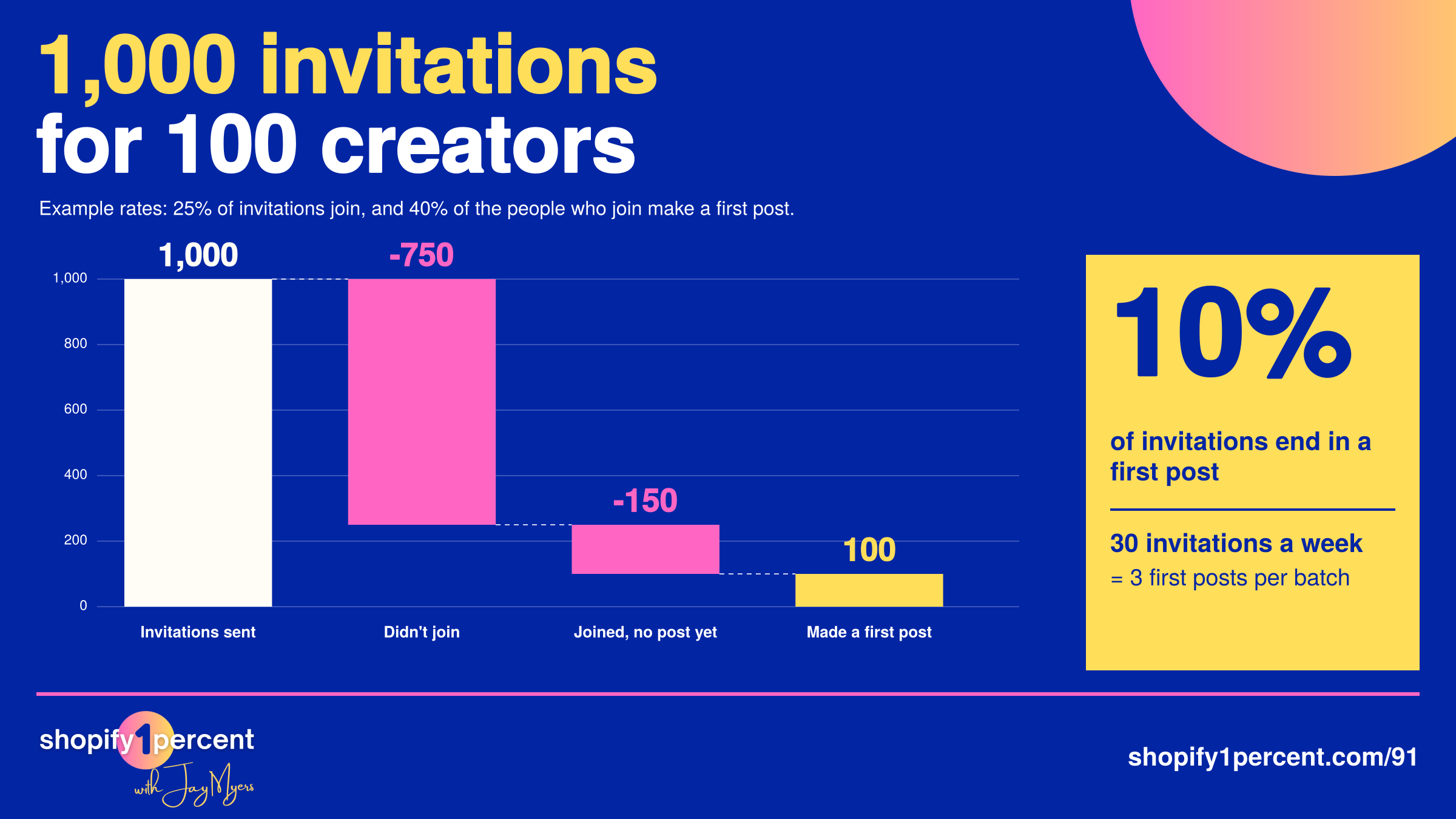
Now the math, with example rates I made up to show how it works. Send 100 invitations. Say 25 people join, and 40% of those make a first post. That's 10 people, or 10% of what you sent. So 100 first-time posters takes about 1,000 invitations. At 30 invitations a week, that's about 3 new posters per batch, once people have had time to reply, get the product and actually use it.
That's why sending 12 messages and waiting leaves people disappointed.
When a batch underperforms, the numbers tell you where the break is. If nobody replies, look at who you're choosing, the message and the offer. If people join but never post, look at what happens after they say yes. Fix that before you send the next, bigger batch. Measure each source on its own, too, because customer invitations, outreach to new creators and the thank-you page all start from different places. Give each group time to respond before you judge it.
Give it one owner and a recurring spot on the calendar. Monday could be customer discovery and invitations, Wednesday new creators, Friday replies, follow-ups and helping new partners get started. If your target is 30 a week, that might be 15 customers and 15 new creators. Keep one shared record of every person, where you found them, why they fit and the next step, so two people on your team never send the same creator two different offers.
For peak season, work back from when you need creators ready. Replies, shipping, trying the product and making the content all take time, and no tool can make a backpack arrive yesterday.
Your 1% win: run your first recruiting batch
Write down one situation your product helps with. Find 10 relevant people, starting with your customers and using an external search to fill the gaps. Run the 4 checks. Send 5 personal invitations with a clear offer and an easy next step. Then book your next session before you close the list.
A batch of 10 prospects and 5 invitations is a starting target, so go smaller if that's what you can support properly.
I made 2 free downloads for this one: the Creator Discovery Worksheet, with the messages above ready to adapt, and the Recruitment Calculator, which works backwards from your goal and tracks every batch. Both are on the episode page. If you want to try SATHI, you can request a free trial at mysathi.io, and code JAY (or mentioning JAY when you sign up) gets you 20% off.
And tonight, before you spend the evening scrolling for somebody new, go check who already bought from you.
The full episode has every message and the walkthrough of each source. Listen to episode 91 of Shopify1Percent, and search Shopify1Percent wherever you listen to podcasts so you don't miss the next one.

Co-Founder @ Bold Commerce // Host Shopify1Percent
Jay Myers has been in the ecommerce game for over 25 years. First as a merchant, then a service provider, and today a software provider. His company, Bold Commerce, has helped over 800,000 online stores sell more on Shopify. Their suite of apps help brands maximize LTV (Customer LifeTime Value), and AOV (Average Order Value).
Bold has been ranked one of Canada's Top Medium Sized Employers, ranked in the top 50 fastest growing companies in Canada by Deloitte multiple years, a Top Growing Company in Canada by the Globe and Mail, and winner of the Ernst and Young Entrepreneur of the Year award.
Play Stupid Games, Win Stupid Prizes: Which Shopify Metrics Actually Matter?