You're Selling to Ghosts: Why the Average Shopify Customer Doesn't Exist
You're Selling to Ghosts: Why the Average Shopify Customer Doesn't Exist
Brice McBeth spent over $100,000 building an ecommerce store, and it flopped. Then he did something I'm not sure I'd have the stomach for. He threw it out for a $300 template, and he says conversions jumped over 350% overnight.
He lost designers over it. They walked.
The short version of what I learned: the "average customer" on most Shopify stores is a blend of two or three very different buyers, so anything you build for the average misses all of them. Brice, founder of Reap Commerce and co-founder of Neurograph, fixes that with two moves. Call the people who didn't buy and give them permission to tell you bad news. Then pull your order data apart until the real segments show up.
Why did a $300 template beat a $100,000 Shopify store?
Brice sells salon furniture. Standish Salon Goods. (There are more salons in the US than gas stations, which he dropped mid-answer like it was nothing.) The expensive site was an IKEA-style walkthrough: 3D-rendered salon rooms, and you picked your chair out of the scene. Gorgeous.
So he started calling the people who had built a cart and left. The first one told him his products were too expensive. Brice knew that wasn't true (he'd been the first in the category to offer free shipping), so he hung up on "that idiot," his words, and called the next one. Too expensive. Next one. Too expensive. Ten or eleven calls in, he finally asked someone to elaborate, and heard the guy typing. "Oh, I don't know. It just looked expensive."
That's the whole episode in one sentence. Brice says the average stylist makes somewhere around $25,000 to $28,000 a year. They looked at a site that felt like a luxury showroom and assumed they couldn't afford it. Nobody scrolled down to check.
My kids gave me the same lesson at a grocery store. There's a No Frills near us, all yellow, nothing on the walls, and my son asked "what's frills, Dad?" I told him the store is trying to look cheap on purpose. I have no idea if their milk actually costs less. I've never checked, because who price compares at the bargain store? That's exactly what Brice's customers did, in reverse.
Looking inexpensive is not the same as a bad experience. Your store can be fast, clear, and easy to buy from, and still not feel like it's charging a premium.
How do I find out why customers aren't buying from my Shopify store?
Brice calls it the three random guys test, and it's free.
Pull a list of people who built a cart and never checked out, ideally a month or more ago so they've moved on. Call them. The wording is the entire trick. His script, close to verbatim:
"I realize you've probably moved on at this point. I'm not here to sell you. I'm just curious how you went about deciding where to buy, and how I wasn't in the mix."
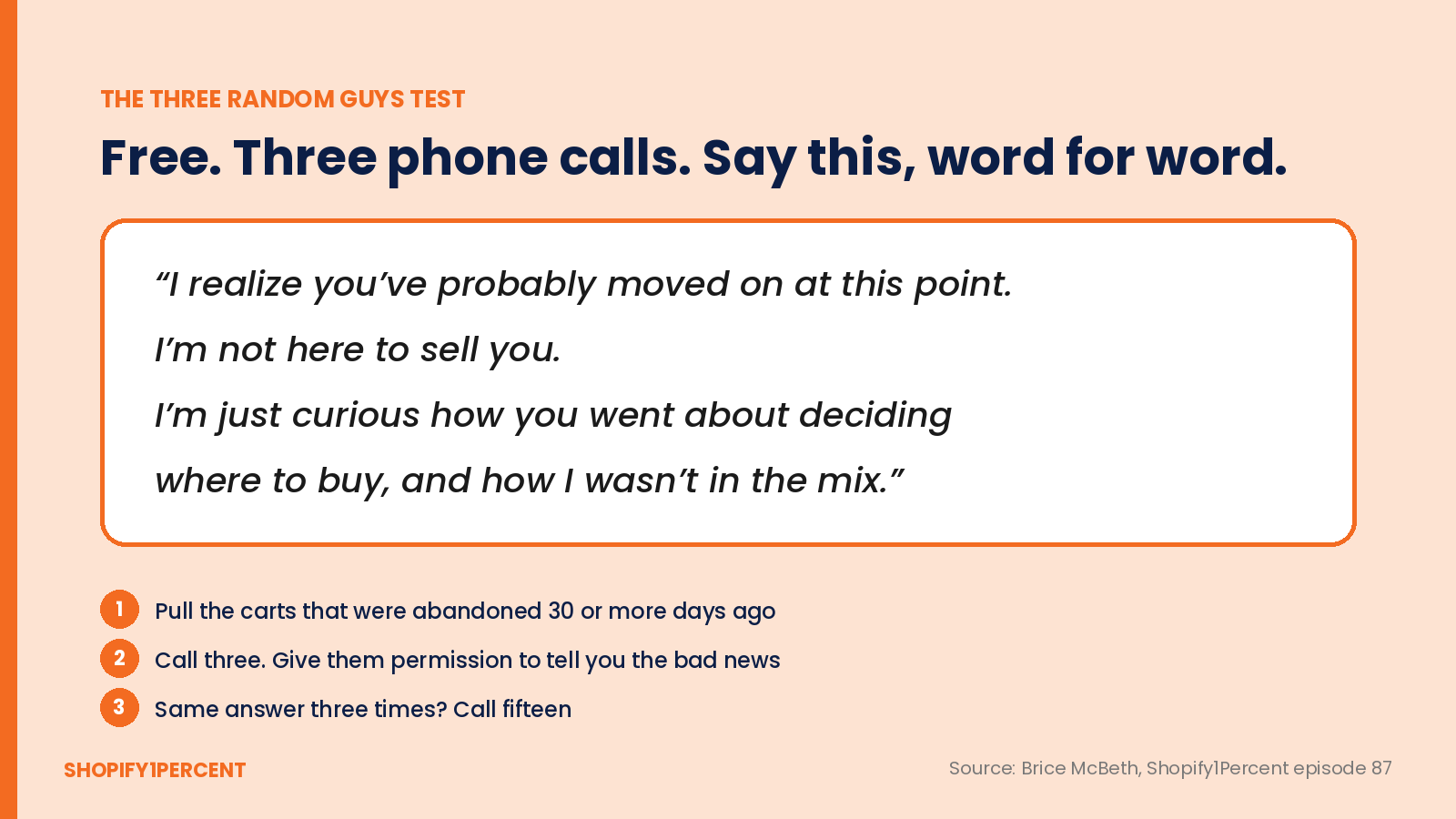
You're giving them permission to deliver bad news without confronting you. Ask "do you like my site?" and nobody tells the truth. Ask how they decided, and they'll say "you were too expensive" before they've thought about it.
If three people say the same thing, call fifteen. When I asked him in the lightning round for the fastest free way to learn something true about your customers, he didn't hesitate: pick up the phone.
Cart abandonment sits at 70.22%, according to Baymard Institute's meta-analysis of 50 studies, updated September 2025. That is a lot of people who already told you what they wanted and then didn't buy it. They're the cheapest research you'll ever run.
Why is my average order value lying to me?
A couple of years into Standish, Brice had his team run the numbers. They came back with an average order value of $900.
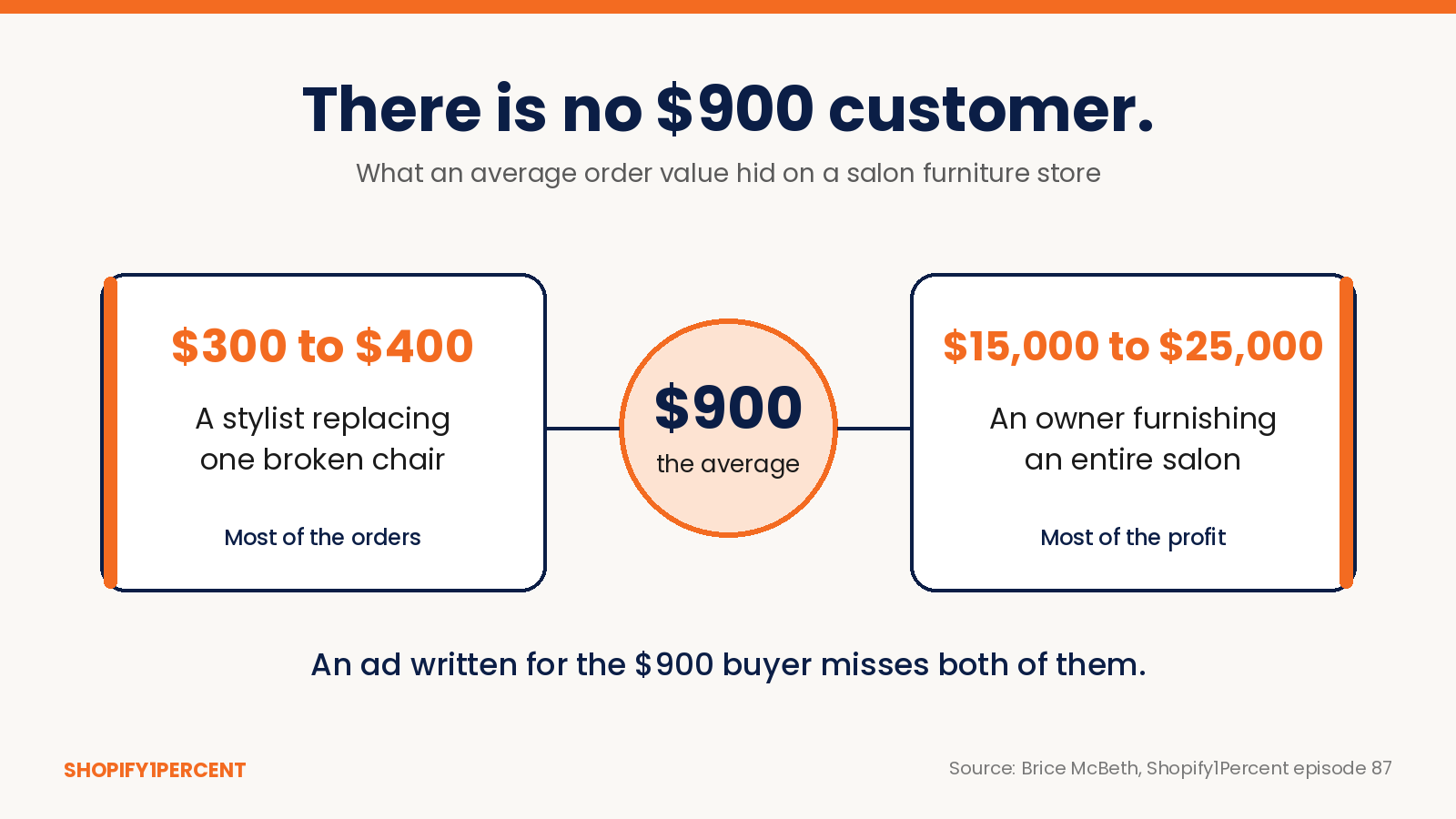
He knew that was wrong because he watched every order come in. So he downloaded the data and ran pivot tables himself. The $900 was two customers. A stylist replacing one broken chair at $300 to $400, and a salon owner furnishing an entire location, chairs, mats, mirrors, shampoo bowls, the works, at $15,000 to $25,000.
Write ad creative for a $900 buyer and you miss both.
His line for this: "Data doesn't lie, but it sure will gaslight the crap out of you." Averages are the worst offender. A 2.5% conversion rate could be 2,000 people converting at 8% and 8,000 converting at zero. The average hides the 8,000. Littledata's Shopify benchmark, cited in Blend Commerce's 2026 conversion rate report, puts the average store at 1.4%, which is exactly the kind of number Brice would tell you to stop staring at.
Adam Pearce walked me through where your Shopify store is leaking money from the CRO side. Brice's point is that you can't plug a leak you've averaged away.
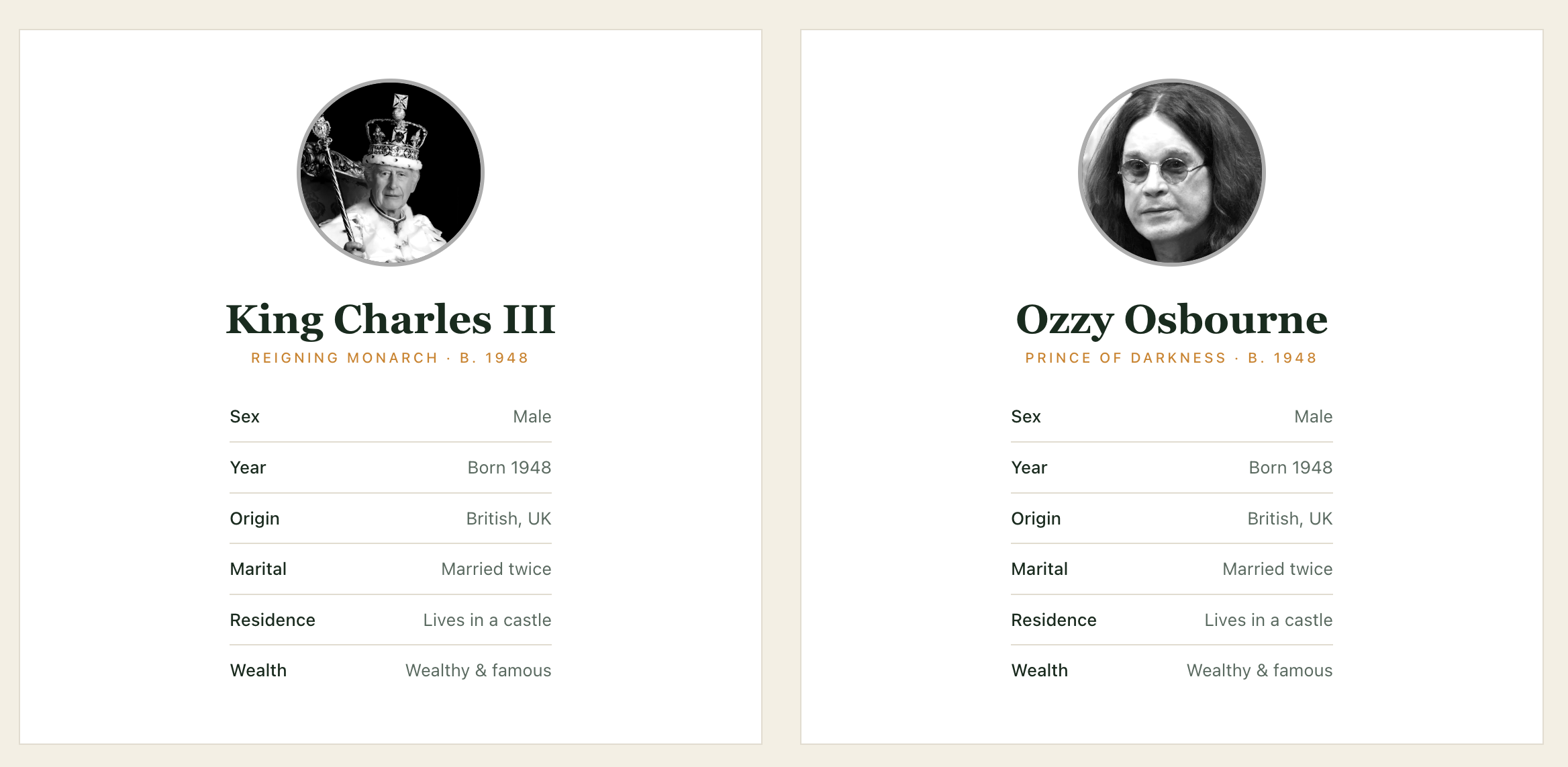
The example he uses on reapcommerce.com is perfect. King Charles and Ozzy Osbourne. Same age, same country, same gender, same income bracket. Identical demographic persona. Two completely different human beings. If your ICP doc says "40 to 50-year-old mom, this income, this postal code," you've got King Charles and Ozzy in the same bucket.
Should Shopify brands stop offering discounts?
Brice says he doesn't get calls for pretty websites. He gets calls from brands that are stuck, and when he looks, discounts are everywhere.
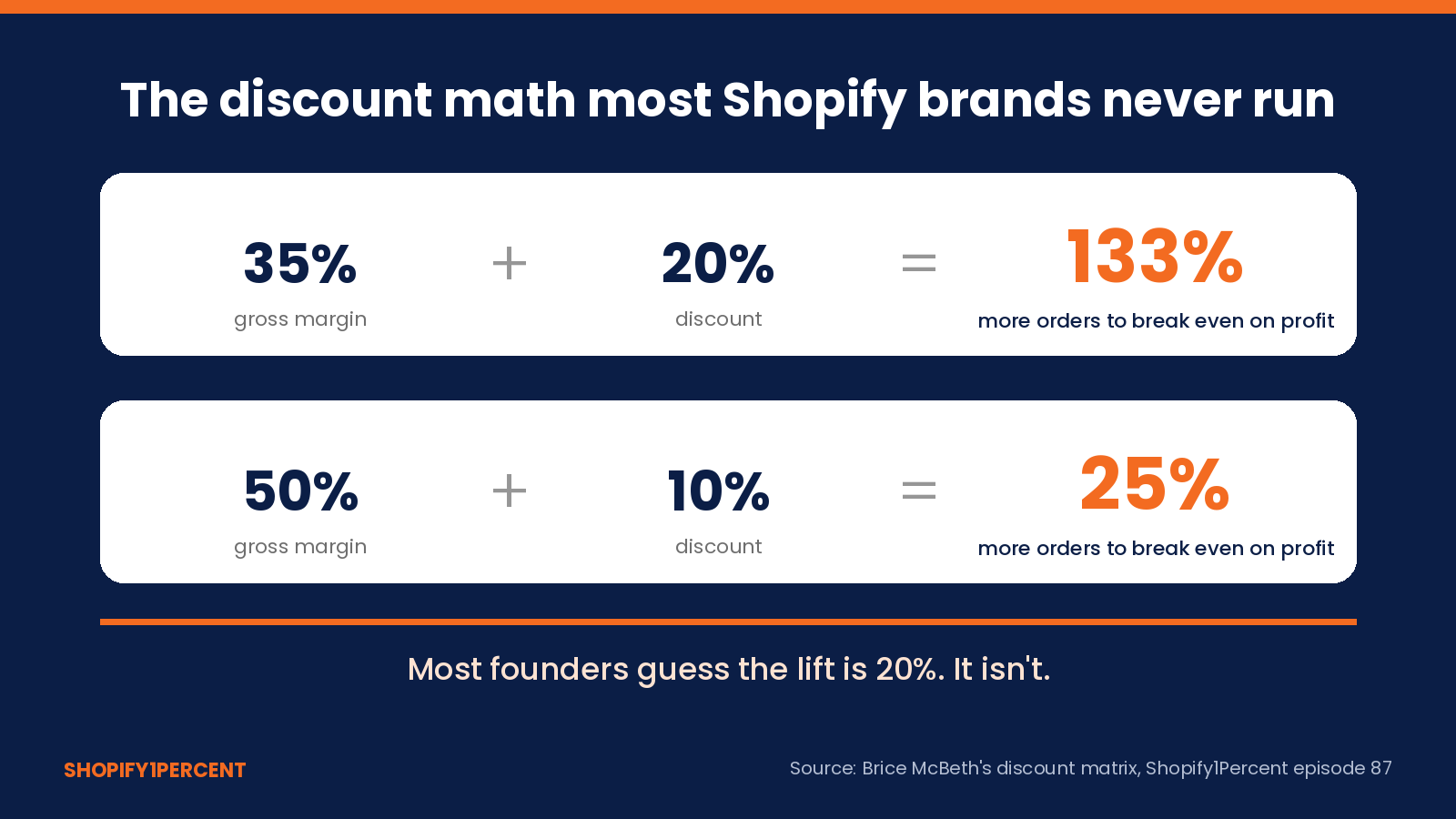
His matrix: 35% gross margin, 20% discount. How much do you have to lift orders to get the lost profit back? Most people guess 20%. Brice says it's 133%. I did the math live on the call and it's uglier than it sounds, because a 20% discount on a 35% margin product is a 57% cut to your margin. Even at 50% margin, he says a 10% discount needs a 25% lift just to break even.
And 20% is the number everyone picks. Seguno's 2025 analysis of Shopify discount codes found 20% off is the most popular percentage merchants choose, used about 17% more often than 10% off. Same lesson as my ad budget math on retention versus acquisition: same top line, opposite sign.
I pushed on abandoned cart flows here because it's my pet peeve. Someone gets all the way to checkout. They've seen the price. Then they leave, and we send 10% off, as if price was the reason. It almost never is. It's returns, warranty, shipping, a question nobody answered. Steve Lequerica's entire business is proof that the cart was never about price.
Brice isn't anti-discount. Decide the goal first: new-to-brand customers, top-line revenue, or profit. If someone is accountable for profit at the end of the year, discounting isn't your answer. And training customers to wait for a sale is, in his words, absolutely true and very hard to undo.
What does Neurograph actually do for a Shopify store?
Brice's first job out of college was at IBM, on the team he says invented the single-pixel tracking GIF. They also coined page views, visits, and unique visitors.
Even back in 1997, he wanted reports that said what to do tomorrow instead of charting yesterday. Neurograph is that idea 30 years later. He calls it an operating system for persona-based marketing. It ingests your Shopify data, including the people who visited and didn't buy, and finds the segments. Then it pushes those signals into Meta and Klaviyo, and you build a landing page per persona instead of one page for the blend.
<!-- IMAGE 3: Neurograph product or brand visual. The neurograph.io social banner is at https://storage.googleapis.com/avant-garde-cdn/neurograph/assets/social-banner.png (pulled from the site's meta tags; download and re-host, do not hotlink). If Brice can send a persona-view screenshot instead, use that. Alt text: "Neurograph persona intelligence platform for Shopify brands, co-founded by Brice McBeth" -->
One high-value cohort was buying products with a party-prep angle. Not the specs. The ease of hosting. Neurograph compared every product page that cohort bought against every one they looked at and didn't, and found a three-word phrase driving the decision. No button-colour A/B test finds that. (Phillip Jackson would say we've A/B tested ourselves into invisibility anyway.)
I'm not sure how much of this a smaller store needs a tool for yet. Brice was upfront that Neurograph is early, and that Reap Commerce is pivoting to help brands act on what it finds. But the phone call costs nothing, and the pivot table costs an afternoon.
The 1% takeaway
Stop using averages. That's Brice's answer to "most Shopify brands would grow faster if they stopped ___," and it's the whole episode.
This week: call three people who abandoned a cart 30-plus days ago, using his script. Then export your orders and find the two customers hiding inside your average order value. Build your next ad for one of them, not the blend.
Brice is offering Shopify1Percent listeners a complimentary persona diagnostic. Go to reapcommerce.com and book a consultation. He says nine and a half times out of ten he finds a market opportunity the brand had no idea existed.
🎧 Search #Shopify1Percent anywhere you listen to podcasts to get the full episode. And hit subscribe, because we're starting a monthly listener Q&A and I want your questions.

Co-Founder @ Bold Commerce // Host Shopify1Percent
Jay Myers has been in the ecommerce game for over 25 years. First as a merchant, then a service provider, and today a software provider. His company, Bold Commerce, has helped over 800,000 online stores sell more on Shopify. Their suite of apps help brands maximize LTV (Customer LifeTime Value), and AOV (Average Order Value).
Bold has been ranked one of Canada's Top Medium Sized Employers, ranked in the top 50 fastest growing companies in Canada by Deloitte multiple years, a Top Growing Company in Canada by the Globe and Mail, and winner of the Ernst and Young Entrepreneur of the Year award.
How to Segment Your Shopify Email List for Black Friday