The $3 Box Insert That Kept Bringing Shopify Customers Back
The $3 Box Insert That Brings Shopify Customers Back
Most Shopify stores lose money on a customer's first order. Not "make a little less." Lose.
In 2013 the average online merchant was $9 in the hole on every new customer once you counted ad spend and returns. By 2022 it was $29, a 222% jump, according to SimplicityDX (2022). I opened my Repeat Commerce series with that number, and plenty of stores run worse.
So when Wes Buckwalter, founder and CEO of SeaMonster Studios, told me he'd rather put $3 of samples in a customer's box than spend $29 finding the next stranger, I wasn't going to argue. His Seattle agency is a Shopify Premier Partner going on 20 years, and he ran marketing for a coffee company before that. He's been the merchant.
The short version: Getting a customer costs more than the first order makes back, so the profit lives in the second, third and 25th order. The cheapest way Wes knows to earn those is a real thank-you (a card from the owner, a $3 sample in the box) with no offer attached, measured against a number you set before it ships. And if your store isn't accessible, roughly one in four shoppers can't buy from you at all.
We talked about it in this weeks episode:
Why does my Shopify store lose money on the first order?
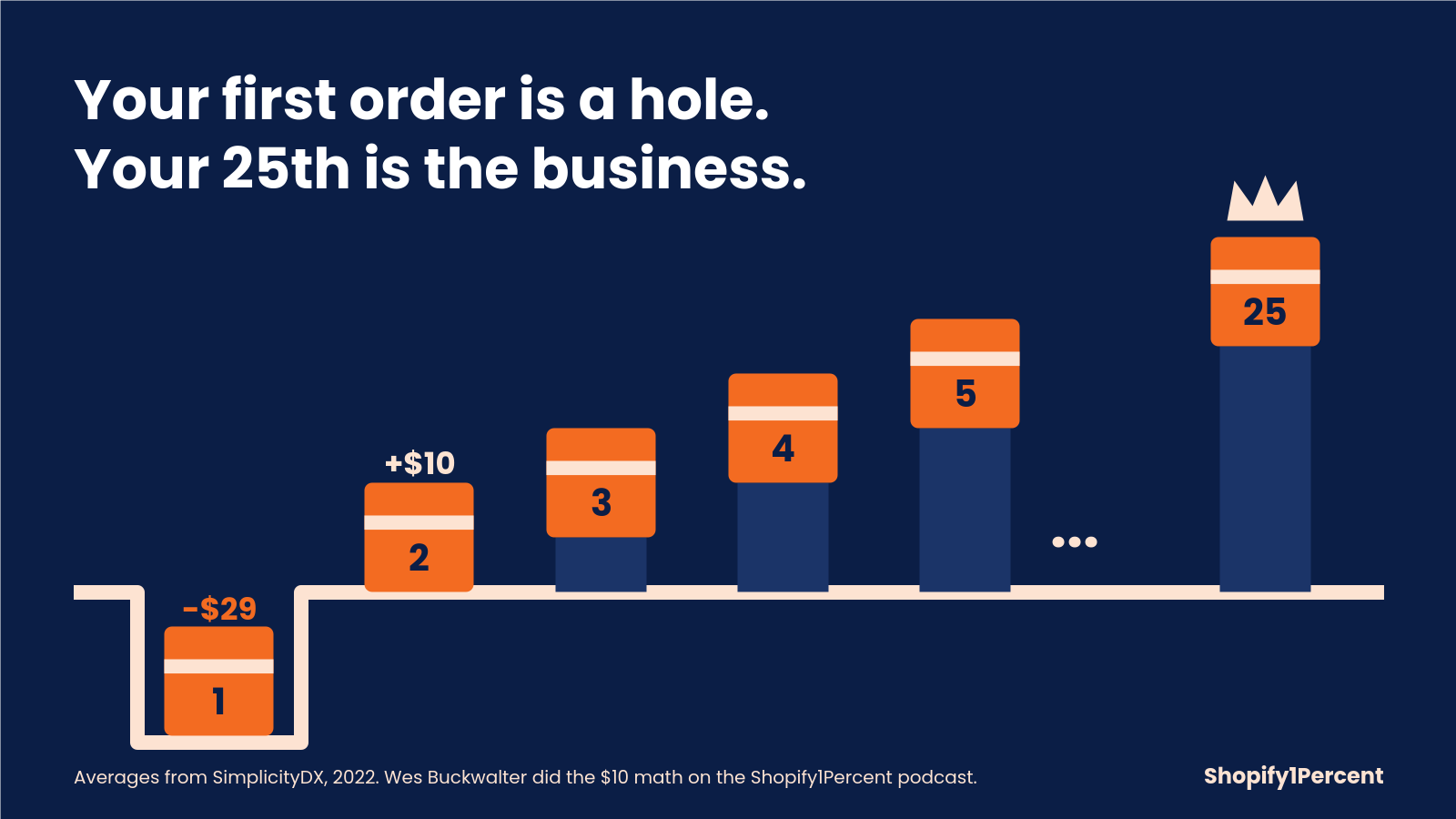
Wes did the math on air faster than I did. If acquiring a customer costs $29 and SimplicityDX puts the average repeat order at $39, the second order only puts you $10 ahead. "Really it's that second, third, fourth, fifth, 25th purchase that really matters," he said.
Then he took a swing at the whole loyalty category, which I enjoyed, given how many points programs I've watched die. In the Shopify world it's just called loyalty, Wes said, "but it's not about loyalty, it's about affinity." Do people actually like you? He's trying to earn their trust, and the repeat business follows.
His test is old-fashioned. In a physical store you'd shake the customer's hand on the way out. Most ecommerce brands never figured out the digital version, so they default to a discount code.
What should I put in the box to get a second order?
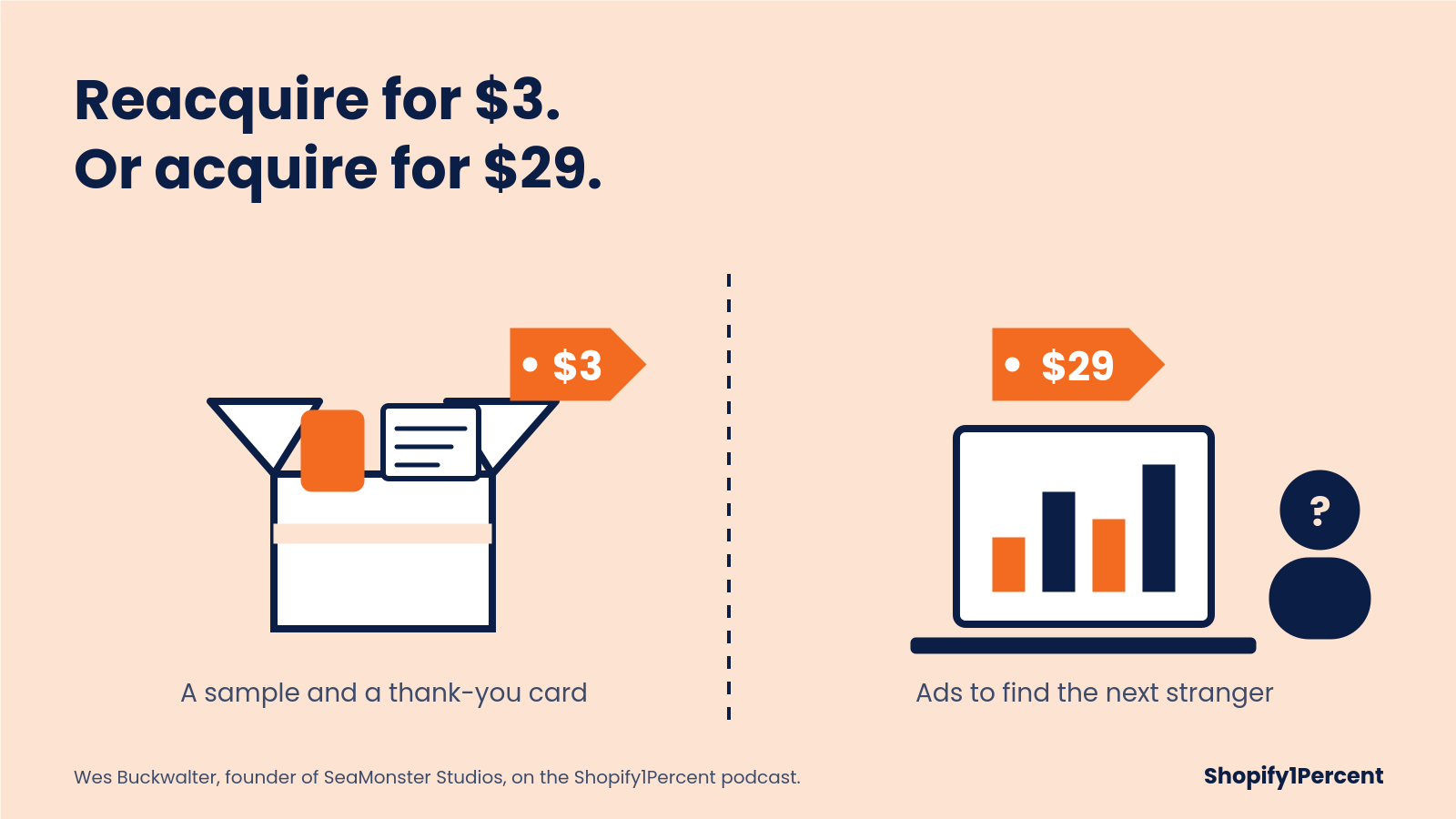
The $3 is a sample. Put roughly three bucks of product somebody might like into the box. Your pick-and-pack labour on that is maybe ten cents. If your acquisition cost is $29, you just spent $3 on a reacquisition instead. Wes says the merchants he's pitched this to didn't disagree. It just wasn't on their radar.
He's been on the receiving end, too. He bought vitamins once, the brand tossed in a couple of samples picked for a guy in his age range, and he came back and bought five new vitamins. "It totally got me," he said.
The other insert is a card. One brand Wes works with puts a handwritten thank-you from the owner in every box. It reads something like: I'm the owner, every purchase matters to my company, and even though we seem like a big company, I actually wrote this card. Wes figures that owner fills out something like 5,000 of those a week.
Five thousand cards. A week. By hand. I've had CEOs tell me they can't find time to record a 30-second welcome video.
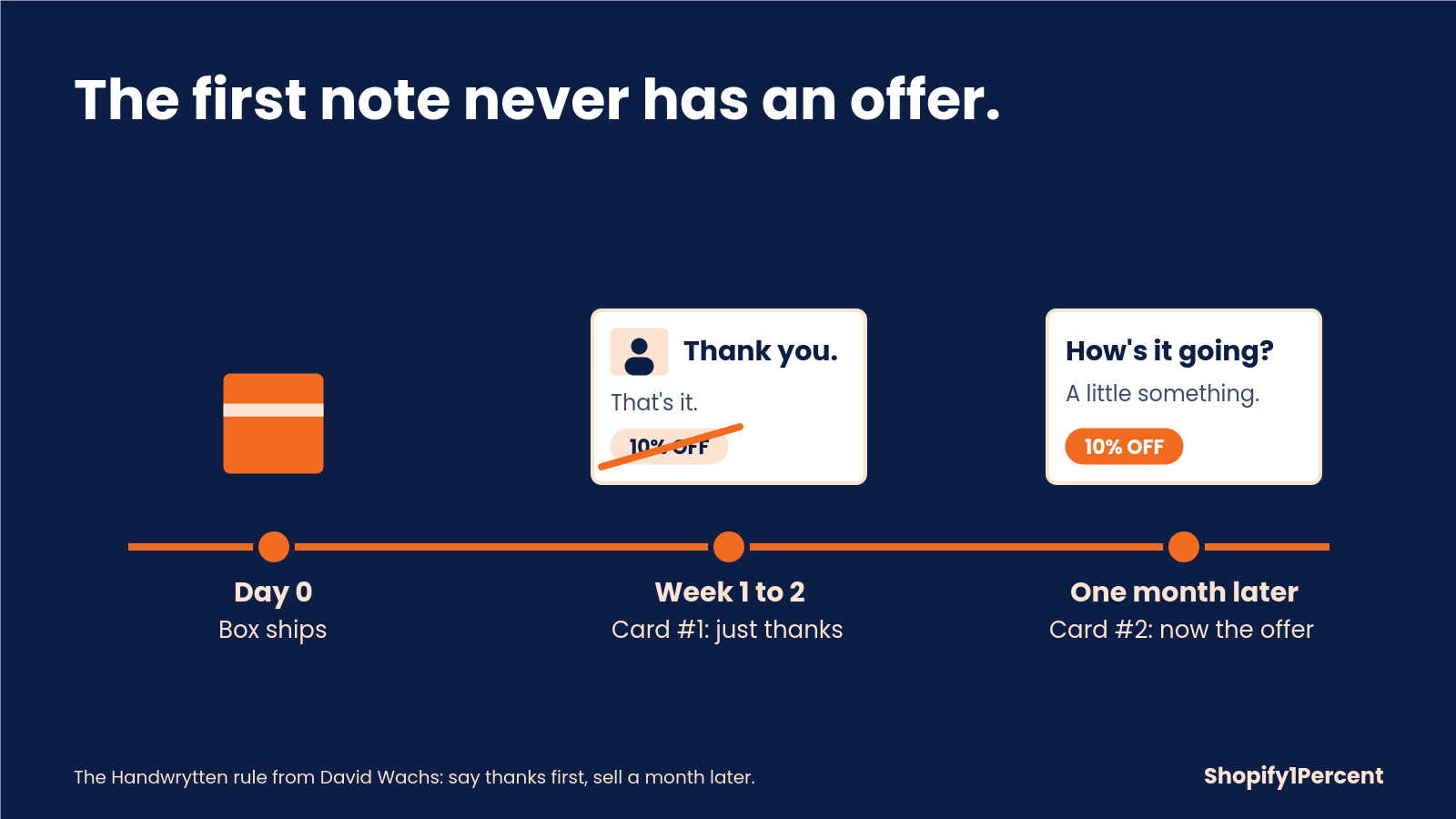
I added a rule of my own, borrowed from David Wachs, the founder of Handwrytten. His robots write notes with real pens, and we spent a whole episode on handwritten notes for Shopify stores. The first note you send should never have an offer in it. Just a thank-you, maybe a photo of the team. Send a second one a month later to check in, and put the offer there.
Wes admitted he was a hard sell on direct mail. It felt "very 1990s" to him. Then he noticed a postcard sits on his counter for a few days and gets read, which is more than he can say for most of his inbox.
How do you know a thank-you card is working?
I pushed back on this one, mostly on myself. My first thought was that you can't track a postcard.
Then I answered my own objection. You know the address, and whoever reorders is shipping to it. Take 1,000 customers, send them a handwritten note within a couple of weeks of their first order, skip it for another 1,000, and compare the lifetime value of the two groups.
I'd bet any money the note group wins. I also have to admit I don't know anyone who has run that test. I know it from watching brands do it, and that isn't the same thing.
Wes's version was sharper. Everyone agrees the card is cool. "How do we know it's cool?" You need a number before it ships. If a second purchase is 100% success and you get halfway, is that worth continuing? Most businesses, he says, plan the cool thing first and go looking for the goal after.
Why won't my customers refer my Shopify store?
Because you never taught them how.
I've said this on the show before: there's no such thing as true value, only perceived value. Hand me a $10,000 guitar and a $300 guitar and I'll shrug, because I don't play. Show me two canoe paddles and I'll talk your ear off.
Most Shopify brands think the education ends on the product page. The second someone buys, they should be getting the welcome video and the note about where it's made. Now they can explain you to a friend. Peer-to-peer referrals are still the channel that converts best, and I can't refer a coffee if all I know is that I liked the flavour.
Wes's example was better than mine. Nobody tells their friends they bought a $50 block of cheese. They tell their friends it was the tastiest cheese they ever had, and then they found out it was organic. "Nobody cares" about the price, he said. They care about the experience. His warning to premium brands: you're a highly educated cheese maker, so the value is obvious to you. If you don't get that knowledge to the customer in a form they can consume (Wes figures the average US reading level is around sixth to ninth grade), "premium" just reads as "expensive."
Is my Shopify store turning away one in four shoppers?
Probably, and you'd never know, because they don't complain. They leave.
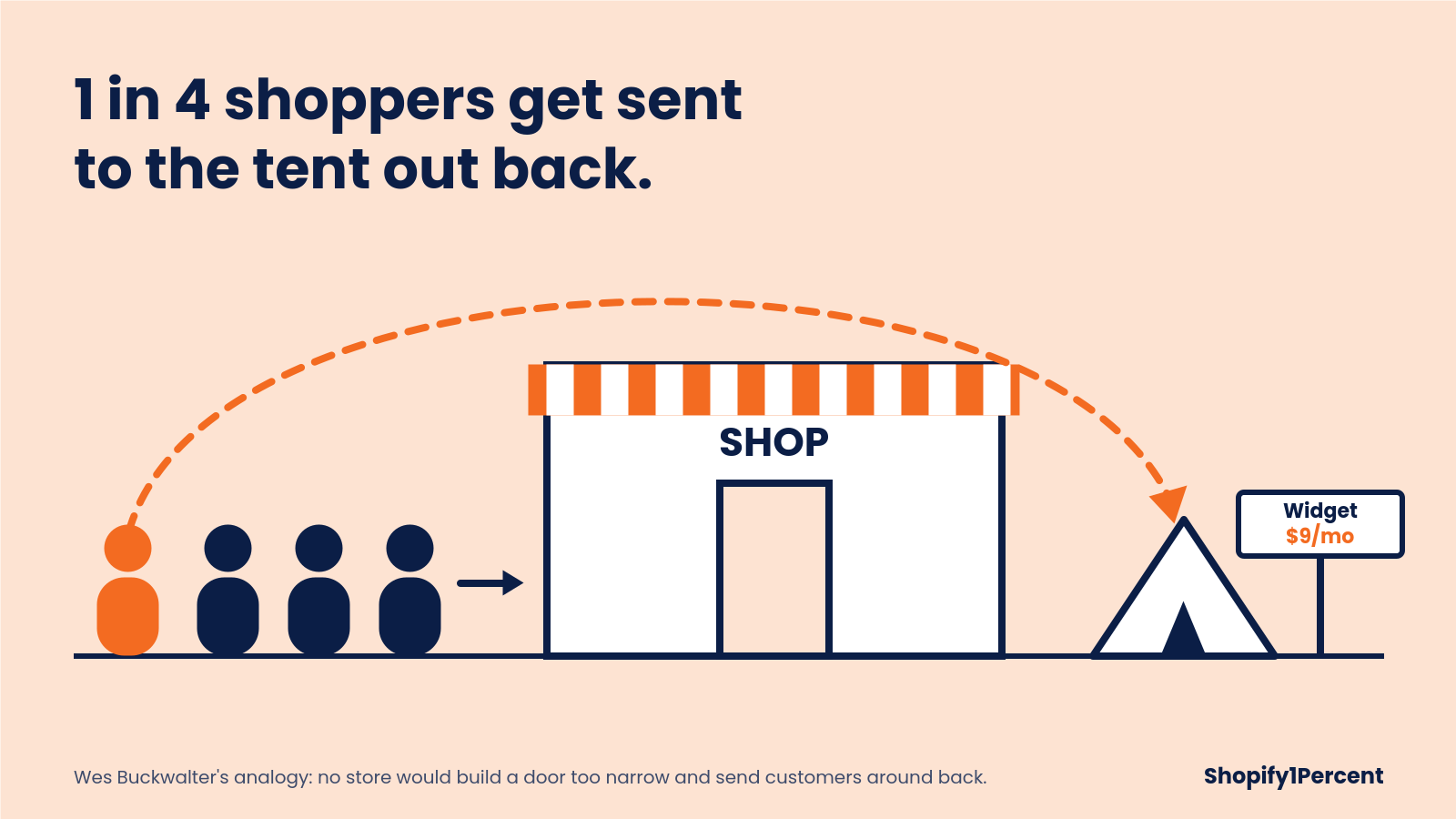
More than 1 in 4 US adults, over 70 million people, reported having a disability in 2022, per the CDC (2024). Wes puts it in revenue terms: an inaccessible site leaves 25% of its possible audience on the table, and they don't come back when you fix it later.
His analogy stuck with me. No store owner would build a door too narrow for a wheelchair and then tell those customers there's a tent out back with a guy who'll help them. Online, a site you can't get through without a mouse is that tent.
Then there are the floating accessibility widgets in the Shopify App Store, the little icon that enlarges fonts and fixes contrast for $9 a month. Wes calls them "essentially placebo." They help someone like him with a slight vision impairment. For a blind shopper on a screen reader, the widget often gets in the way of the tool they already use. Wes has an employee whose actual job title is Captain Accessible, and digging into these widgets is his job.
Worse, in the lawsuits Wes's clients have received, the widget was the target. My first reaction on air was that if I were an ambulance chaser, I'd just pull a list of every Shopify store running one. They think they're covered. They're a sitting duck. UsableNet tracked more than 5,000 digital accessibility lawsuits in 2025 (2026), and 1,416 of the companies sued were using an accessibility widget, up from 1,023 the year before.
What Wes does instead: start at overlayfactsheet.com, which lists the overlay companies that have themselves been sued. If you want software, use something that fixes the code. He pointed me to TestParty, which scans your theme and proposes fixes. Wes figures it gets a store 50 to 75% of the way there, and then a human has to test it. I hadn't heard of it. I'm going to go play with it.
The 1% takeaway
Before you buy another click, say thank you to the customers you already paid for. Put something in the next 100 boxes that costs about $3 and asks for nothing: a sample, or a card from the owner with no offer on it. Write down the number you'll judge it by before the boxes ship. It's cheaper than $29, and it's the handshake on the way out the door.
Wes is offering Shopify1Percent listeners a free audit of their store covering performance, accessibility and conversion. Mention the show on the contact form at seamonsterstudios.com.
🎧 Search #Shopify1Percent wherever you listen to pods for the full episode. And if you're not subscribed yet, fix that.

Co-Founder @ Bold Commerce // Host Shopify1Percent
Jay Myers has been in the ecommerce game for over 25 years. First as a merchant, then a service provider, and today a software provider. His company, Bold Commerce, has helped over 800,000 online stores sell more on Shopify. Their suite of apps help brands maximize LTV (Customer LifeTime Value), and AOV (Average Order Value).
Bold has been ranked one of Canada's Top Medium Sized Employers, ranked in the top 50 fastest growing companies in Canada by Deloitte multiple years, a Top Growing Company in Canada by the Globe and Mail, and winner of the Ernst and Young Entrepreneur of the Year award.
Does Shopify Back Up Your Store? What the Terms Say.