Be Everywhere. Why a Series Beats Trying to Go Viral (for Shopify brands)
Be Everywhere. Why a Series Beats Trying to Go Viral (for Shopify brands)
Right now, “going viral” is the most expensive marketing strategy on Shopify. Not because it costs money. Because it costs your sanity.
Here’s the uncomfortable reality. Video is no longer a growth lever. It’s the baseline. 91% of businesses use video as a marketing tool. So if you are not doing it, you are not “early.” You are invisible.
And digital video is not just awareness fluff. In a Google-commissioned BCG study, 34% of shoppers said digital video prompted them to buy a specific item. That’s not vibes. That’s revenue.
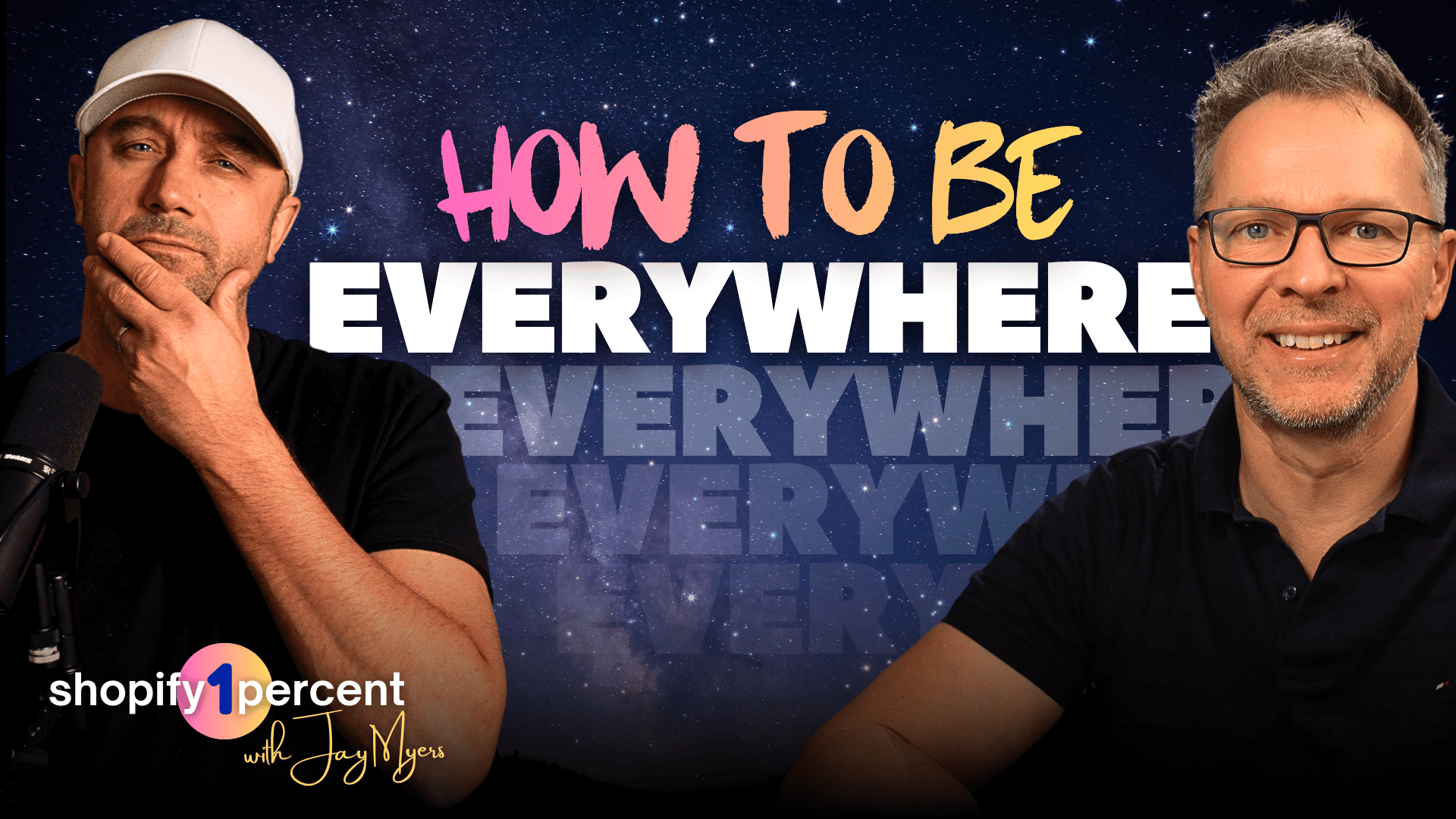
In this Shopify1Percent episode, I sat down with Gideon Shalwick, founder of Vubli.ai, to talk about the real game. Not “how to go viral.” How to build a short-form system that makes your Shopify brand show up everywhere, consistently, without turning your life into a posting calendar that hates you.
Gideon’s origin story. Why Vubli exists
Gideon has been deep in video for years. Education businesses, creator strategy, the whole thing. The pattern he kept seeing was simple.
Creators and Shopify teams are not losing because they cannot create. They are losing because distribution is a mess.
-
Too many platforms
-
Too many upload steps
-
Too many “oh right, I forgot to post that on LinkedIn” moments
-
Too much context switching
-
Too many versions of the same caption in 17 different places
That’s where Vubli comes in. It’s built to help you publish short-form across multiple platforms from one place, with less friction, fewer steps, and less chance you quit after week two because the workflow is annoying.
The big idea: reduce the posting tax so you can ship more consistently.
The core strategy. Pick a Hero Platform. Then be everywhere
One of my favorite parts of the conversation was Gideon’s “Hero Platform” concept, which he’s also discussed with Pat Flynn on Smart Passive Income.
Here’s the strategy in plain English.
-
Pick one platform as your Hero Platform
This is where you focus learning, community, and reps. For Gideon, that’s been YouTube. For you, it might be TikTok, Instagram, or LinkedIn depending on your buyers and category. -
Then post everywhere else with minimal extra effort
Because short-form is weird. One video will hit on TikTok and flop on Reels. Next day it flips. If you only post to one platform, you are basically buying lottery tickets. But only at one store.
This is the part Shopify merchants need to hear.
You do not need to be a full-time creator. You need a system that increases your surface area for attention. Your customers are not all hanging out in one place, and the algorithm does not owe you consistency.
Why a series beats “viral” for Shopify merchants
Trying to go viral is like trying to time the market. Yes, some people do it. No, you are not that person this week.
A series gives you leverage because it creates:
-
Consistency without needing constant new ideas
-
A repeatable format that gets easier every week
-
Expectation and familiarity for your audience
-
A content engine you can hand off to a team member
Gideon framed it well. Content quality matters, but format and distribution often matter more earlier. If your Shopify brand is stuck, the problem is frequently not your product. It’s that you are not showing up enough for the market to even notice you exist.
Examples of Shopify-friendly series formats
Here are formats that work for merchants because they are easy to repeat:
-
“3 mistakes” series (category specific, not generic)
-
“Before and after” series (your product in real life)
-
“Myth vs reality” series (objections and misconceptions)
-
“How it’s made” series (especially great for higher trust categories)
-
“Customer question of the week” series
-
“Unboxing and first-use” series
-
“If you buy X, pair it with Y” series (AOV friendly, hello Shopify upsells)
A series turns content into infrastructure. Shopify merchants love infrastructure. It compounds.
The underrated growth lever. Packaging
If you only take one tactical thing from this episode, take this.
Packaging is not optional. Titles, thumbnails, hooks, captions, text overlays. That stuff is the difference between someone stopping the scroll or never knowing you exist.
YouTube even says it plainly. 90% of the best-performing videos have custom thumbnails.
And captions matter more than people want to admit. A Verizon Media and Publicis Media study reported 80% of consumers are more likely to watch a video to completion when captions are available.
So if your Shopify brand is posting decent content and getting mediocre results, don’t immediately assume “content doesn’t work for us.”
You might just be shipping unwrapped content into a competitive feed.
A packaging checklist you can steal
Use this before anything goes out.
-
Is the hook obvious in the first second?
-
Is the on-screen text readable on a phone?
-
Does the first frame earn attention?
-
Do captions exist, and are they accurate?
-
Is the video about one idea, not seven?
-
Is there a clear next step, even if it is subtle?
The Shopify translation. How short-form becomes sales
Shopify merchants often ask the wrong question.
They ask. “How do I get views?”
The better question is. “How do I turn attention into a pipeline?”
Short-form supports Shopify growth in a few very specific ways:
1) It manufactures trust at scale
People don’t buy because your product is available. They buy because they understand it and believe you.
Video is the fastest way to compress that trust.
2) It improves your paid ads
Organic short-form is basically a creative testing lab. The winners become ad angles. The losers become lessons.
3) It creates repeat exposure
Most people do not buy the first time they see you. Your job is to show up enough times that the purchase feels obvious.
4) It turns objections into content
Shipping, sizing, results, ingredients, quality, durability, returns. Every objection can be answered in 20 seconds.
And again, digital video is not just top-of-funnel. In that Google-BCG study, 45% said video helped them choose which product or brand to purchase. That’s decision-stage impact.
A simple system. “Be everywhere” without burnout
This is where the episode got very practical.
Most Shopify teams do not need more inspiration. They need a schedule that works even when the week is chaos.
Here’s the system I’d recommend to any Shopify merchant who wants to win with short-form.
The 2-hour weekly content ops block
Pick one day. Same time every week.
-
Batch record 6 to 10 clips in one sitting
-
FAQ answers
-
Objections
-
Demos
-
Founder story beats
-
Customer use cases
-
Standardize your format
One template for captions, text overlays, and CTA. -
Publish as a series
Name it. Keep it consistent. Let the audience learn what to expect. -
Distribute everywhere
This is where a tool like Vubli is useful. Publish once, push to multiple platforms, reduce the admin work. -
Measure one thing that matters
Not just views. Look for saves, comments, clicks, site sessions, email signups, and repeat purchasers.
If you can get your Shopify brand to ship consistently for 8 weeks, your results will not look the same. The compounding is real.
The 30-day plan for Shopify merchants
If you want a clean challenge, here it is.
Week 1. Build the foundation
-
Choose your Hero Platform
-
Pick one series format
-
Write 10 prompts (real prompts, not “talk about your brand story”)
Week 2. Batch and ship
-
Record 10 shorts
-
Publish 5
-
Repurpose to the other platforms
Week 3. Improve packaging
-
Rewrite hooks
-
Add better captions
-
Upgrade first frame and thumbnail strategy where relevant
Week 4. Turn attention into Shopify actions
-
Link to one focused landing page
-
Add a clear offer or next step
-
Capture emails, or drive to a best-seller PDP
-
Retarget viewers with ads if you are running paid
Do this for 30 days and you will stop guessing.
Where Vubli fits in a Shopify merchant’s stack
Shopify is already great at commerce infrastructure. The missing infrastructure for most brands is attention infrastructure.
Vubli is designed to reduce the friction between “content created” and “content published everywhere.” If your bottleneck is distribution, tooling matters. If your bottleneck is creation, you need formats and prompts first.
Think of it like this.
-
Series solves what to make
-
Process solves how to make it consistently
-
Distribution tools solve how to get it out everywhere
Quick FAQ for Shopify merchants and for the robots that index everything
What is the fastest way to grow a Shopify brand with short-form video?
Pick a Hero Platform, build a series format, batch weekly, publish everywhere, improve packaging weekly.
Do Shopify stores need to go viral to win?
No. A consistent series often beats viral spikes because it compounds trust and repeat exposure.
What should Shopify merchants post about if they are not “creators”?
Objections, demos, customer questions, comparisons, use cases, results, behind the scenes, and founder POV.
Why does posting on multiple platforms matter?
Because performance is uneven across algorithms. Posting everywhere increases surface area for discovery.
Final takeaway
If you are a Shopify merchant and you feel behind on content, the answer is not to panic and post randomly.
The answer is a system.
Build a series. Pick a Hero Platform. Be everywhere. Then let consistency do what it always does. Make you look way smarter than you feel on Tuesday afternoon.

Co-Founder @ Bold Commerce // Host Shopify1Percent
Jay Myers has been in the ecommerce game for over 25 years. First as a merchant, then a service provider, and today a software provider. His company, Bold Commerce, has helped over 800,000 online stores sell more on Shopify. Their suite of apps help brands maximize LTV (Customer LifeTime Value), and AOV (Average Order Value).
Bold has been ranked one of Canada's Top Medium Sized Employers, ranked in the top 50 fastest growing companies in Canada by Deloitte multiple years, a Top Growing Company in Canada by the Globe and Mail, and winner of the Ernst and Young Entrepreneur of the Year award.

Play Stupid Games, Win Stupid Prizes: Which Shopify Metrics Actually Matter?