Hello? Can I Speak To A Human Please? Why The Biggest Shopify Opportunity Right Now Isn't AI
Hello? Can I Speak To A Human Please? Why The Biggest Shopify Opportunity Right Now Isn't AI
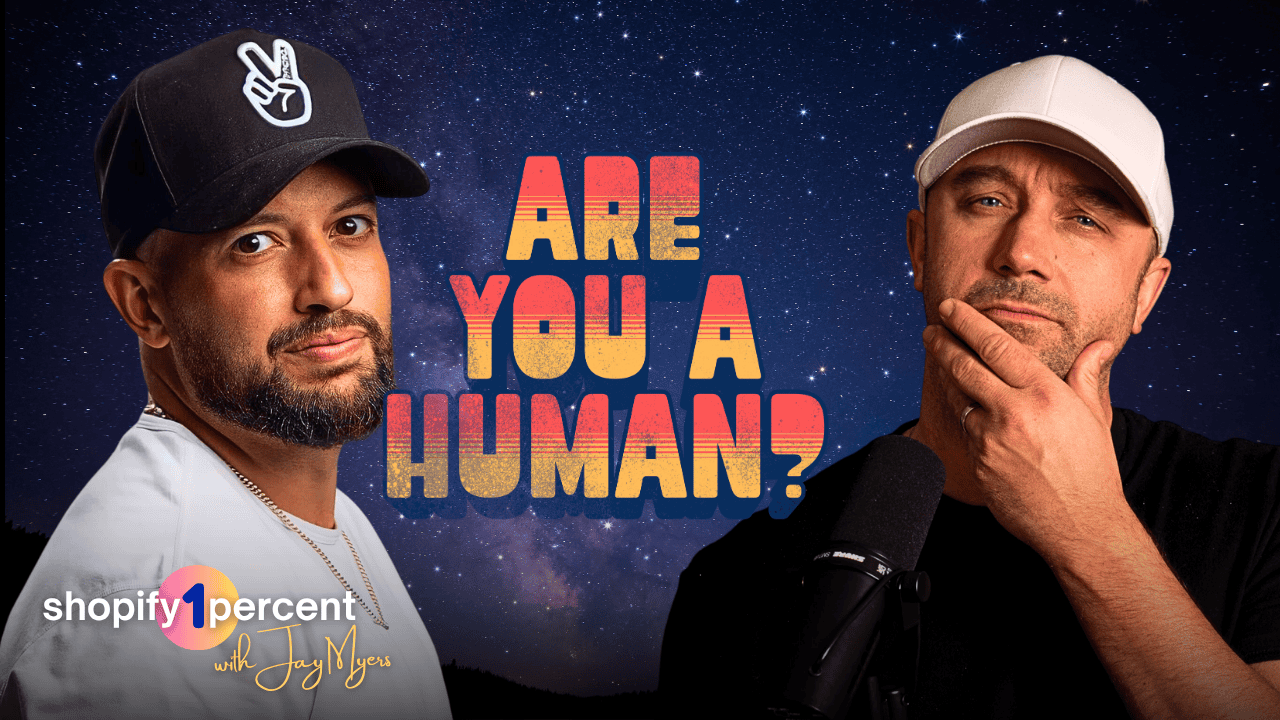
A shopper got a text from a brand, replied, and then asked the most reasonable question in the world: are you a real human?
The AI on the other end said it couldn't answer that.
That's a real exchange, from a competitor of my guest this week. A bot so carefully guardrailed it couldn't even own up to being a bot. It's the most accurate snapshot of ecommerce in 2026 I've seen in a while.
Meanwhile I'm over here typing "HUMAN. HUMAN. HUMAN." into a chat widget like a man losing his mind, which is roughly my experience with about nine out of ten brands I try to contact.
So I wanted to talk to someone building in the opposite direction.
The short version: Steve Lequerica is the COO of LiveRecover, a Shopify app that puts actual human agents on SMS with shoppers who abandon checkout. Across their brands, those conversations convert at an average of 21%, which is roughly triple what a strong automated SMS flow returns. The lever isn't the discount. It's that a person can answer the specific question that stopped the sale.

Why do real humans recover more Shopify carts than automation?
Start with the hole everyone is trying to fill. Baymard Institute puts the average cart abandonment rate at 70.22% across 50 studies, a number that has barely moved in a decade despite everyone rebuilding their checkout twice.
Steve says LiveRecover averages a 21% conversion rate on the conversations their agents start. When I asked what a traditional automated SMS flow does, he said a good day is 6% or 7%.
Here's the part that genuinely caught me off guard, and I've been in this space since 2009.
There's a legal line between an automated text and a human one. Automated messages, what the industry calls A2P, need explicit marketing opt in. The checkbox, the double opt in, the pop up. And the overwhelming majority of people who abandon your checkout never opted into any of that.
But a real person texting another real person is a separate category. P2P. If someone left a phone number at checkout, a human can text them once, legally, without that marketing opt in.
So this isn't just "humans write better copy than your flow." It's an entirely separate audience that your Klaviyo or Postscript flow is not legally allowed to touch. That reframed the whole thing for me.
Steve's own analogy for what it should feel like is his guy at Bloomingdale's. He texts him twice a year about a cologne or a shirt, gets a straight answer, sometimes a "come in Thursday, I got you." Same number, same person, every time. That's the experience, not a broadcast. It's the same instinct behind why a real handwritten note still lands so hard in a mailbox full of printed junk.
Should you discount abandoned carts on Shopify?
Probably not, and this is the part of the episode I got most fired up about.
LiveRecover's data shows that for every 1 customer who redeems a discount code, 3.7 more buy without one. That number also shows up publicly in a review from the brand Awe Inspired on the LiveRecover Shopify App Store listing, alongside a returning customer flow converting at 46.9%.
I think discounting an abandoned cart is fundamentally backwards, and I said so on the show.
Think about what actually happened. Your customer saw the price. They added it to the cart anyway. They went to checkout. At every one of those steps they were fine with the price.
Then they left. And our industry's collective response is to fix a pricing objection that was never raised.
Baymard's research backs this up. The leading fixable reason people abandon is unexpected extra costs appearing at checkout, cited by roughly half of shoppers who bail for a reason other than browsing. Not "too expensive." Surprised. Those are different problems with different solutions.
If you're selling a $200 t-shirt, a 5% discount is noise. That person wanted to know they could return it, no questions asked, if it didn't feel right. They wanted to know it would arrive before the weekend. Nobody was waiting on eight dollars.
And the second you train people that abandoning gets them 10% off, congratulations, you've built a machine that teaches your best customers to stall. I've watched brands do this to their own margins for years. This is the same disease as the surprise shipping cost hiding under your checkout button, just further down the funnel.
Steve was honest that removing the discount does cost you some conversion rate. He said they typically see 5 to 10% instead of 15 to 20% when no incentive is on the table. Fine. That's a margin conversation, not a strategy failure, and it's a trade a lot of brands should be running the math on.

What are your abandoned cart conversations actually worth?
This is the thing I didn't see coming, and I think it's worth more than the recovered revenue.
Every one of those conversations is a transcript. A real person, high purchase intent, telling you in their own words exactly what stopped them from buying.
While Steve was talking I said what I'd do with that: dump every transcript into Claude or ChatGPT, ask it to pull the five recurring question themes, then go answer those five things directly on the product page and at checkout.
Turns out they already built it. It's a feature they call Insights.
The example that sold me was a brand called Jordan Craig. They went through their conversation data and realized their shipping was a mess. Not from a survey, not from a consultant. From reading what customers were actually saying. They ended up rebuilding their entire fulfilment offering into three tiers, gold, silver and bronze, off the back of it.
Another brand selling a $400 red light mask used the agents to run a post purchase survey. They were convinced their buyer was 25 to 40. The responses came back majority 55 and older. Their entire targeting assumption was wrong, and a text message found it.
There's an AI angle here too that I don't think many merchants have connected. If a customer is asking your agents a question, and the answer isn't anywhere on your site, then ChatGPT doesn't know the answer either. Your transcripts are a map of the gaps in your own content. That's directly relevant if you care about showing up when AI recommends stores in your category.
You will never get this from an automated text nobody can reply to. You get a click or you get silence.

Where should Shopify brands use AI and where should they use people?
Steve isn't anti AI, and I want to be fair to him on that. He uses it. His team ships fast because of it. His view is that people are pointing it at the wrong moments.
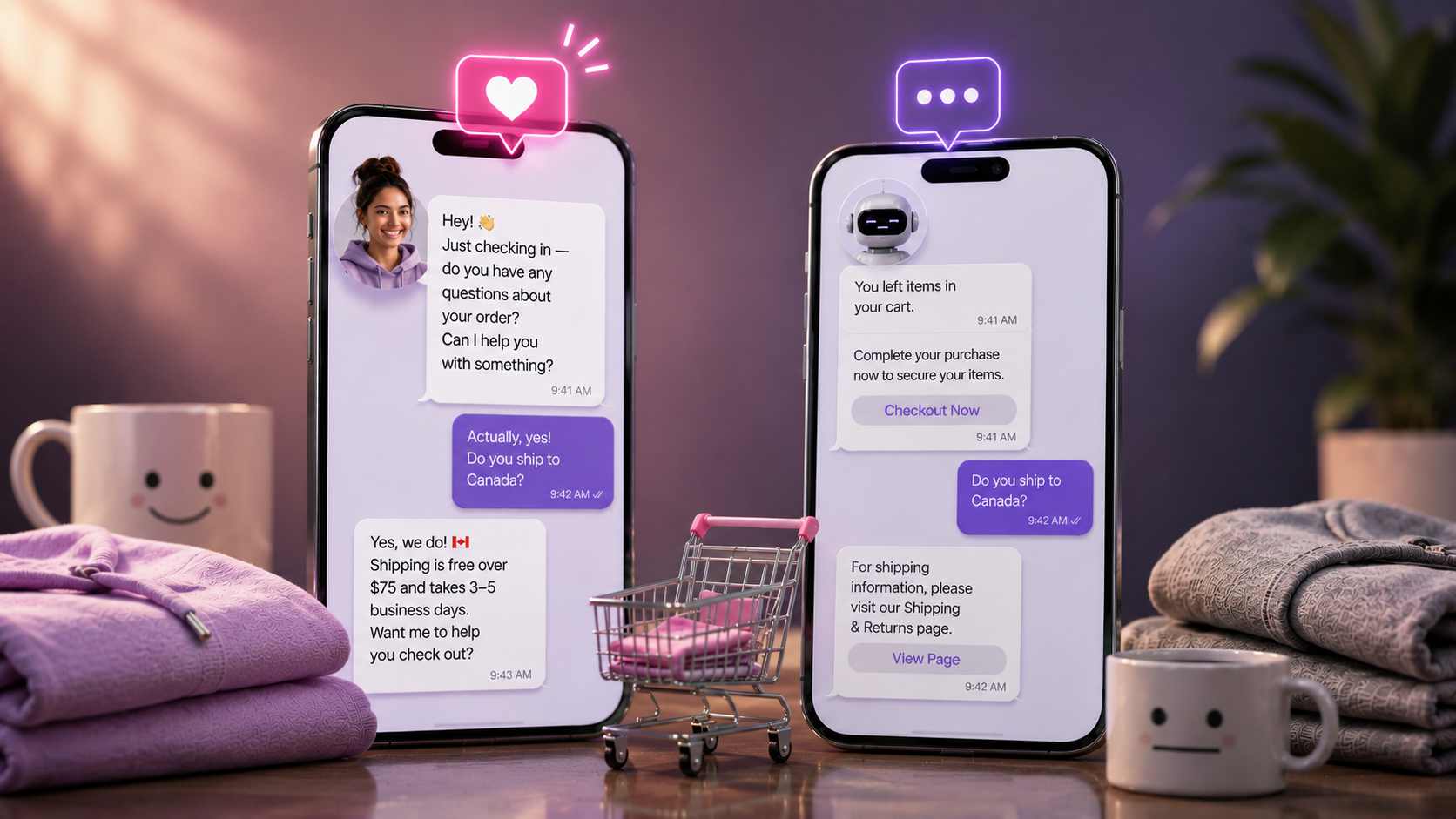
The split he lands on is roughly: automate the low stakes stuff, put humans on the high stakes stuff. Order status, tracking, password resets, let the machine have it. Nobody wants a relationship with your brand over a tracking number. Purchase hesitation, complaints, a $500 cart with a sizing question, that's where a real person changes the outcome.
The market keeps proving this the hard way. Klarna replaced roughly 700 customer service roles with AI in 2024, celebrated it loudly, then reversed course. CEO Sebastian Siemiatkowski told Bloomberg in 2025 that the company had leaned too hard on efficiency and cost, and that quality paid for it. They're hiring humans again.
And customers are further ahead of brands on this than most operators realize. A Gartner survey of 1,539 US consumers published in March 2026 found that 50% would prefer to give their business to brands that don't use generative AI in consumer facing content. Half. That's not a fringe group you can ignore.
Steve said something that stuck with me: what they do is non sexy, no buzzwords, no MCP, no agent framework. It's old school. It just works.
Fifteen years ago a human picked up when you called a brand. There was no bot. Now that's a luxury item, which means it's sitting there as a differentiator for anyone willing to pick it up. Being reachable is a moat now. That's a very strange sentence to type.
If you're wondering what's actually left to compete on once AI can copy your store in a weekend, I'd put "a customer can reach a person" pretty near the top of the list.
The 1% takeaway: go talk to the people who didn't buy
I asked Steve for one thing a merchant could do to get 1% better. His answer was to argue against his own product, which I did not expect and respect enormously.
His words, near enough: forget LiveRecover, forget any tool. Just find a way to talk to the people who come to your site and leave without buying.
Text them. Call them. Do it manually for a couple of weeks. You'll eventually hit a wall on scale or compliance, and that's the point at which you go buy something. But before then, you'll learn things about your store that no dashboard will ever tell you.
Roughly 97 of every 100 people who visit your Shopify store leave without buying anything. We've covered on this show exactly where that traffic leaks out, but sit with the number for a second.
Imagine a physical shop where 97 out of every 100 people walk in, turn around, walk out, and not one employee says a word to any of them. You'd fire everyone. That's your store. That's every store.
So here's the 1%: this week, pull your last 20 abandoned checkouts with a phone number attached. Text ten of them yourself, from your own phone, as a human. Don't lead with a discount. Ask what stopped them.
Whatever comes back is the most valuable customer research you'll get this quarter, and it costs you nothing but twenty minutes and a bit of ego.
The full conversation with Steve goes deeper on the compliance side, the post purchase and subscription plays, and the TikTok Shop gap that's swallowing customer phone numbers. Search Shopify1Percent wherever you get your podcasts, and hit follow so you don't miss the next one.

Co-Founder @ Bold Commerce // Host Shopify1Percent
Jay Myers has been in the ecommerce game for over 25 years. First as a merchant, then a service provider, and today a software provider. His company, Bold Commerce, has helped over 800,000 online stores sell more on Shopify. Their suite of apps help brands maximize LTV (Customer LifeTime Value), and AOV (Average Order Value).
Bold has been ranked one of Canada's Top Medium Sized Employers, ranked in the top 50 fastest growing companies in Canada by Deloitte multiple years, a Top Growing Company in Canada by the Globe and Mail, and winner of the Ernst and Young Entrepreneur of the Year award.
How to Segment Your Shopify Email List for Black Friday