More 5-Star Reviews Won't Fix What AI Says About Your Shopify Store
More 5-Star Reviews Won't Fix What AI Says About Your Shopify Store
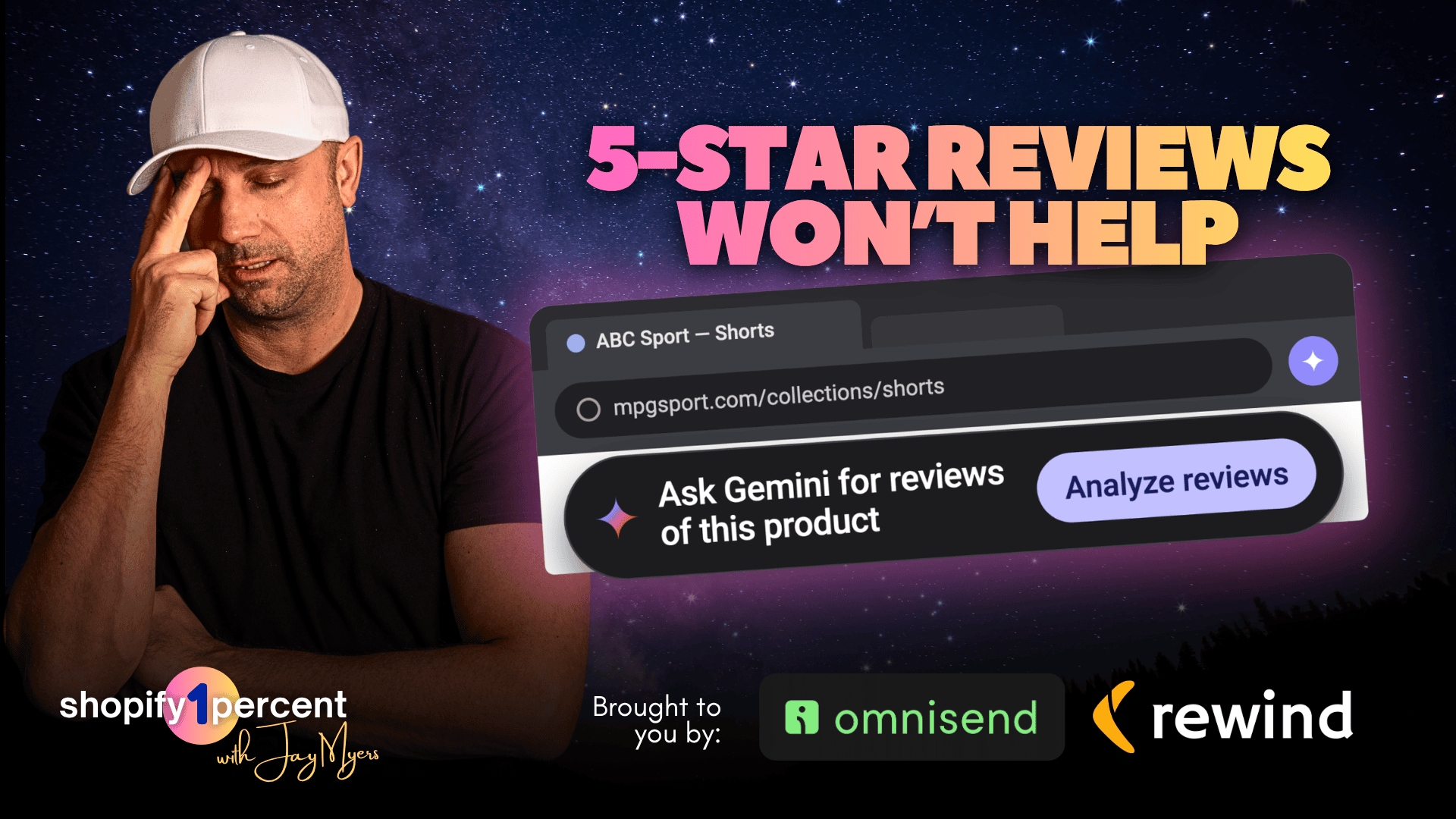
I was on a product page the other day, looking at a pair of athletic shorts, and a little bar dropped down beside the URL bar in Chrome.
"Analyze reviews."
That wasn't the store asking me. That wasn't a pop-up somebody installed. That was Chrome, offering to tell me what everybody thinks about this product before I read a single word the brand had written.
So I clicked it. I figured it would summarise the reviews sitting right there on the page.
It didn't. It came back with a full pros and cons list, and some of what it told me clearly wasn't coming from the brand's site at all.
My first thought was, okay, this changes reviews.
The short version
When AI summarises reviews for a shopper, a bad summary can come from four completely different places: your actual product, bad or stale data, a mismatch between what you promised and what you delivered, or your genuine off-site reputation. Each one has a different fix, and only one of them involves collecting more reviews. Before you change anything, take one negative claim from the summary and figure out where it came from.
Why won't more five-star reviews fix this?
Because most merchants are going to read something negative in that summary and immediately reach for the same lever. Get more reviews. Get better reviews. Run a campaign.
That could be completely wrong, and here's the cost of getting it wrong: you spend three months and a chunk of budget collecting reviews, and the summary says the exact same thing at the end of it. Because the problem was never the reviews.
You can't fix the answer until you know where the answer came from.
How many people are actually seeing this?
Chrome had just under 70% of worldwide browser share in June 2026, and 52.26% in the US, where Safari is much stronger because of the iPhone (StatCounter, 2026). About seven out of ten browsing sessions globally.
This is not an experimental feature being tested on fourteen nerds in Mountain View. A lot of your customers are in Chrome right now.
And reviews were already central to how people buy. BrightLocal's 2026 Local Consumer Review Survey found 41% of consumers now say they always read reviews, up from 29% the year before (BrightLocal, 2026). Small honest caveat on that one: BrightLocal's research covers local businesses, not pure ecommerce, so I'm using it for direction, not as your benchmark.
The direction is enough. People lean on reviews, and now AI can compress hundreds of them into a few sentences.
That compression is the part that actually interests me.
A recurring complaint used to be scattered across pages and pages of reviews. Some five stars, some three stars. One person mentions the waistband. Another says the sizing feels weird. A third says it was tighter than expected. A shopper had to hunt for the pattern and most of them never did.
Now AI does that work for them. It takes a messy pile of feedback and turns the pattern into one line.
"Customers frequently mention inconsistent sizing."
Volume can't bury a recurring complaint anymore.
I honestly don't know exactly how Google weights all of this. Does a review from last week count more than one from two years ago? Probably. How much more? No idea. Google hasn't handed anybody a recipe card that says 32% recency, 18% Reddit, sprinkle in some Merchant Center. So let's not pretend we know the algorithm. We don't need to. We can work on the inputs we can actually see.
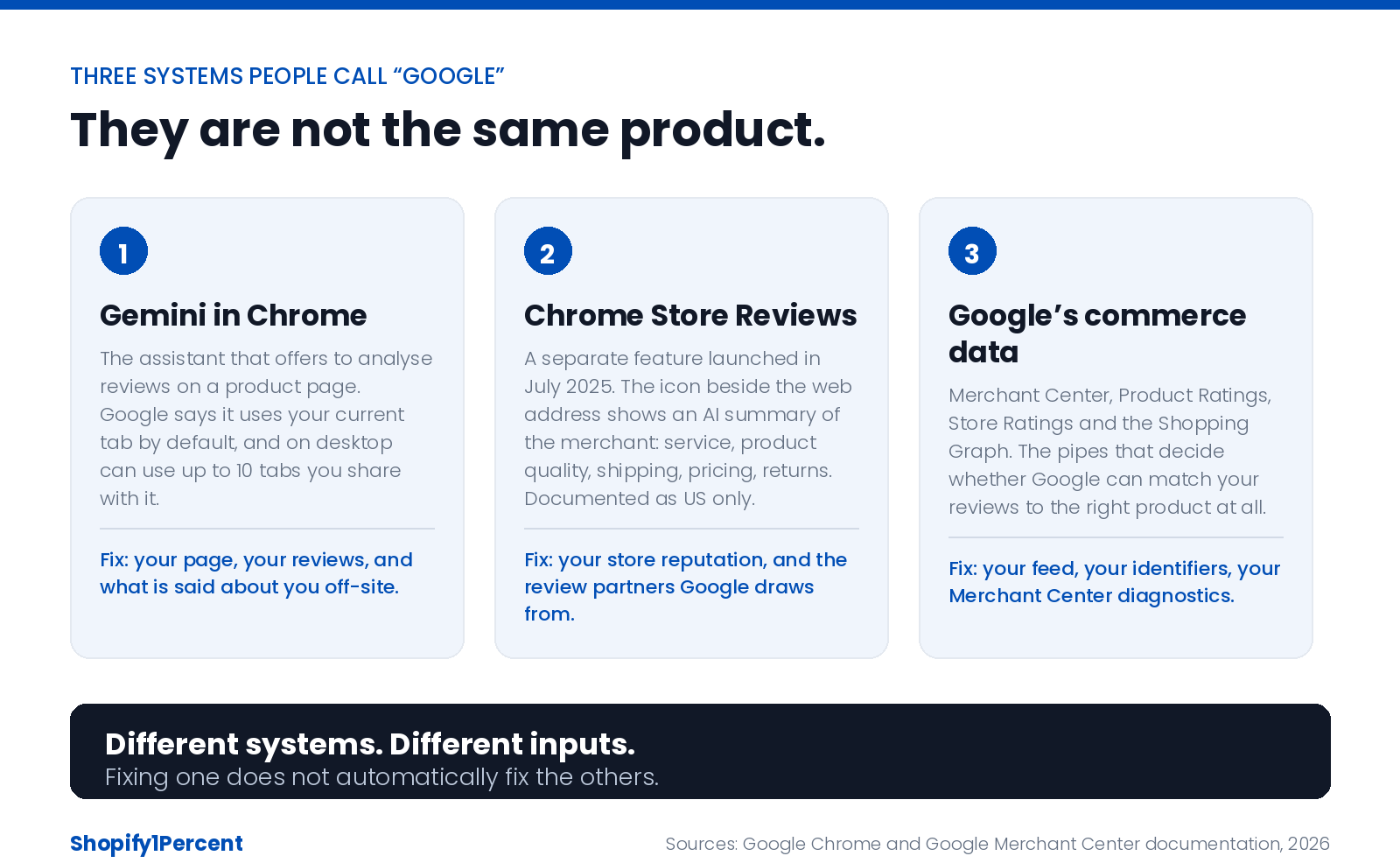
What are the three Google systems merchants keep confusing?
This matters because the fixes are different, and if you mash them together you'll spend effort in the wrong place.
Gemini in Chrome. This is the prompt I saw. Google says it uses the content of your current browser tab by default, and on desktop you can share up to ten open tabs with it. Which means a shopper can have your product open and your competitor's product open, and ask about both.
Chrome Store Reviews. A different feature, launched in July 2025. You click the icon beside the web address and Chrome shows an AI-generated summary of the merchant: customer service, product quality, shipping, pricing, returns. Google says it draws from Google Shopping and other popular review websites. As of this writing, Google still documents it as requiring the user to be located in the US.
Google's commerce data layer. Merchant Center, Product Ratings, Store Ratings, the Shopping Graph.
Different systems. Different inputs. Fixing one doesn't automatically fix the others.
This is the same underlying problem I got into in the AI Mirror Test episode on becoming the store AI recommends, just showing up in a new place. AI is reading your store. The question is what it's reading, and from where.
Move one: how do you audit what AI says about your Shopify store?
Start stupidly simple. Open your bestseller in Chrome and run Analyze Reviews.
One practical note from my own testing: the prompt doesn't appear every single time. If it doesn't drop down on its own, click into the URL bar and look at the side. Depending on your country it'll say either AI mode or Analyze reviews.
Then run it on three products, not one.
Your bestseller, because that's where the money is.
Your highest-return product, because that's where the truth is. If you sell apparel and one SKU has a 14% return rate while everything else sits at 6%, I want to know whether the AI can see the same problem your returns data has been screaming about for a year.
Your closest competitor's equivalent product, because that's the comparison a shopper is running anyway.
And don't stop at the default button. Ask the questions a real buyer asks:
- What are the biggest complaints about this product?
- Who is this best for?
- Does it run true to size?
- What should I know before buying this?
- Compare this with the competitor I have open in the other tab.
You're recreating the moment somebody is almost ready to buy and is quietly looking for a reason not to. You're not auditing your star average. You're auditing the story AI tells when somebody interrogates your product.
One more thing if you sell internationally. Google says Store Ratings need enough unique reviews within a country before it can establish a rating for that country. So don't assume the reputation data Google holds for you in Canada is identical to what it holds for you in the US.
Fifteen minutes. Five or six prompts. Screenshot everything. Move on, because the useful part starts next.
Move two: how do you trace an AI review claim back to its source?
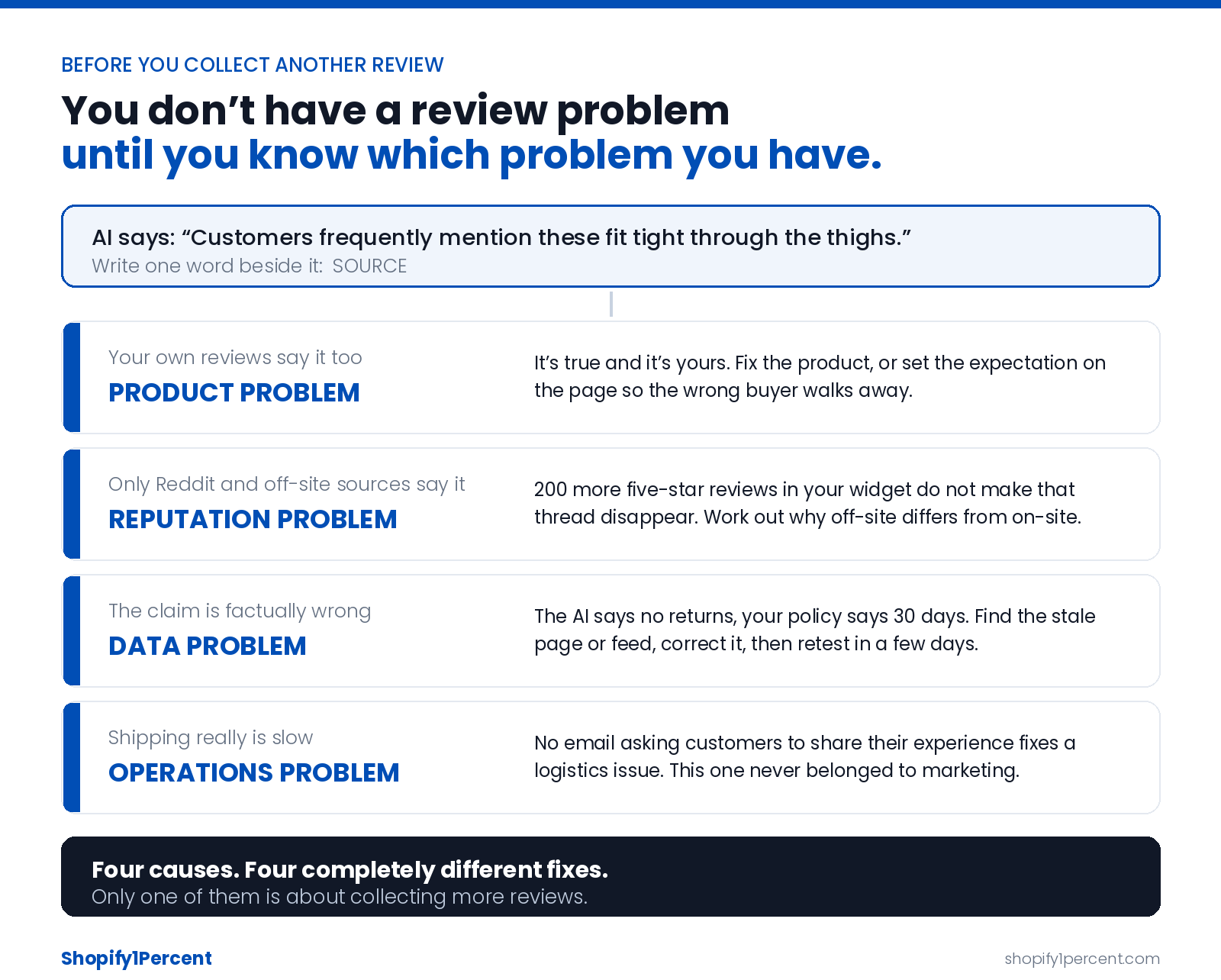
Take the first meaningful negative claim and write one word beside it.
SOURCE.
Where did this come from? It sounds obvious. It completely changes what you do next.
Say Gemini tells a shopper: "Customers frequently mention that these shorts fit tight through the thighs."
Scenario one, a product problem. You go through the reviews on your own store and there it is, again and again. Customer after customer says the same thing. Your review strategy isn't broken. The shorts fit tight through the thighs. Now you have information. Maybe that's a product development issue and the next manufacturing run changes. Maybe it's completely intentional. Either way you know what you're solving.
Scenario two, a reputation problem. You search your own reviews and almost nobody says it. Then you find a Reddit thread where twenty people are talking about the fit. Getting another 200 five-star reviews into your widget does not make that thread disappear. Now the question is why the off-site conversation differs from the on-site one. Older reviews? A previous version of the product? Or are the people reviewing on your site disproportionately happy because of how you collect reviews? I don't know. But at least you're looking in the right place.
Scenario three, a data problem. The AI says something that's just wrong. "Returns aren't accepted," and your site clearly says 30 days. That's not an unflattering opinion. That's the AI being wrong, and it's a completely different job. Is there an old return policy URL floating around? Did the policy change while another page kept the old wording? Is Merchant Center carrying outdated info? Is a third-party listicle describing your product incorrectly? Find the stale source, fix it, retest, and give it a few days before you expect the AI to catch up.
Scenario four, the one nobody likes. The AI says shipping is slow because your shipping is slow. Your review app cannot fix FedEx taking nine days. No email asking customers to share their experience fixes an operations problem.
Here's where I think merchants are going to get themselves in trouble. Reviews feel like marketing. So when the AI says something bad, marketing gets handed the problem. Sometimes marketing has absolutely nothing to do with it.
Which is the thing I'd want you to take from all of this:
You don't have a review problem until you know which problem you have. Product, data, expectation, or reputation. Those need completely different fixes.
Move three: is Google even receiving your Shopify reviews?
Now the boring plumbing, and I love this stuff, because boring plumbing quietly wrecks a shocking amount of ecommerce.
You can have 2,000 beautiful reviews sitting in Shopify and still be doing a terrible job of feeding Google. Those are two separate jobs.
Test one, the page test. Run one of your important product pages through Google's Rich Results Test. You're checking that Google sees your Product structured data, and where it applies, Review and AggregateRating information. You don't need to become a schema expert. You're looking for obvious holes. If you have reviews on the page and Google isn't seeing any, something is broken, and that's a conversation with your review app or a developer.
Test two, the source test. Only bother if something looked wrong. Look at where the Product structured data is actually being generated. Google recommends putting Product structured data in the initial HTML when you're optimizing for Shopping results, and notes that JavaScript-generated markup can make Shopping crawls less frequent and less reliable.
I was going to say "make sure Google can see your reviews," and that's not quite right. The more interesting problem is whether Google can correctly associate all of this with the right product.
Test three, the distribution test. Go into Google Merchant Center. Look at your Product Ratings setup and your diagnostics.
Quick aside, because this trips people up: you might not even know your products are in Merchant Center. If you've ever set up a Google product feed, a YouTube product feed, or Google Ads, your products are almost certainly in there.
Google's Product Ratings documentation says you need at least 50 reviews across all your products to participate, and that onboarding can take up to two weeks even after you clear that bar (Google Merchant Center Help, 2026).
Then the detail that matters most. Google says the most important factor for matching reviews to products is a globally unique product identifier, specifically the GTIN. Those live on your Shopify product pages. If they're missing or wrong, Google will attempt weaker matches using SKU, brand plus MPN, or the product URL, but Google explicitly says those alternatives often result in fewer reviews being correctly associated with products (Google Merchant Center Help, 2026).
And SKU is genuinely weak, because different brands can use the same SKU.
So picture this. You have 500 reviews. They exist. They're detailed. Customers can see them. You feel great about yourself. But the identifiers in your review data don't line up with the product data Google holds.
Collecting another 500 reviews does nothing. You don't need more reviews. You need cleaner data.
One more requirement people miss: Google says a complete and accurate Product Ratings review feed needs to be uploaded monthly to maintain eligibility. If you're submitting that yourself, that's your job. If your review provider is doing it for you, then you need to know what they actually support and whether the integration is working.
And don't assume "connects to Google" means much. Product Ratings, Store Ratings, and Chrome Store Reviews are three different things. Your review app supporting one tells you nothing about the others. Ask support. Read the documentation. Put the answer in your team's SOPs.
This is not glamorous work. It's also exactly the kind of thing somebody at a $20 million Shopify brand assumes another department owns, while every department assumes the same thing, and nobody actually owns it. Where your store is leaking money is usually a place like this.
Move four: what questions should you actually ask for a review?
Once you've audited what AI says, traced where it comes from, and made sure your data is getting where it needs to go, you've earned the right to change something.
First, fix the ask.
Most review request automations are lazy. Order delivered, wait X days, "Hey Jay, how are you enjoying your order?" Five stars, submit, done. Great. Meaningless to Google.
The amount of time somebody needs before they have a useful opinion depends completely on the product. Shorts? A customer knows pretty quickly whether the fit works. A mattress? Maybe don't ask me on day one, I haven't slept on it, give me a month. Protein powder? I'd rather hear from somebody who's worked through most of the tub than somebody whose entire review is "package arrived fast, haven't tried it yet, five stars."
If you're using Shopify's own Shop reviews, Shopify currently lets you set the request anywhere from 1 to 180 days after delivery (Shopify Help Centre, 2026). The setting is in Shopify admin, Sales channels, Shop, Settings, Shop reviews.
Important qualifier. That's Shopify's Shop reviews. It doesn't control whatever workflow you've built in Judge.me, Okendo, Yotpo, Loox or anything else. For those, go check the app.
Then look at the question itself. These reviews are going to feed AI, so ask things that produce information:
- How did the fit compare with what you expected?
- What almost stopped you from buying, and why did you buy anyway?
- Who would you recommend this for?
- How are you actually using it?
- What surprised you after buying it?
- Why did you come back and buy again?
Here's why this matters, and it's my favourite example from the episode. Say you sell travel bags. A good question gets you a review that says: "The thing I love most is it's the largest size I can take in addition to my carry-on when I travel."
You might not have that sentence anywhere in your product description. But somebody out there is typing exactly that into ChatGPT right now. "I'm looking for the biggest bag I can take in addition to my carry-on."
Your customer just wrote the answer for you. "Great product A++++" writes nothing.
I want to be careful with the language here, though. We're not trying to coach customers into saying nice things an AI will repeat. We're trying to get more detailed, honest information. If the product sucks, I want the review system to tell me the product sucks. That's useful. That's how it gets better.
What if the complaint is true and you can't fix it?
Second, fix the truth.
If the criticism is legitimate and fixable, fix it. The zipper breaks, change the zipper. The lid leaks, change the bottle. Customers can't follow the assembly instructions, rewrite the instructions.
But sometimes the complaint isn't going anywhere. Maybe those shorts genuinely have a tight athletic fit. That's the cut. There's nothing to fix in the factory.
Fine. Say so. Put it in the product description, put it beside the size guide, lean into it. If enough customers are saying "size up if you've got bigger thighs," your product page should say that before somebody orders. This is exactly the kind of thing the microcopy under your buttons is for.
Sometimes the best way to improve your future reviews is to convince the wrong customer not to buy.
Fewer avoidable returns. Fewer disappointed customers. Better-fit buyers. That's just good ecommerce.
Is it okay to offer a discount for a review?
Shopify's current Shop review guidelines tell merchants to solicit reviews neutrally, and specifically say not to compensate customers for reviews with money, discounts, free products or refunds (Shopify Help Centre, 2026).
That's Shopify's rule for their system. It isn't universal, and rules differ by platform, so check wherever you're actually collecting the review.
My own position, and I'll admit this is where I part ways with the strict reading: I think it's fine to thank someone with a discount for taking the time. But you do it for every review. Good ones, bad ones, the two-star ones that sting. The moment the reward is tied to the sentiment, you've bought a review instead of earning one.
As a general operating principle, I wouldn't pay for positivity. If the only way your product gets five stars is by bribing somebody with 15% off, you have a different problem.
Why does this get bigger from here?
There's one reason to care about this beyond a little Chrome button.
Google's Shopping Graph now contains more than 60 billion product listings, up from 50 billion in January 2026 (Google, 2026). That's 10 billion in four months. It was 35 billion back in February 2023. And Google says more than 2 billion of those listings refresh every hour.
Meanwhile Shopify's Agentic Storefronts already have Google AI Mode and Gemini in early access, with the product connection running through Shopify's Google & YouTube sales channel (Shopify, 2026). I got into what that shift looks like in practice in the Spring '26 Editions breakdown, where the thread running through most of the updates was that your product data is now a storefront.
I don't know how quickly shopping behaviour changes. Anybody telling you exactly what percentage of commerce runs through AI agents three years from now is guessing with nicer slides. But the direction is impossible to miss.
Software is getting involved earlier in the buying decision. It isn't waiting until checkout. It's narrowing the options, comparing them, answering objections, telling somebody what other customers liked and didn't.
For twenty years, reviews helped the customer decide. Now they're becoming evidence software uses to decide what the customer even gets shown.
Which is why I wouldn't treat this as a review widget story. It's a product data story, a customer experience story, and eventually a product discovery story. Same theme as why your Shopify traffic is dropping and where it went, and the same reason AI needs to be able to explain your brand before it will recommend it.
What's the 1% win?
Don't rebuild your review program this afternoon. Don't install three apps. Please don't walk into work Monday and announce that the answer is a massive five-star review campaign.
Do one thing.
Open your bestseller in Chrome. Run Analyze Reviews. Screenshot the result. Find the first negative statement that matters and underline it. Beside it, write SOURCE.
Then figure out where it came from. Your customers? Your website? An old policy? An outside review site? Reddit? Bad product data? An actual product problem?
Don't fix anything until you can answer that.
Because that's what happened to me with those shorts. I clicked Analyze Reviews expecting Google to summarise what was on the page. Instead I realised the interesting question wasn't "do I like this summary." It was "why is Google saying this?"
Once you start looking at reviews that way, you stop treating every negative AI answer like a five-star review problem.
If you run this on your store, email me and tell me what you found. jay@shopify1percent.com. I'd genuinely like to know.
The full episode is on the Shopify1Percent podcast wherever you listen. Search Shopify1Percent and hit follow so you don't miss the next one.

Co-Founder @ Bold Commerce // Host Shopify1Percent
Jay Myers has been in the ecommerce game for over 25 years. First as a merchant, then a service provider, and today a software provider. His company, Bold Commerce, has helped over 800,000 online stores sell more on Shopify. Their suite of apps help brands maximize LTV (Customer LifeTime Value), and AOV (Average Order Value).
Bold has been ranked one of Canada's Top Medium Sized Employers, ranked in the top 50 fastest growing companies in Canada by Deloitte multiple years, a Top Growing Company in Canada by the Globe and Mail, and winner of the Ernst and Young Entrepreneur of the Year award.
The $3 Box Insert That Kept Bringing Shopify Customers Back