The Shopify Retention Math Nobody Runs
The Shopify Retention Math Nobody Runs
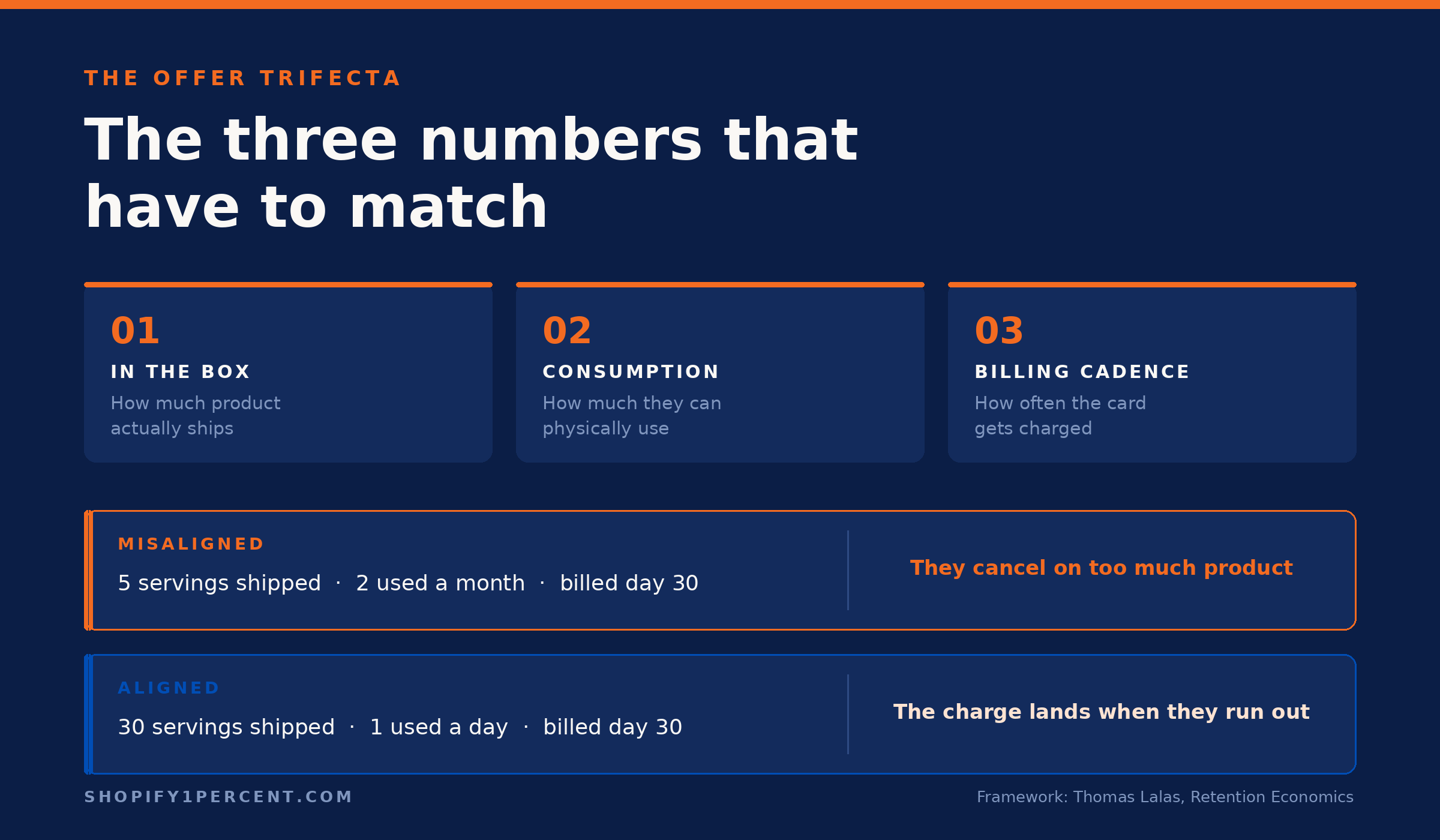
A brand sells you a bottle with five servings. You can use two a month. They charge you again on day thirty.
Then they hold a meeting about why churn is up.
Thomas Lalas has analysed real-time data from more than 2,000 ecommerce brands, and this is the pattern he sees constantly. When he asks a brand what their number one cancellation reason is, they guess price, or they guess the product didn't work. It's neither. It's "too much product." They engineered the cancellation into the offer before anyone ever clicked buy.
The short version: most Shopify brands lose their customers in the first ninety days, and it usually isn't the product's fault. Thomas says up to 80% of customers are gone in that window at most brands, and even the best ones lose half. The fix starts with three numbers agreeing with each other: how much is in the box, how much a person can actually consume, and how often you bill them.
Why don't Shopify customers buy a second time?
Thomas calls it the billion-dollar question. How do you get someone from order one to order two.
His data says that if somebody buys without a subscription, 90 to 95% of them never come back. Not "churn slowly." Never come back. The product fades, it never becomes a habit, and it joins the pile of things we all bought and forgot.
That only matters because of what's happened to the front end. Shopify's 2026 Global Commerce Report puts merchant-wide acquisition cost at $318, up from $274 the year before, and 88% of subscription brands reported higher CAC in 2025. Plenty of brands now lose money on the first order by design, which makes order two the whole business.
I ran the rough math with him on the show. A $60 product, a $40 CAC. That's a good CAC. You're left with $20, and realistically after everything else it's closer to $5. Get that person to buy again and you haven't doubled your profit, you've done something closer to ten times it, because there's no acquisition cost on the second order.
The three numbers that have to match
This is the part I'd act on first, because it costs nothing and most brands have it wrong.
Thomas looks at three things: how much product is in the box, how much a person can physically consume in a day, and your billing cadence. Those three have to agree.
His example was blunt. He asks a brand how much someone should consume in a month. Up to two. How much are you shipping every thirty days? Five. By month two they've got a cupboard full of your product and a credit card charge they didn't need.
They don't cancel because they stopped believing in you. They cancel because you set them up to fail.
If you sell coffee, people drink more per day, so more product per cycle works fine. One-a-day capsule, thirty pills, thirty days. Want to sell sixty, bill every sixty. It isn't complicated. It's just apparently not something anyone checks.
Why the biggest cancellation spike is your own email
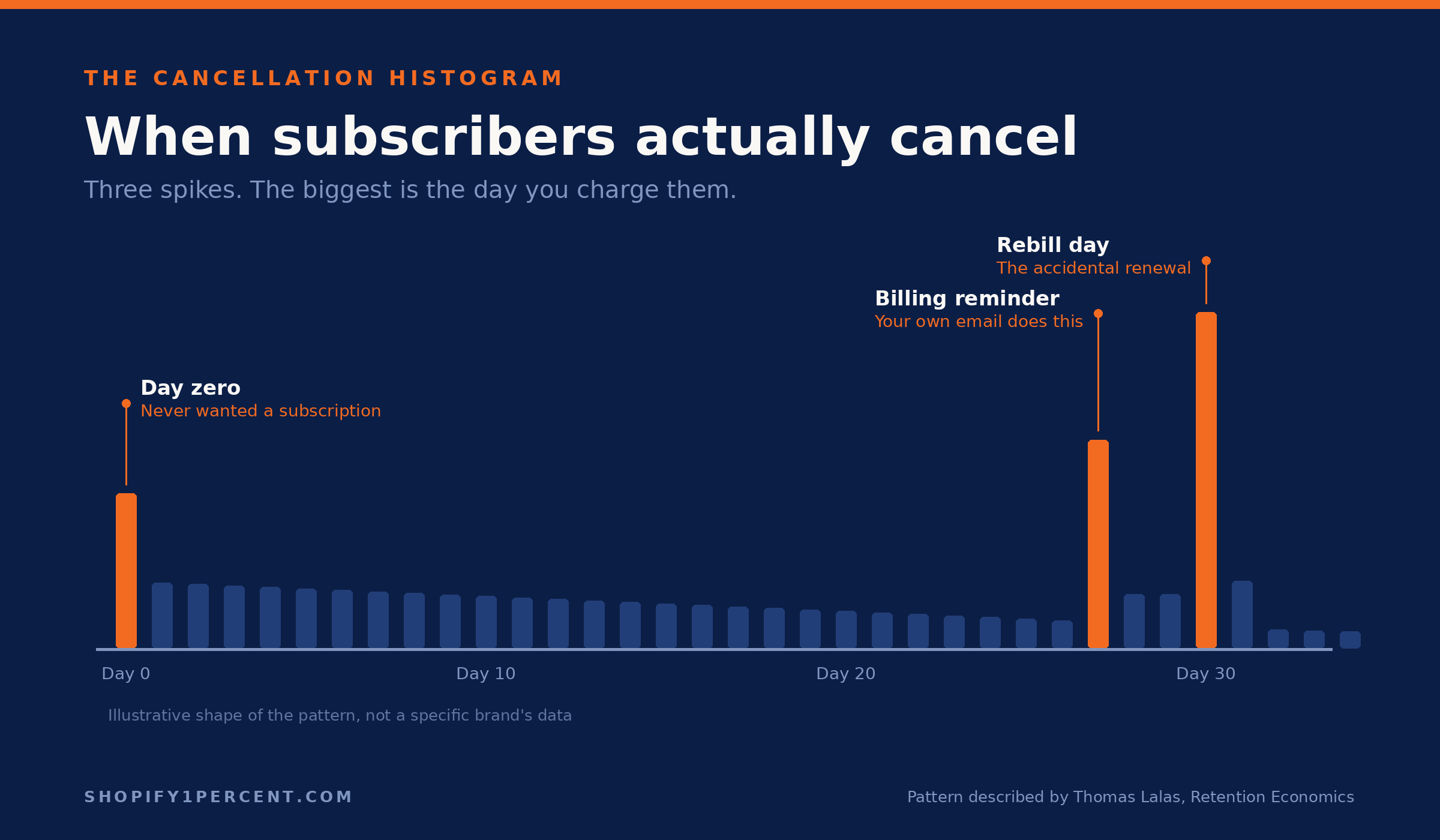
Thomas does something I hadn't seen before. He plots every cancellation by how many days after signup it happened, and the histogram has three spikes.
The biggest by far is the day of rebilling. Second is the billing reminder. Third is day zero, people who cancel the same day they subscribed.
Sit with the middle one for a second. Your billing reminder, the email you send to be transparent and compliant, is one of the top three moments customers quit. Because most of them read like an invoice. Here's what you're about to pay us. And the email helpfully includes buttons marked skip, pause, manage and cancel.
Thomas reframes it. Instead of money leaving, it's value arriving. Here's the freebie coming in three days. Here's where you are in your journey. You're two orders from the VIP tier.
Same email, same moment, opposite job.
That rebill spike ties back to what he calls the accidental renewal, and it's the more uncomfortable one. If your biggest cancellation day is the day you charge them, a chunk of your subscribers didn't know they were subscribers. Independent data backs the shape of this: roughly 44% of subscription cancellations happen inside the first 90 days.
What should happen in the first 14 days
Thomas's answer to onboarding is what he calls bite-sized premium masterclasses. Not a blog post nobody reads or a fifteen-minute video nobody watches. Two minutes, slides, browsable fast, a small win at the end.
He gets the idea from mobile games, which is where I jumped in, because we spent time on this at Bold.
Think about a Nintendo game when you were a kid. There was an instruction booklet in the box. Now there's nothing. You download it and the game teaches you as you play, one easy win, then a slightly harder one, and twenty minutes later you're invested enough to keep going. Games solved onboarding completely. Commerce is years behind and mostly doesn't seem bothered about it.
Why it matters for a supplement or a coffee brand is timing. Real results take weeks. Belief has to arrive faster than results do, or people quit before the product gets a chance.
I'll admit my own version of this. I've got a greens subscription and I'd missed about six days straight. Then I watched a documentary about twins on different diets, one bit about the mucus lining in your gut wearing down without enough vegetables, and I took my greens the next morning without connecting the two until later. Nothing about the product changed. What changed was that I understood it.
Same reason a $50 bottle of wine tastes better than a $10 one. Blindfold me and I probably couldn't tell you. But once I know about the farm, I appreciate it more. If you sell a couch, tell me how the leather was treated.
The one stat I pushed back on
Thomas has written that customers who contact support in the first 30 days churn up to 60% more.
We see the opposite at Bold. When someone reaches out to our support team, their odds of activating are more than double. So I said so, on air, because that number didn't match what's in front of me every day.
He was quick about it, and his answer was better than the stat. The correlation is for negative experiences. Someone frustrated, or asking a question that never gets answered properly. If support goes beyond what's expected and delights them, it flips.
Which is really a story about whether your support team is allowed to fix anything. You've had the experience where something went wrong, someone owned it, went out of their way, and you came out more loyal than if the order had just arrived fine. That's not a support outcome. Somebody decided in advance that a human could spend money to make it right.
Thomas's line on this is the one I'd put on a wall: you cannot outmarket a bad customer experience.
Make people claim the thing they were already getting
This one is nearly free and I hadn't heard it before.
Say you give everyone 15% off their next order. Thomas has tested asking people to claim it instead of just applying it. Same discount, same cost to you. The ones who claim it engage more, hand over more zero-party data, and stay longer, measured against 90-day retention. Same holds for freebies in the second order.
His advice on what the gift should be is the sharpest version of this I've heard. Don't buy a cheap branded thing off Alibaba. Look at what your customers already spend money on around your product, and buy that for them with your name on it. Nobody wants a hat with their coffee. They'd use a frother or a nice glass.
He works with a brand selling wellness shots that need refrigerating once opened, so his answer was to sponsor the fridge. Containers, a magnet you have to move to get the bottle out. Your brand in front of them daily without a single email.
Where I pushed back: I think there's room for gifts that don't feel earned at all. My local coffee place has a punch card, and when I get my tenth coffee free I feel roughly nothing, because I earned it and I saw it coming. If the barista just handed me one and said this one's on us, you're in here all the time, I'd probably post about it.
Thomas's caution is fair. At scale, random doesn't stay random, and it has to move a business number. But the version I'd test is a note from the founder at whatever month your churn actually spikes. This one's on me, thanks for seven months. Nobody claimed it, nobody earned it, and it costs one month of product to find out.
The 1% takeaway
Open your best-selling subscription and check three numbers against each other: how much is in the box, how much a customer can realistically use in a cycle, and how often you bill. If they don't line up, that's your churn, and no email flow is going to outrun it.
Then go read your billing reminder. If it reads like an invoice, rewrite it to lead with what's arriving instead of what's leaving.
Two things, one afternoon. That's the 1%.
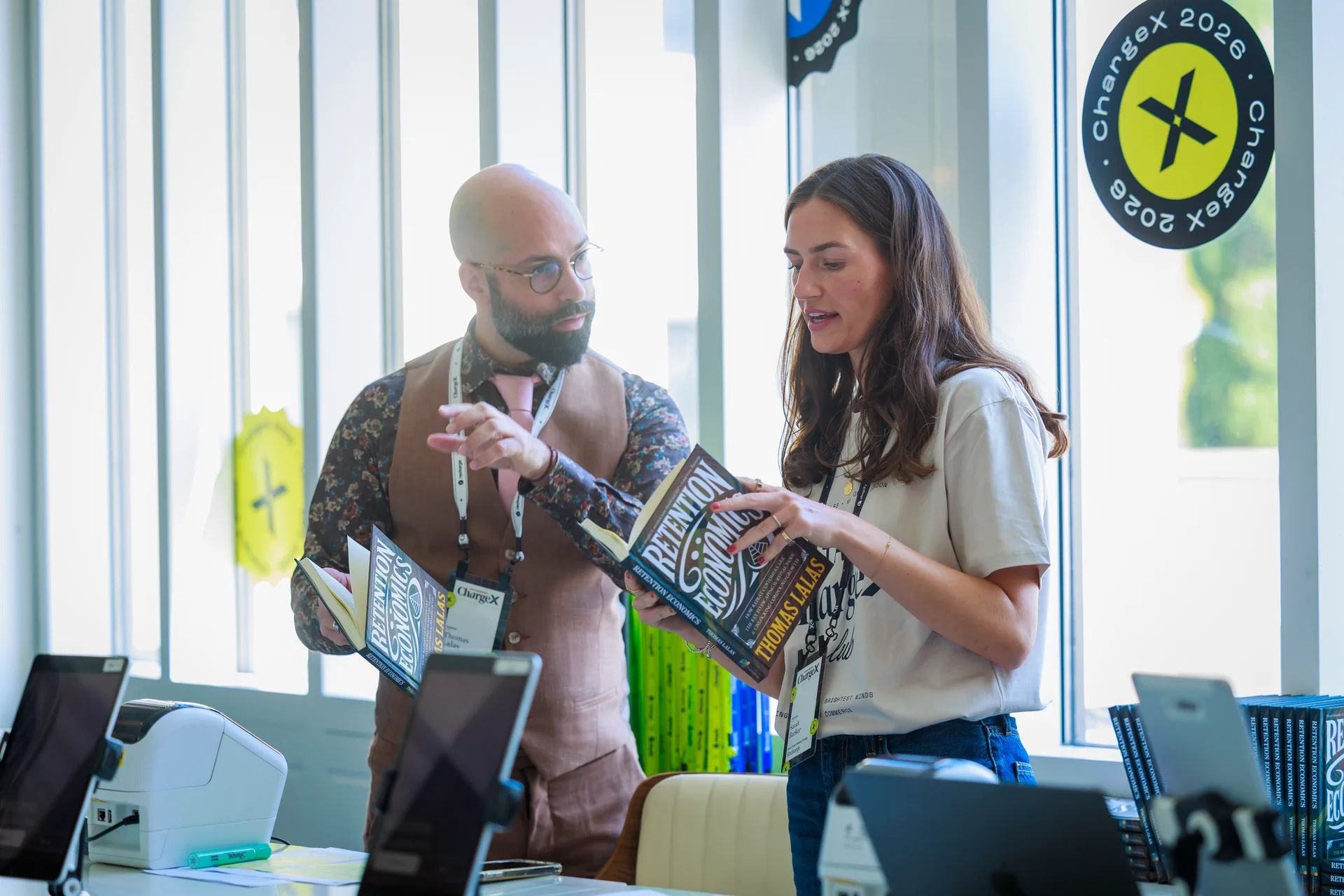
Thomas and I got into plenty more than fit here, including his RCM Pyramid, why he sells his book at cost, and the ancient Greece idea for his next one. He's also giving away copies of Retention Economics to the first five listeners who leave a comment or review with one thing they learned.
Related: Matt Edmundson on why repeat purchase rate decides what your Shopify business is worth, Steve Lequerica on what the best brands do differently in their first 30 days, and the free Repeat Commerce Scorecard if you want to audit this properly.

Co-Founder @ Bold Commerce // Host Shopify1Percent
Jay Myers has been in the ecommerce game for over 25 years. First as a merchant, then a service provider, and today a software provider. His company, Bold Commerce, has helped over 800,000 online stores sell more on Shopify. Their suite of apps help brands maximize LTV (Customer LifeTime Value), and AOV (Average Order Value).
Bold has been ranked one of Canada's Top Medium Sized Employers, ranked in the top 50 fastest growing companies in Canada by Deloitte multiple years, a Top Growing Company in Canada by the Globe and Mail, and winner of the Ernst and Young Entrepreneur of the Year award.
The $3 Box Insert That Kept Bringing Shopify Customers Back