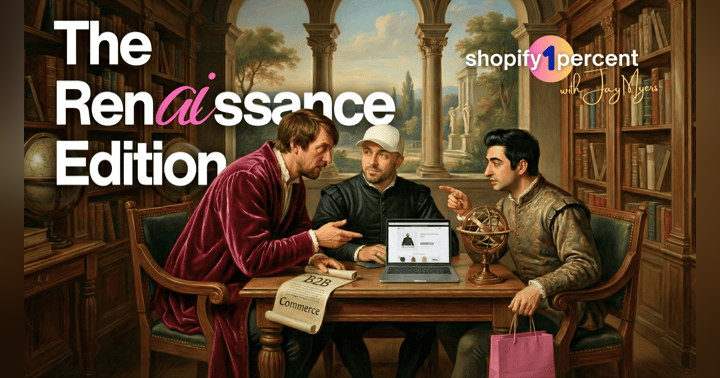
SHOPIFY EDITIONS "The Renaissance Edition". What's Good, What's Not, and What Got Missed?

Shopify just dropped Winter Editions '26, which means you probably should spend time reading the 150+ release notes and try to figure out what "Renaissance" actually means for your margins.
Fear not. I read them so you didn't have to.
On this special roundtable episode of Shopify1Percent, I brought in the heavy hitters—Gavin McKew (Shero Commerce) and Max Rolon (Domaine) to do surgery on the update. We strip away the marketing fluff to find the features that will actually make you money (and the ones you can safely ignore until 2027).


Shopify just dropped Winter Editions '26, which means you probably should spend time reading the 150+ release notes and try to figure out what "Renaissance" actually means for your margins.
Fear not. I read them so you didn't have to.
On this special roundtable episode of Shopify1Percent, I brought in the heavy hitters—Gavin McKew (Shero Commerce) and Max Rolon (Domaine) to do surgery on the update. We strip away the marketing fluff to find the features that will actually make you money (and the ones you can safely ignore until 2027).
We are cutting through the noise on:
Agentic Storefronts: Are consumers really ready to let ChatGPT buy their pants, or is this just another shiny object?
Shopify SimGym: Is unleashng an army of AI bots to stress-test your store brilliant, or just a really expensive way to find out your checkout button is broken? (Spoiler: The panel is divided).
The 2,048 Variant Limit: The meme is dead. You can finally sell a t-shirt in more than 3 colors without hacking the mainframe.
Native A/B Testing (Rollouts): Why this is the "sleeper hit" of the entire update and why you should cancel your expensive testing app immediately.
B2B Getting Sexy: ACH payments, Store Credit, and features that finally treat B2B buyers like adults.
Plus, the Elephant in the Room: We discuss the one glaring omission that Shopify still hasn't launched (Hint: It rhymes with "Customer Data Platform").
Stop guessing which features matter. Listen to this episode, implement the 1% wins, and go back to enjoying your life.
About the Guests:
Gavin McKew: Managing Director at Shero Commerce
Max Rolon: CTO at Domaine
🫶 Support the amazing sponsors that make this show possible 🫶

Omnisend - I personally use Omnisend for every Shopify store I manage! I’ve tried them all and Omnisend is hands down the easiest way to set up email and sms automations and campaigns, leverage segmentation to personalize them, and A/B test everything to optimize conversion. The push notifications and gamified email collection tools are just the icing on the cake 🤌
(plus most report paying about half the price of Klaviyo 🤫)
🚨Listeners (YOU) get an exclusive 30% OFF for 3 MONTHS: https://shopify1percent.com/omnisend

Bold Commerce - Maximize your Shopify sales with Bold's suite of powerful apps. From AI Upselling, to powerful Subscriptions, Memberships, and VIP Pricing tools, Bold has everything you need to Maximize your Shopify revenue!
Try Bold apps for free here: https://shopify1percent.com/bold
Did you know leaving a ⭐️⭐️⭐️⭐️⭐️ review on Spotify, or Apple will give your shop gooood ecommerce karma? ❤️
ay Myers (00:00)
We've got a special Shopify 1 % episode here. Last week, Shopify dropped their latest additions, the winter additions. It was called the Renai-essence, the Renaissance edition with the emphasis on the AI, because obviously a lot of the announcements are all around AI. So I wanted to bring on a couple of experts in the area. They're actually...
two companies that are our former guests on the show. Gavin from Shero commerce was a former guest and then I've got Max from Domaine Domaine was a former guest, but it was Mac from Domaine, not Max. That must be confusing at your company all the time. I guess. And three and three letters too, right? Like, um, so I brought in a couple of people. We're going to have a little bit of a round table discussion and dive into some of them, which ones are like ones you want to absolutely jump on right now? What are things that are maybe exciting, but
Max Rolon (00:35)
What an answer. It was like a mock-up as well.
Jay Myers (00:51)
not as important to get on and maybe what was missed. What are some of our favorites? So let's get right into it because there's a lot to cover. There was a hundred and over 150 announcements. We're obviously not going to touch on all of them. I would highly encourage everyone to go to the additions release page and read through it. like take block off a couple hours on your calendar. I mean, this is your business block off a couple hours and go through it and learn it. ⁓ but we're going to highlight some here and, and give some color on them. So let's get started. I,
First one on I want to touch on is the whole agentic storefront announcement. Shopify has, I mean, they announced this recently that you could Shopify and OpenAI were working together to make products discoverable in chat GPT and potentially be actually purchased. I'm in Canada. So this hasn't actually worked in Canada yet. I think in the U S it has for a brief period, but not everywhere.
but now they're essentially saying they're going all in and it's the new storefront essentially and Shopify's big announcement was that agentic storefronts are here and Shopify wants to be the place to store your product data if you want to be found. let's get some feedback on this. is this the new way that people are shopping or is this just another
top of funnel awareness thing the brand should be thinking about. Like I've got my Google, I've got my SEO, I've got every other social media and okay, now I've got to consider this or is this the new way that shopping is going to happen and we need to go all in on this. I'll throw it to like Max, let me throw it to you to start and we'll get feedback from both of you here.
Gavin McKew (02:26)
Thank
Max Rolon (02:32)
Well, it's definitely something to take seriously. think it's still, even though it might feel like we've been talking about it for six, 12 months already, it's like still ultimately early. Like when we're seeing, you know, GEO or chat like LLM based discovery trends across our brands, you know, we're seeing like exponential growth, like 300 to 500 % even, you know, over a small period of months, but we're still in like single digits of overall like acquisition channels.
Jay Myers (03:00)
Mm-hmm.
Max Rolon (03:01)
It's something
that where every branch would be like thinking about how they can turn up and use these tools that Shopify is building. mean, I think it's amazing that Shopify really is holding themselves accountable to be the forerunner in e-commerce integrations and approach with this type of discovery methodology. But I wouldn't, I wouldn't be stressing a lot. If you're a brand, I would just be using this time to get ahead of it. And thinking about the right ways to get ahead of it. Like working with brands that have GEO.
Jay Myers (03:24)
Mm-hmm.
Max Rolon (03:30)
experience. It's really, we see it as the next iteration of traditional SEO, like imbalance of tech and content approaches. And there are some things that you can start doing to be able to really get ahead.
Jay Myers (03:41)
Yeah, that's what I was going to ask. And Gavin, maybe you some thoughts. Is there anything stores need to do or does this just there's been some like comment that like, it just works now. If you're on Shopify, it just works. But I don't think that's necessarily true for the five million stores. All of this works. I think there's some ways you can optimize it.
Gavin McKew (03:58)
Yeah, I mean, I would agree with Max in the sense of, for starters, I think the brands should definitely not leave this off their radar. There is going to be exponential growth and we're seeing that ourselves. It does work out of the box, but this completely depends on store setup and how you've currently got it done. So there's a lot of third party apps that exist that kind of take data out of Shopify and don't store that data in Shopify. So essentially if
If depending on your store setup, if you're, if you're storing data in those third parties and you need to answer engines to use that data to answer questions, you need to look at ways essentially to get that data back into Shopify through some means that could be through Metafields, Metafield definitions. So I think for most brands, and again, it happens at different levels of scale and different levels of complexity. Essentially the route is
to get as much of your data natively into Shopify. And if you do that, you are set up. Obviously, this is just a Shopify conversation. Any other platform, it's a different conversation. But on Shopify, the rule should kind of be, how many questions can I answer from my Shopify data, just that data that lives within Shopify? And if you can't answer the questions that potentially are being asked on answer engines, how do I get that data read?
Jay Myers (04:55)
Hmm.
Yeah. Do you think this will hurt brands using third party PDPs like product data platforms where there's like, if it doesn't feed. Yeah. And if it, feeds everything in right.
Gavin McKew (05:25)
Depends where the source is. Depends where the source is. Yeah.
Max Rolon (05:29)
I think it's not, depends on how yeah, how it's architected. I don't think it like erodes the idea of using PIMs because typically a PIM based workflow still gets your core catalog within Shopify. Like Shopify is still the central location for that. For like Headless where you're using third party CMS and kind of binding that to product data. I mean, it's a consideration, but generally you should still make sure that the integrity of your product data within Shopify is correct and it's intentional and it has.
Gavin McKew (05:55)
Yeah.
Max Rolon (05:57)
the information that it needs to then syndicate to other channels just outside of your storefront. If you're not thinking multi-channel, you're thinking like a uni-channel or thinking we're putting too much emphasis on brand.com, like that's a concern.
Gavin McKew (06:09)
And on that point, Max, as well, think, is like what you... We're at this from a lens of Shopify's feed and the answer engines. But if you're using any type of PIM or any type of feed to anywhere else, lots of these platforms are obviously still connecting and sharing data with these answer engines as well. essentially, yeah, from a headless standpoint, as long as whatever is formulated in the headless or you're pushing your data with,
and we could talk about all the feed software and all PIM software, but as long as you're kind of covered, I suppose, from the element of the data it's selling, questions answered, Shopify is feeding all this in through ACP and ACP has been fed out that way. As long as the other elements to that stack where that data lives is also feeding that into ACP, you are covered, essentially.
Jay Myers (06:49)
Mm-hmm.
Yeah.
I said PDP. met Pim. I was thinking CDP in my head for actually a question. I know there's too many Akron's and yes. OK, let's let's move to the next one. I think I have like 15 on my list. I know we're not going to get through all of them, but I want to touch on as many as we can. Sim Jim is another one of the announcements that I thought worth highlighting. It's essentially.
Max Rolon (07:05)
So many actions.
Jay Myers (07:20)
In a nutshell, it's it's an app you can install. Currently it's in waitlist. I tried installing it today and I had to join a waitlist so it's not. Live yet, but you can install it. Get on a waitlist and the concept is for it to. Not user test, but more like stress test and so not usability, but functionality like do buttons work. It'll click everything it'll go through. It'll scroll. It'll try to break stuff and it. I don't know if it's at the.
level of actually creating like personas and like actually testing. Contents like headlines will this headline convert better or this it's more like does everything work? That's my my take unless you guys know different. What are your thoughts on this? Is this going to be a super value tool or is this more of a novelty that might be more of a distraction?
Max Rolon (08:06)
I'll go. mean, honestly, like I'm kind of mixed on this one. Like sometimes there's these reveals and it's really like devils in the details on the features and functionality to be able to address like mid market as well as upper and large and enterprise. think it's pointing to a future that I believe in, which is things like, you know, smoke testing or pre-release testing is going to be a mixture of manual automated testing. I think for a lot of brands, it's still heavily manual.
which is there for good reason. But look, if you can do personas, if you can eventually be able to create repeatable tests and regression tests that protect the brand as more brand awareness of where their own edges are, it could be really powerful. But if it turns into a generic tool where you can't put brand integrity baked into that tool, then it might fall short. for me, it's an area to watch.
and we'll see where it goes.
Jay Myers (09:04)
Yeah.
Gavin McKew (09:05)
This was actually Jay on my, and you asked earlier on the podcast what my least favorite item was, and it was this item, right? And again, I'll see how it goes, but let me explain a little bit why I think that it's kind of, I think it's kind of, it seems initially like it's really good for small to mid brands in the sense that it's an immediate appeal, ones that aren't doing this on enterprise, but to kind of, right now to convert,
Jay Myers (09:10)
Mm-hmm.
Mmm.
Mm-hmm.
Gavin McKew (09:34)
user query and user intent and brand personas around what that looks like. It's not particular. I'm not saying this on the, on the, on the, from the Shopify side, it's just not there in the AI. It's not there in order to, know, essentially if we think about how AI is going to work in the different ways to how it works within the current methodology to find them, whether that's social advertising or, or search advertising, it's problem fixing is what it works off. Right. And the realities are is
If it pursues itself to fix the problem that the user has and it runs those tests through every possible problem that the user could potentially have, it will kind of get there. There is a small, there's also, and again, this isn't a kick, there's a small fee essentially associated to running certain simulations at certain volume within the, I've got early access and a little bit of a testing. Again, yes, sorry, Jay, sorry, Jay.
Jay Myers (10:23)
Mm-hmm.
Ha, you bugger.
Gavin McKew (10:31)
But around that early access, the idea and the way that this is going is completely correct. And I think Shopify is almost showing the way that we need to think about this as opposed to this is the very thing that brands will use. Do know what I'm saying? So app developers should take note, look at what this could potentially look like, look at the root of what problems they are facing. It's definitely gonna be a problem. I don't think it's a problem so much today as Max mentioned earlier.
Jay Myers (10:48)
Totally.
Gavin McKew (10:59)
like the level of usage from answer engines and level of traffic isn't particularly massive. Let's see what 2626 brings, but then it'll grow. But I think it's kind of the direction of travel is the most interesting part for everybody, whether it's brand developers, agencies, especially.
Max Rolon (11:19)
I agree there. It's really good that Shopify is painting a picture and providing a low cost tool for a certain market. think time will tell exactly what that market looks like. But it is spinning the idea. It's showing the way. And Shopify ecosystem, the value comes from a lot of third parties that are tightly coupled within this ecosystem. I wouldn't be surprised if this becomes some sort of functional baseline and then
There's a whole bunch of third parties that start to take that idea, run with it and add fidelity to it. And then, you know, we might see just generally that there's more thought and intrigue around automated, know, same generation and testing, you know, coming into 2026.
Jay Myers (12:04)
Well, and it kind of leads into the next one that I wanted to highlight, which is native A B testing. Cause I feel this is in a similar vein. Some gym is more testing something that might be broken or AB testing is more testing. Does the user understand the copy? Does the images work better? Is there.
Gavin McKew (12:20)
Yes.
This is actually in my most favorite announcements as opposed to my least favorite announcements. Yeah, and that one would get the headlines and this one wasn't because this is wrapped in rollouts and rollouts does have A-B testing, which I think is super useful and it will definitely be used in the way that this is demonstrating, but it has things like, know, themes released at certain times, products released at certain times.
Jay Myers (12:30)
Okay, so we went from least to more, okay.
Gavin McKew (12:51)
linked to eBay testing, all part of rollouts. So I think essentially it's kind of in the non-agentic way, as a force, and in the more real, and more in the more real world usable factors by brands, agencies. I think rollouts is definitely a big player because A-B testing mixed with deployment of themes, products, catalogs.
Jay Myers (13:00)
Mm-hmm.
Gavin McKew (13:16)
collectively as an essential app has kind of been asked for years by lots of us in this space. We've had workarounds and we've had like, you know, certain things that we've done to make this happen. But wrapping A-B testing with theme rollout product uploads, I think it's massive.
Max Rolon (13:37)
It's funny, my least favorite and most favorite are like exactly the same as yours, Gavin. Like, it's funny that we're thinking the same.
Gavin McKew (13:43)
There you
go. Again, you've got to remember, when additions drops, you've got to grab headlines to a degree. There's a certain element of things that seem brilliant. And then that is why of, know, SimGym seems big and Rollout seems small. But the reality is his Rollout is big and SimGym's not small, but it's just not big to do. And it's got potential, it's got legs, shows the app developers the way.
Jay Myers (14:02)
Mm-hmm.
Gavin McKew (14:11)
And then kind of on that point, I think, Jay, just to add, I think, and you're probably gonna ask this, but I'll kind of just like kind of, cause I think it does lead into it, is I think around the favorite announcements of like how this really essentially looks for brands, developers, agencies. I think KatLog API, and you touched on this in the first point that you made, I think KatLog API is...
Jay Myers (14:31)
Hmm.
Gavin McKew (14:35)
probably the biggest and most influential thing collectively. think, and even though this was, like you said, this was announced a while ago and it's been announced a while ago, the biggest single thing there is not the fact of what it does and how it works. It's the fact that we all now have access to this, whether that is developers, app developers, agencies, how that can work, what that can look like. So that kind of leads into those two things, I suppose. But yeah, I'm interested.
Jay Myers (14:38)
Hmm.
Mm-hmm.
Mm-hmm.
Max Rolon (15:00)
Yeah.
Gavin McKew (15:01)
What was your favourite one Max? Did you have one?
Max Rolon (15:05)
I mean, it was around rollouts. I think like showing the investors into the headed CMS and like, you know, it's not just about A-B testing, as you said, it's like tied into the way that you can think about content, providing the ability for brands to be more dynamic and how they control that content, showing the fidelity of like a the headed CMS. ⁓ because, know, as you move up market and need to grow as a brand, you know, there are some pain points there and Shopify showing that it's investing in those pain points.
Jay Myers (15:05)
with
Mm-hmm.
Max Rolon (15:34)
know, Launchpad was how you would release content, you know, in the past, that's kind of getting deprecated. So this is the way that, you know, the view of it being more tightly coupled into that overall, you know, CMS ecosystem. And it also paints the light that we can expect more CMS based releases coming into, you know, the next edition. So I'd say that would be a place for me to watch.
Gavin McKew (15:58)
Of course.
Jay Myers (15:59)
It feels like we're close. Like to me, I wasn't as excited about the A-B testing, but it's interesting. Like I'm a huge believer in it, I haven't played with it yet, but I have to be convinced that it's better than some of the tools that are out there. ⁓ If it is, then it's huge.
Max Rolon (16:14)
Yeah.
Gavin McKew (16:16)
Yeah,
mean, yeah, I mean, it probably won't be out the gate, right? That's true. You know, these guys have been working in that space for a while. I think with AB testing as well though, and again, there's kind of a lot of, I wouldn't, there's a lot of strategic talk around AB testing, but, it is all relevant massively and how you deploy that, what that looks like, what the roadmap is. But at the same time as well, just to dip your toe into AB testing if you haven't. Now AB testing,
Jay Myers (16:31)
Mm-hmm.
Gavin McKew (16:43)
additionally only really matters for relatively decent traffic websites. Like there's no point A-B testing, low traffic websites. If the hook doesn't convert, the product's not a good product, the price point's not right, the basics aren't correct. Obviously most brands that work in the mid-large enterprise level and the kind of above, they look for something potentially a little bit more robust, but it's really interesting to see Shopify stepping into that space, bolting it on with other tools.
And I think that's really exciting and they could certainly build that out.
Max Rolon (17:16)
Yeah. And the other thing is like, it is just going to be like an A-B testing tool. Like it might be a too narrow dimensionality to think about it. Like it could turn into being able to create content charting across different customer segmentation over time. Like, so I think...
Gavin McKew (17:33)
Yeah, I think B2B
Jay Myers (17:34)
That's what I'm hoping.
Gavin McKew (17:34)
Max as well.
Jay Myers (17:34)
I hope there's a bigger vision to it. I actually hope they, the AI theme building, theme generation, I hope when you create a page, you can create, push a button and create seven different variations of it with moving content around and having a hero image or a small image and like, yeah, well that's, and that will be powerful.
Gavin McKew (17:47)
⁓ Yeah, it's going there, It's going there, Jay.
And it will be massively powerful. And if you even think what it could mean for the B2B segment of Shopify in the sense of, if you look at B2B catalog surfacing or B2B themes based off which catalog you view, there's so many variants and so many options that they could build into rollouts.
that essentially have not really been discussed because they've just announced rollouts as a relatively small feature. But at the same time, from the Sidekick side, from the B2B side, from the enterprise side, there's so much more they could build out within that functionality, which I think is really exciting.
Jay Myers (18:31)
Variant limit. They raised the variant limit. This was a big enough, you know, it's funny. We started, so I had a store on Shopify in 2009, started building apps on Shopify in 2012. And there was always this hundred variant limit. I actually remember talking to Toby in Ottawa. We used to like spend a week out there every year and I'd say, how can you raise the variant limit? And there's like, no, there's no, his exact words where there's no logical reason a product should ever have more than a hundred variants.
Max Rolon (18:40)
Mm-hmm.
Jay Myers (19:01)
And then I would talk to like other employees and I would say like, why can't I like, I actually had another store in big commerce and Shopify at the same time. And my store on big commerce, I sold sporting goods spies. had like hundreds of variations and colors and sizes, but then on Shopify, I had to create multiple products of the same one. and, and there was one person that actually told me it will never be increased. The way that the structure is built, a product structure can only have a hundred. It'll never be increased. So
Max Rolon (19:29)
That's why it took so long is because they needed to do kind of surgery onto their basic primitives to enable this. Like I think I heard about this like two years ago. And so it's good to see that it's kind of getting into the.
Jay Myers (19:29)
They finally did it.
Gavin McKew (19:32)
Yeah.
Jay Myers (19:35)
Yes. Yeah.
Gavin McKew (19:40)
It
Jay Myers (19:41)
Yeah.
Gavin McKew (19:41)
was announced about a year ago that it was happening and then it took a year to get it, which was fine in the sense of at least we knew they were moving in that direction. At the same time though, if you think about the variant limit, we get a variant limit, but we don't get a variant options limit, which is like, so you've increased the variant. And this is again, I'm not kicking Shopify, but in reality, so you can add 2000 variants to one particular option. So I can say color and I can offer 2000 colors.
Jay Myers (19:41)
Well, that's.
We're coming. Yeah.
Right.
Gavin McKew (20:08)
But if I have color, size, weight, dimensions, style, fragrance, whatever, right, as an option, as other options within those 2000, we're not quite there yet. This isn't a kick. It's just you still only get the same amount of varying options within what that is.
Jay Myers (20:25)
What is that
amount? I'm actually not aware of what the limit 8 8 options.
Max Rolon (20:27)
Three. Three. Yeah,
Gavin McKew (20:28)
it's three yeah
three it's still three so yeah it's three
Max Rolon (20:30)
it's good. Yeah. And that's.
Jay Myers (20:33)
⁓
interesting. thought it was OK. So you can only have three different types of options. But.
Gavin McKew (20:39)
Yeah, exactly. So if you've got color,
size, yeah, exactly. If you've got color, size and weight, hypothetically, and then you want to add flavor, I'm using this all hypothetically, you could not add flavor, even with lesser variables. Now, obviously, I think they're obviously going to be looking at this and they've had to do open heart surgery to get to 2018. So it's a massive shift to the database. Think about increasing that amount of levels across the amount of stores that Shopify has.
It's pretty wild in terms of data infrastructure. I would imagine we'll get that within a year, but right now the three options is there.
Max Rolon (21:14)
And there's
a couple of things there as well. Like there is certain verticals that this is really important for. Like we've worked with shoe brands that have a lot of different color variations when it comes to this, that top line. And we have had to explode products and stitch them together on PDPs to be able to see their product catalog. And this does help that where they did, they still could use three varying options to be able to get that done. Also beauty is a big part here. Like beauty have a lot of skin color shades and a lot of shades that they put out into a single product. So it makes sense to be able to.
utilize this to make their product catalog simple. Technically, you can get four if you use combined listings, which is why they probably kept this there for now. You can use a combined listing approach with Shopify to be able to get three and get a fourth there to stitch together multiple products in a kind first party way. And then the other thing
Gavin McKew (22:04)
Yeah, I think I was going
to stipulate on that point on Max as well as if you look at it from a beauty standpoint or a car parts standpoint, let's say so two very different verticals. Let's say car parts, a crazy level of options within a computer configurations. You're trying to build a computer. Hypothetically, you need all the parts. You need to build all the configurations. The problem still lies within that sector, but obviously is still massive in
Max Rolon (22:13)
Mm-hmm.
Gavin McKew (22:32)
a small amount of variation, a small amount of options, but a large amount of variation sector. Beauty has just been fixed, essentially. Car parts and building computers, not up.
Jay Myers (22:42)
We built, we built an app for that in 2012 called product options. Literally. Yeah, we've, we, we made a lot of money off of this a hundred variant limit over the years. We actually, don't have that app anymore, but, no, there was like dozens. We built the very first product options app ever, but I think now there's probably hundreds. don't remember. I don't even know, but,
Max Rolon (22:44)
Yeah.
Gavin McKew (22:45)
You did. You did. I've used it many times.
There's
a few key players, there's nothing like serious in that, you know, there's five or six kind of players that play in that space.
Jay Myers (23:07)
Yeah.
⁓ I think the one, one piece of advice I'd give listeners is, you know, sometimes just because you can have a lot of options on a product, there's sometimes still a strategy. And I don't know, you guys might have opinions on this, but if you're looking for a t-shirt on Amazon, you'll often see brands, what they do is they put the red one is a product listing, the blue one is a product listing and the green one is a product listing. So it's actually three products. And then when you open it up, each one has its own size. And so it covers.
It's sometimes a better shopping experience when you're browsing a collection page. Like if you're selling a winter jacket and there's variations to see the variations and drill down, it's like when you buy a Mac, like this always blows my mind. When you, if you go to buy a Mac or an iPad or anything, there's only one, they just have different memory, different screen size, different processor, different. mean, they really only need one, but if you click to buy a Mac, they show four or five.
And then you open that one up and then there's a couple options because that's the way customers think they don't want 2000 choices on a product. They want to go down a choice path, right?
Max Rolon (24:13)
Yeah,
it's like, this is one of the biggest decisions that brands should be thinking about with product merchandising when they are thinking about how to architect or re-platform or rethink the theme. It's how do you want your products to either stitch together or combine? And how do you want it to come into listing pages and PDPs? There can be some patterns around like average order value and the need to explode. Like jewelry is a great place where you have every single iteration on a listing page or collection page.
You said like high-end jackets is a good example there, whereas for more commodified or smaller price point products, you might want to combine. It's just, there's not a rule by any means, but you know, there can be some patterns that we see there.
Gavin McKew (24:52)
Depends as well, feel on the angle that's asking the question. So as an example, if you're speaking at a brand's SEO team, they might prefer having single listing pages because they get more control, right? So, now that's gonna change slightly if we move a slightly more into the agentic answering questions route, unless on any to Google, whack something and hope we've got more H1 tags. So when we kind of get into the weeds of like different, whether it's a merchandising team,
the SEO team, the marketing team, they will all have that slightly different opinions. It's very brand driven and very user journey centric on how the expectation because like you mentioned earlier, if I'm looking for a red t-shirt, a blue t-shirt or a white t-shirt and I land on the white t-shirt, but I'm actually looking for a red t-shirt, you have the potential to lose me as a customer at that point, right? You can, can go somewhere else, especially on Amazon. But you could go, well, if the red t-shirt was on the same PDP,
Jay Myers (25:26)
Hmm.
Gavin McKew (25:48)
Well, I would have potentially bought the red T-shirt and that's the same from and getting into the psyche of what this looks like, but also as well as a really great feature would be to put this in the A-B testing app would be to almost combine, combine listings with A-B testing, surface that there and then pull that backwards.
Max Rolon (26:07)
Mm-hmm.
Jay Myers (26:08)
Yeah, I want to show you guys something. This actually just throw it up here. I mean, I think there's a lot of psychological. So we're looking at the Apple website and this always baffles me. So this is the MacBook 14 inch model. There's only one 14 inch model, but when I go to click buy, it'll show me a few different options here. The 10 core with five, 12 gigs, 10 terabytes. And then this is also 10 terabytes, but it's got higher memory.
If I click into any of these to buy, but you notice the difference here, this is $2,300 more and another $300 more. So I'm only making a $300 decision on each of these. Now I go in and if I pick this one, that's my base. Now I might upgrade the display. It's 250. I might upgrade this. It's this, but I've bucketed. Like if I started on the cheapest model, like if they just said, buy a MacBook and it started on the base,
Gavin McKew (26:45)
Mm-hmm.
Jay Myers (27:03)
And now I have to add all these other options as a customer. I'm feeling like I'm adding so much and it feels like it's getting expensive, but people can make small choice decisions in steps. And so like a jacket, let's just go back to that example. If you've got different levels of insulation and there's different qualities, like let them, the customer identify. So break that out. Like I would pick the whatever model here and then I would add on the better screen. I,
Gavin McKew (27:32)
It's
essentially, Jay, it's making small decision, a big decision into small parts of a decision without scaring the buyer. So essentially is it's breaking this down psychologically into if you go onto a $1,500 Mac and you end up buying a two and a half thousand dollar Mac, Apple absolutely nailed this, right? They see this slight incremental bump, whether it's on a spec bump within a feature you want, but they split it out in such a way.
Jay Myers (27:39)
Yes.
Yes.
Gavin McKew (28:02)
that it almost feels by the time you've added two or three of these items, that tiny decisions really have made actually quite incremental gains on AOV for Apple. They definitely, definitely nailed this. mean, nobody, nobody goes onto Apple and buys a Mac, clicks buy and clicks buy again. Like nobody, right? They don't click buy twice. They just don't, right? They click buy, they review what it is. They make a small decision that they need a RAM bump or an hard drive bump or they need some software.
Jay Myers (28:29)
Mm-hmm. Mm-hmm.
Gavin McKew (28:30)
or they need
a keyboard, they click that button and they get that ID, increase the OV. There's a lot of lessons in this, I think.
Jay Myers (28:35)
Yeah, totally,
totally. And then, and it's like, just because there's tools, it doesn't mean that you got to use them in a certain way. So because there's 2000 variants, still think about your strategy. So let's move on to the next sidekick pulse. sidekick is the Shopify's little, sometimes I call them Clippy, little ninja guy in the corner that you can talk to and it'll help you with your running your store. I never used it for the longest time.
just in the last couple of months, I've actually found it pretty helpful. And the main reason things I use it for is running reports. So there's some canned reports, but like if I want to go in and run and actually run like a write a script to run a query to get certain data ⁓ also for customer segments, I found it really useful. Like create a segment of VIP customers who've bought X amount of times and spent a certain amount. But now it's getting proactive. So now it's going, you have to opt into this.
I think it just shows in the it's live, I think for everybody. When you log into your Shopify admin, you'll see it up at the top to opt in opt into what is it called Shopify insights, I think is the term anyways, as long as you opt into it. Sidekick will give you proactive advice on running your store and optimizing maybe abandoned cart emails or optimizing others like proactively telling you to do stuff based on
the data it sees. Thoughts on this?
Max Rolon (29:57)
I am overall, I'm bullish on Sidekick It's, I did like a talk on Sidekick maybe like three months ago and the cliff notes were like, it's cool, but like, don't take away the human component of it because it is merging tool. Like there's been a bunch of, well, Shopify released an engineering behind the scenes, like an hour long talk. And I thought it was really interesting how much they're investing in this part of the business. Like this is not just like attack on this is like quite a
Jay Myers (30:09)
Hmm.
Max Rolon (30:25)
strong investment that has a lot of AI experts. And in order to like, capture, like to action this data set and build your own pipelines, like it's, it's a real soul here. And I think, you know, we're still seeing it to grow and develop. I think Shopify is still playing around with it, but I think it has the opportunity to be quite powerful. And I see there as being, um, uh, yeah, like a behavioral trend for administrative
power users where instead of doing a bunch of these clicking, particularly, you know, can save a recurring pattern that you do and put it into. I kick and use sidekick as your, you know, like one of your core areas interact with the admin. think it's got a good training mechanism here too, which is not, you know, if that, if Shopify is like changing the UI or introducing a new feature, you don't have to go like try and find that you can just ask sidekick. And then I think data and insights is also a really important part.
Jay Myers (31:00)
Mm-hmm.
Max Rolon (31:20)
They rebuilt Shopify's querying language, Shopify QL, with the last release of Sidekick so that they play really nice together. And we're starting to really see that come through. think that was in the details again. Like if you're doing location-based segmentation, like maybe check if it's on billing address or shipping address, if you're looking at orders, like some things like that. But it's exciting. And I think it's good to see that they're capturing proactivity and being able to use some of these tools. Again, I would just urge...
Jay Myers (31:29)
Mm-hmm.
Max Rolon (31:47)
Check it, make sure that you as a human believe in that insight before you go ahead and action it because there's probably gonna be some hallucinations or some considerations.
Gavin McKew (31:57)
Yeah, I agree Max. I think Sidekick is becoming center in front of where Shopify is going to go though, I think. There were three real things I think were big on Sidekick this time. And the first one was taking the gadget.dev approach and deploying apps. So essentially allowing you to store databases. And if you can store databases, you can run small apps and get that developed. I think that's really exciting. Really early, so I don't think it's going to really be heavily used by anyone of any significance.
But certainly small brands that can't really, I don't really want to spend money on apps and they kind of want to think they can kind of control it themselves. I think that'll be used now. That will change in the future. Second one I think is, and this is the big one, this is probably one of my most interesting points of additions. I think Sidekick app extensions was probably the most interesting point of the whole additions out of everything was, I speak to what we build apps, Max will build apps, app developers I speak to every day.
How do we get AI into Shopify? What do we do? Essentially, they were building an infrastructure layer, putting their own credits on it, pinging it out and making that ping back. Now that there's app extensions, you can essentially use SciKick through two means to use and read that data and read it back. So I think that's really interesting. And the third one is kind of around, well, the report inside was always part of it from summer editions.
You haven't really seen much sections being built in Shopify. And I seen, I seen from one demo the other day building some really advanced design sections on front end. I think the design side of what this could potentially do. Now, don't get me wrong. It's not going to be what the agency level can do or any means by that. But I think for smaller brands, I think given elements of design within sections directly in Scikit could potentially open up some opportunities for brands. There are the three, but Scikit app extensions.
Jay Myers (33:18)
Mm.
Gavin McKew (33:44)
for me is probably the single side of rollouts, probably the single biggest feature I feel in this edition.
Jay Myers (33:52)
I put it as my Shopify's all the stuff around Sidekick as my number one, like I think impactful thing for merchants because I, they be testing is awesome, but I think Sidekick is getting to a place now where like everyone should be using it. Even if you're just asked like ask it questions you wouldn't normally ask, ask it to analyze your, business's health for the last three months. What, what products
Gavin McKew (34:14)
Yeah.
Jay Myers (34:17)
⁓ are at least performing best performing run a sale on the ones that are like ask of things you wouldn't only think about doing and it's, it's there. Like it's good.
Gavin McKew (34:25)
And
one thing that is interesting as well is I read and I heard that Shopify's token limit that they used within Sidekick forexed in the last quarter. Now bear in mind that it forexed in this quarter without all of these features released. So let's suppose it forexes again. Now, I mean, I don't want to get in the granular detail. How long can Shopify hold those tokens, whether that's for app developers or merchants? I mean, there's going to, if it gets significantly heavy use.
Jay Myers (34:40)
Yeah. ⁓
For sure.
Gavin McKew (34:53)
It's got to live through some level of channel. And I know Shopify use Anthropic and Google and OpenAI and kind of merge that into their own knowledge base and outputs what that is. And they've got their own infralayer. But I think the usage was already forexed in this quarter, which I think is super interesting. What about next quarter?
Jay Myers (35:01)
Yeah. Yeah.
Max Rolon (35:10)
That isn't,
yeah, yeah. I wonder how long they can stay. No, that's a good point. But I, yeah, maybe, yeah, exactly.
Jay Myers (35:15)
But if it helps merchants make more money and they're making money off of the
know. Yeah.
Gavin McKew (35:19)
That's a very solid argument in the sense of what it is. But if it really pivots and they set that up with flaws and they start setting full automations up and not using credits every time, there's risk there. But anyway, it's sort of worry for now, but it's just a consideration.
Jay Myers (35:28)
Yeah. Totally. Yeah.
Max Rolon (35:34)
Yeah,
Jay Myers (35:34)
Yeah.
Max Rolon (35:34)
yeah, probably wouldn't worry about it. But yeah, the embed is really cool. Like when I was thinking about SideKick months ago, was like, what if the actions that you could prompt could be done in recharge or could be done in the third parties that make up your stack rather than just like siloed in the single instance of Shopify? So now that those ties are starting to get unraveled, it just becomes much more of a powerful tool.
Gavin McKew (35:55)
Yeah, the
amount of conversational AI conversations I had with people building conversational AI for Shopify apps, know, there was, mean, everyone was essentially building the same app and it was how do we build conversational AI? And I was essentially saying, when this surfaces on Sidekick, it's gonna, you're better off to surface in it naturally anywhere and then it's gonna happen anyway. I think another interesting point on Sidekick and this is for the future. I think, if you look at Sidekick right now, it's only backend right now.
Jay Myers (36:03)
Right.
Gavin McKew (36:24)
Everything exists in admin on SciKick. And I think one of the most interesting things would happen, especially across the app ecosystem, will be when SciKick goes front end, right? Right now, I serve at SciKick as an admin on Shopify and I have certain tools. Now let's suppose that that doesn't happen and I can use it on the front end for different use cases for users. That's a very interesting use case. What's your thought on that?
Jay Myers (36:27)
Yeah.
Yeah.
Okay, now take that one step further with,
because the next on my list was the Shopify product network. And then you also have Shopify, shoot, what's it called? Where you actually like drop ship, ⁓ collective, collective. So Shopify product network they announced, which is kind of like an affiliate experience where you can show other people's products on your site through search.
Max Rolon (36:59)
active.
Jay Myers (37:12)
If they click through and buy it on that other site, not on your site, and that's the difference between collective, um, you get some type of an affiliate fee and I don't know what that is yet. I don't think they said, but it's probably going to be like five to 15 % like typical affiliate kind of fees. And then you've got collective, but I was like, now imagine it's like Shopify slowly becoming a marketplace. I think everyone knows that. Um, well, it's shot. is a hard, it's a market. Yeah. Yeah.
Gavin McKew (37:38)
What's the Shop app? What is Shop app? Shop app is a, it's
the second or third biggest app in about 12 different countries right now worldwide, up there with Google. So yeah, it's becoming a map.
Jay Myers (37:48)
It's
I still remember when they were arming the rebels though against the Empire against so that yeah, but but it's a it's such a delicate thing and I actually think Shopify is doing it in a way that is good. It's a it's like if they just full on I mean they did launch a marketplace years ago and they shut it down but but now they're kind of slowly.
Gavin McKew (37:53)
They're still doing that. They're still doing that. Just in a different way.
They're covering themselves.
They have to cover themselves here, aren't they? In the sense of that they need to cover themselves from the agentic side, from the from the marketplace angle that could happen. As long as essentially they get checkout, which is again what's happening in agentic. They have to cover themselves from all angles and the level of velocity that they're building and developing in all of these areas. There's literally nobody. There's nobody in any ecosystem, let alone e-commerce that's building anything at the velocity that Shopify does across.
so many different verticals and I think that's like when you I mean when summer editions dropped I was blown away by how much they dropped and then winter editions drops and they do it again there's literally five and a half months between it so yeah correct though
Jay Myers (38:44)
Mm-hmm.
Well, when
you mentioned like sidekick living on the front end of the store, have you played around with shop app when you ask it's AI for a product?
Gavin McKew (38:54)
There you go. that's
it. exactly. And then you can buy multiple stores. You can have multiple check. I did it the other day. I ordered three products from Japan, two products from America and two from Europe. I'm in the UK and in one checkout in one time all on the shop app. And I had the level of trust that I knew that I could see the reviews from there. So I could read them directly from the app and that I would be some level covered. So this marketplace isn't just like
Jay Myers (38:59)
Yeah.
Gavin McKew (39:21)
individually localized to that region. I'm using shop apps to order worldwide, essentially.
Jay Myers (39:28)
Yeah.
So is it good or is it bad Shopify product network should be should merchants be turning it on to make some more money or cause it caused more damage?
Max Rolon (39:35)
I think it's like for me, it's
like a place to watch. as again, it goes back to this market thing and like how, like I think brand integrity is like a big part of it. Like how do you control where you turn up and kind of control that channel and like, you know, reputation of that perception. So me like.
Gavin McKew (39:44)
Yeah. Yeah.
Jay Myers (39:46)
Yeah.
Yeah.
Gavin McKew (39:52)
Luxury, luxury,
luxury or struggle Max, I think, you know, luxury products would probably not not be of a good vertical, like in that sense, but potentially like utility products or homeware products, potentially like in that region, it works. It's very niche to niche specific and brand orientation and layout specific. So I think like, yeah, there's definitely use cases. It's a clever idea. It's smart. But at the same time, the brand needs to make that call.
Max Rolon (40:02)
Mm-hmm.
Yeah.
Jay Myers (40:21)
Yeah, like I'm,
I'm, I'm a fan of collective. actually I'd like, I'm I'm I was, I'm actually a bigger fan of Carl. And if you guys use the Carl, it was been around long before collective and they actually have a much more expansive network that you can pull in products from target, from Walmart, from best buy. It doesn't just have to be a Shopify brand, but, ⁓ we've seen stores who have a single skew, like maybe they sell a blender and bring in a product that compliments it. Like, ⁓ the oil to
Max Rolon (40:28)
Hmm.
Jay Myers (40:50)
to put on your blender to keep it running. It's not something they sell, but there's good blender oil. And so they use Karo to bring that in, sell it on your site, one checkout, one experience. It feels like a brand like that I get. And I've seen stores like increase their average checkout size, like 60 % by adding products that are very complimentary to their core.
Max Rolon (41:13)
That doesn't
make sense to me. And the other thing that I can add is...
Gavin McKew (41:15)
Is this the
new drop shipping? Is this the new drop shipping? Is it collective meets Shopify catalog? Is this the new drop shipping? Is there a way to kind of, do people fall in angles within that? I don't know.
Jay Myers (41:19)
That's the question.
Macs are some of the brands that you work with using Collective or Caro or...
Max Rolon (41:31)
Collective is, I'd say like it's kind of come up when you can control their surfaces. like, you know, we work with a lot of multi-brand kind of businesses where the need to like, bring that product catalog onto multiple Shopify stores is something to solve. Like it can be sold through a PIM for example, or you can do that cross up cell using something like Collective. And so that's where Collective can kind of shine rather than, you know, the wide sweeping thing, which is I'm going to allow my pop prop
Jay Myers (41:36)
Yeah.
Max Rolon (41:59)
my products to be published anywhere. That is something that we don't typically see a
Gavin McKew (42:03)
It's probably handier for smaller brands as it is for larger brands, you know, get some level of exposure in places you necessarily wouldn't. Really, it's about surface and products and essentially maybe getting some free level of exposure. But I think for the larger brands, certainly when they're trying to protect the brand, it's maybe not prevalent.
Jay Myers (42:22)
I know we're getting close on time here. I want to pick one more feature that we highlight and then I want to talk about just one thing that we think was missed in this one. So Max, I know you've you saw my list. You probably have list in your head. Is there one that we think we should highlight that we haven't talked about yet?
Max Rolon (42:37)
I mean, I got like a boring techie one, but it's been nice to see Shopify investing in a bit more of its POS back office, like omnichannel office, like small, but the fact that they took away the time limit on inventory system of order. Data retention is a big one, like proper IMS, like proper inventory control within Shopify. It starts to break down at scale, and then you're thinking about what you can bring in there.
Jay Myers (42:45)
Mm-hmm.
Max Rolon (43:03)
And so the fact that they've got purchase orders, transfer orders, you know, more, more inventory elements there. And then starting to bring that into the POS surface is a very comforting thing for me to see is where looking at POS gaining more more traction and being more more attractive for brick and mortar scale brands.
Jay Myers (43:21)
Yeah,
they're clearly that is a future path for them like that is there. Yeah. Gavin, what which one would you want to highlight that we haven't yet?
Max Rolon (43:24)
Perfect. Yep. Yep.
Gavin McKew (43:28)
I agree.
Well, I've got a few, I'm just going to do one which links exactly to what Max has just said. And I think I'm going to mention B2B features. So I think collectively, the B2B features, again, we got POS, we got some hardware, we got lots of tiny features that make big differences. I think B2B got the same as well. Potentially not had the love it's probably deserved over the years. It's had to kind of be the second cousin to B2C. But I think we've just seen the shift a little.
Jay Myers (43:38)
Mm-hmm.
Gavin McKew (43:56)
on that to a degree in this editions and it was nice to see some B2B features and again linked to POS. So I think that unified commerce angle is becoming more relevant.
Jay Myers (44:06)
Yeah, I noted a couple of highlights. I thought there was some really good ones in B2B too, so that you can now issue store credit to your B2B merchants, is important. ACH payments, when you're doing huge volumes, saving a couple percent.
Max Rolon (44:18)
ACH and
Shopify Payments was good.
Jay Myers (44:21)
Yes.
Gavin McKew (44:22)
It's is good. I mean, because again, you've got to think and this, you know, how does Shopify make money? It probably makes money from this check out, right? And if you have to give some of that of way to create efficiency around how B2B users use, I think that's a really interesting player and very proactive from Shopify to act on that and deliver what's kind of been asked in the B2B space.
Jay Myers (44:44)
Yeah, and then the dynamic payment terms I thought was very useful too. So if you want to give different terms to a wholesaler who spends hundreds of thousands with you a year versus someone who doesn't, you can give them longer terms, better terms like net 90 with 1 % versus net 30 with 2 % like.
Gavin McKew (45:01)
Yeah
Exactly,
yeah, mean, only had like the obviously the terms meets catalog setup. So you had to set a catalog set of set terms. And then you could you didn't have any level of dynamic between catalog and terms. The fact that we can now do that massive so many use cases.
Max Rolon (45:20)
And the fact that like everything is back-burned by the API. that like big part of B2B is extensibility of B2B and how it fits into a, you know, PRP and all that kind of stuff. So the fact that payment terms are exposed in an API layer is also like.
Jay Myers (45:36)
Yep. Uh, one last one that I wanted to highlight. It's a small one, but I think it's actually super useful. And I've found myself needing this a lot is the direct editing in the theme editor. Um, it seemed like a small feature that not a lot of people talked about, but now in your theme editor, if you want to change the price on a product or change copy or change something, cause I always would have got my theme editor and then go back to the product and go back thing and context shifting costs a lot of time.
Gavin McKew (45:45)
Hmm?
Jay Myers (46:02)
And when you can do something when you're in one workflow, I find it a lot easier. This might be for smaller brands with not where they're managing their only a few products, but I think it'll be a big time saver for a lot of brands.
Max Rolon (46:14)
Yeah, me too. It's not just about editing. Like you can actually see the value. So it's like, even if you don't actually edit the thing, the fact that you have visibility on those data endpoints can continue going in that.
Gavin McKew (46:15)
Agreed.
Jay Myers (46:23)
Yes.
Yeah, think that's that you'll actually be able to see. All the options that are on a product and change them right from there as well too, right? Yeah, I haven't played with it yet, but that's my.
Max Rolon (46:33)
I so.
Gavin McKew (46:33)
Yeah, you can see
the options. You can see anything that it lives on within the Metafields or anything that it subs off that particular field. Hugely valuable, even valuable from a standpoint if you were to bring in a third party ERP integration or you want to do anything from an integrational standpoint at a later stage, at least you can see where that lives, what that looks like on the backend without necessarily having to scope around and look at what that looks like in the backend. So yeah, really great.
Jay Myers (46:42)
Super viable, yeah.
Yeah
Yeah.
OK, what was missed? What was the thing that was there anything you were hoping for that didn't get announced or? You think?
Max Rolon (47:07)
I want to see a little
bit more in admin permission growth and some thinking about the different workflows of brands that come in. I think this is going to be an area that will see some traction in 2026. So I'm not holding my breath for too long. kind of that and how it might play into market, how you might be doing. You could get users in certain countries to be playing nice in certain parts of the instance together would be a good thing that would enable some of the brands that we work
Gavin McKew (47:35)
I think one thing that was slightly missed and they released SMS through contact and now I think you've probably seen how you can now SMS as well as email through the through.
Jay Myers (47:43)
Yeah, it's now instead
of Shopify, it's Shopify messaging.
Gavin McKew (47:47)
Shopify messaging, I think the part, and I don't know whether it was necessarily missed as opposed to it's just in the roadmap and they build it out, is if you look at what like Claviyo and whatnot kind of do around flaws and how that links to that messaging, I think some type of unification between messaging on SMS and email, but that's kind of potentially linked to flaws. it's kind of like, you you can essentially build contact flaws within Shopify itself.
using these native features because right now the reason I think if you and I obviously Shopify is invested interest in Claviyo but in the sense of if you look at if you look at for smaller brands why they would need Claviyo it's essentially around communication and flow and really Shopify already has that because it has flow and it can now comes through SMS and email but the part of the unification of that pulling together yes it can be built but it should kind of just be kind of almost there small but massive
Jay Myers (48:44)
I, the one I thought I, I think it's going to happen, whether it's the next edition or a few additions down the road is I, I feel like Shopify needs to launch Shopify CDP. So like, and that's what I was thinking in my head earlier when I said PDP instead of PIM, a customer data platform that like, seem to be going in this direction with their AI personalization. They've kind of got loose customer segments you can create and they're
kind of building a lot of wrappers around it, but like a true customer data platform of knowing who the customer is, everything about them, the lifetime.
Gavin McKew (49:18)
Yeah.
And then also
link to PIM as well on that point here as well. We're seeing on our end as many migrations with Shopify to PIM as people who were getting rid of PIM and then using PIM on there. then the only part that they miss is that CVP part where they want that full kind of what's the customer journey? What are they all doing? What does that data set look like? But bringing all that together as a collective is kind of...
Jay Myers (49:29)
Mm-hmm.
Yeah, yeah, I just,
go in some stores and like the tags on products just is overwhelming and the way that they're managing it. And I thought, and actually I asked ChatGPT if like, does this make sense? Like should Shopify be going in their direction? it said, Shopify is essentially building an agentic commerce future on top of a customer model that was designed for 2014. So I guess.
Gavin McKew (49:51)
Shit.
Yeah, I if you could definitely, you could, I like that cynical view. I like that cynical view. It's pretty true.
Jay Myers (50:11)
I don't know. was a bit harsh, but.
Max Rolon (50:15)
I-I-I-I-
Jay Myers (50:19)
Thanks.
Max Rolon (50:20)
But I think it's a good question to ask. Yes, it's investing in Ingenetik, but it's also investing in owning the customer more and more. like the big part of the unification story is like have a unified profile of that customer and then be able to action that across a multi-surface channel environment, turn up anywhere someone wants to interact with you. And so I think it is going to mature over time. I'm very interested in the interplay with something like Claviyo that
Gavin McKew (50:40)
Yep.
Max Rolon (50:48)
You know, is some CDP there as well. you know, that's really tied into SMS and email and app prompts and what have you. And what's the big picture there and how much does Shopify want to take on?
Gavin McKew (51:00)
And is as well, Max, on that. think, I think SciKick's potentially the eyepass for all of those things to happen, whether they're unified apps and non-unified apps. And I think if you start to look at it a little bit that way, in the sense of like from a brand perspective, I think that's where they see SciKick living. It is essentially the eyepass for all these internal flaws to then be built out, like these full customer journey, on and check out, A-B testing, report flaws, and then report back. And I think...
Jay Myers (51:07)
Hmm.
Hmm.
Mm-hmm.
Gavin McKew (51:28)
It's some really smart moves by Shopify in how they're kind of getting there without really demonstrating the master plan.
Jay Myers (51:35)
Yeah, agreed. Well, this was fun. There was 147 ones we didn't announce so or that we didn't discuss on the show. Make sure you check them out. Everyone listening, go, go read all about them. It's it's worth the time. Some of them are really worth playing. I mean, we didn't even talk about the new flexible inventory controls. I love the unlisted products. You can create things that are hidden products now that you can.
Max Rolon (51:36)
Yeah.
Jay Myers (52:02)
Use for multiple reasons like there's so much in this one. It's definitely worth checking out. This is a lot of fun. We'll have to do it again on the next six months in the summer summer editions. Can you guys just let our listeners know really quick if someone wants to follow you or learn more about you, your company, what social media platforms you're active on and where you want to send them.
Max Rolon (52:22)
Yeah, totally. My name is Max Rolland. Find me on LinkedIn, CTO of Domaine. Pretty mildly active there. So, you know, we'll get back in touch quickly. website is meetdomain.com. You can always get in touch there. You can reach out to me at max at meetdomain.com.
Gavin McKew (52:39)
Amazing. Yeah, Gavin McKew Shero Commerce, I'm pretty active on LinkedIn. You can reach me out on there. Gavin at Shero Commerce.com if there's any queries around anything. But this has been super fun, Jay. Thank you so much for having me.
Jay Myers (52:51)
Well, thank you for giving the time and coming on and sharing your insights. I appreciate it. All right. Talk soon, guys.
Gavin McKew (52:55)
Max amazing. Thank you, Max.
Max Rolon (52:57)
Thanks. Let's
play.
Gavin McKew (52:58)
Bye, guys.


Director
Gavin McKew has spent more than 25 years at the sharp end of eCommerce, building, scaling and rescuing online businesses across the UK, US and Europe. He’s currently Director of Shopify Practice at Shero Commerce, where he leads some of the biggest brand replatforming projects in the Shopify ecosystem. Over the years, Gavin has helped generate more than half a billion dollars in online sales, guided Fortune-500-level retailers through complex migrations, and built the playbooks for discount strategies, loyalty, and AI-driven commerce before most people knew what “AI-driven commerce” meant.
Away from Shero, Gavin is the founder of many ecommece brands, bought and sold ecom companies since 1999 (still own some now). Also worked a CTO for some big brands in the UK.
He’s one of the loudest voices pushing brands to get “agent-ready” for the coming wave of AI-powered shopping. Known for cutting through hype with practical frameworks, he’s equal parts strategist, builder and straight-talking advisor to Shopify merchants.
When he’s not rethinking the future of online shopping, Gavin is a dad of three, a guitar-playing music obsessive, and someone who still loves testing new tech stacks for fun.