His AI Formulates, Designs AND Builds a 100% Customized Supplement Product, With your Branding!
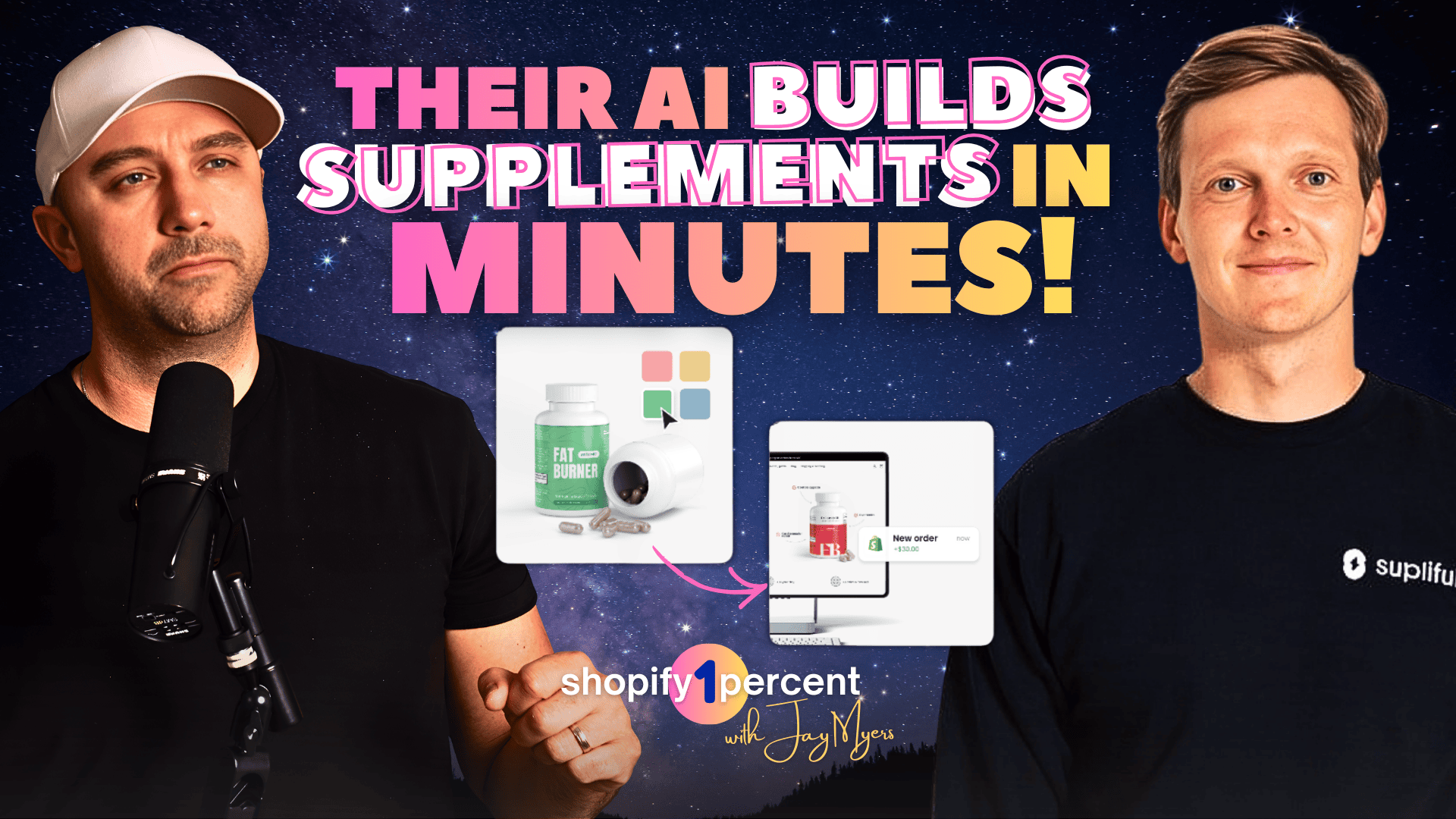
I just got off the mic with Martins Lasmanis, the founder of Supliful, and honestly? My brain is spinning a little bit.
If you’ve been in the Shopify game as long as I have, you remember when "dropshipping" meant selling cheap, plastic widgets from AliExpress that took 4 weeks to arrive (if they arrived at all). It was low risk, sure, but building a real brand? Nearly impossible. You were just an arbitrage middleman hoping the customer didn't notice the Chinese shipping label.
Well, those days are officially dead. Or at least, they should be for you.
Martins has built what is essentially Printful for supplements. We’re talking private label, FDA-compliant, on-demand consumables that ship from the US in 1–3 days. No minimums. No inventory. No garage full of expiring protein powder that your spouse is threatening to throw out.
If you aren't paying attention to the consumables market right now, you are leaving massive recurring revenue on the table. Here is everything you need to know from the episode, plus a few "hot takes" I’m throwing in for free.
The Market is Exploding (Literally)
First, let’s look at the numbers, because they are staggering.
The global dietary supplements market was valued at around $167.5 billion in 2024 and is projected to nearly double to over $318 billion by 2033. We aren't just talking about multivitamins anymore. This is specialized performance, niche health, and functional foods.
One of the wildest trends Martins mentioned—and honestly, the biggest opportunity I see right now—is the rise of GLP-1 support supplements. Think Ozempic users who need nutritional support to handle side effects or muscle loss.
I looked it up to confirm: product launches with "GLP-1" on the label soared from fewer than 100 in 2023 to over 3,000 in 2024. That is a gold rush, folks. And usually, to get into a market like that, you need 12 months of R&D and $50k in inventory. Martins is letting you do it in an afternoon.
The "Cheat Code": Speed & SKU Iteration
The biggest takeaway from my chat with Martins wasn't just about supplements; it was about speed.
In 2025/2026, the brands that win are not the ones with the deepest pockets. They are the ones that can test ideas the fastest. Speed and SKU iteration are the only metrics that actually matter in the early days.
With Supliful, you can spin up a "Gut Health for Pickleball Players" brand (yes, we actually joked about this, and yes, I checked—pickleball is still growing). You can design the label in Canva, plug it into Supliful, and have it live on your Shopify store before you finish your morning coffee.
Here is the playbook:
Pick a hyper-specific niche. Don't sell "creatine." Sell "creatine for tired dads over 40."
Use a white-label product first. Don't formulate custom yet. Supliful has a 74% match rate for custom ideas against their existing catalog.
Launch and test. Run ads. Send emails. See if anyone cares.
If it flops? You lost zero dollars on inventory. You delete the product and try "Magnesium for Gamers" tomorrow.
If it sells? Great, then you scale it.
The "Spillover Effect" Strategy
Here is a tactical nugget Martins dropped that I loved, and I’m dubbing it The Spillover Effect.
Smart merchants are launching products on their Shopify store, driving traffic via social/ads, and then auto-fulfilling successful products to Amazon FBA.
Why? Because customers will see your ad on Instagram, get intrigued, but then go search for the product on Amazon because they have Prime brain rot and trust the badge. Instead of fighting it, own both channels.
Supliful integrates with both. You can use your Shopify store to build the brand story, capture emails, and own the customer data. But you can simultaneously list on Amazon to capture that "spillover" traffic without doing double the fulfillment work. It’s the closest thing to having your cake and eating it too.
We Let AI Build a Sleeping Pill (And It Worked)
We also did a live demo of his new tool, LaunchMagic.ai. I’m usually skeptical of "AI tools" that promise the world, but this was legit.
I gave it a vague prompt about a "sleep aid," and within seconds, it:
Generated a custom formula based on actual manufacturing capabilities.
Created a compliant label.
Calculated the COGS (Cost of Goods Sold) and suggested a retail price.
Found a 74% match with an existing white-label product so I could start selling immediately while the custom formula was being developed.
It’s basically replacing a year of supply chain headaches and back-and-forth emails with manufacturers with a single AI prompt. If you are still trying to formulate products by Googling ingredients yourself, you are officially doing it the hard way.
Founder Reality Check: Don't Burn Out
We ended the episode on a heavier note, but arguably the most important one.
Building a business is hard. And it’s getting harder. Martins opened up about the "dad guilt" and the grind of 16-hour days. He’s not alone—a 2024 study showed that 53% of startup founders reported burnout, with nearly 60% saying it impaired their ability to lead.
If you are a founder, that stat should scare you. It scares me.
Martins' advice? Rigorous discipline. He swears by a specific routine that keeps him sane:
Journaling every morning. Get the noise out of your head.
Mid-day high-intensity workout. He says this is the pillar everything else rests on. If the workout slips, the diet slips, then the sleep slips. It's the keystone habit.
Cold showers. For the dopamine hit (and probably to wake up from the 16-hour days).
One meal a day. He fasts until dinner with his family.
Now, do you have to starve yourself until dinner to be successful? Probably not. But you do need a system that protects your mental capital. As I said in the show, the biggest reason businesses fail isn't bad products or bad marketing—it's founder burnout. When the founder quits, the business dies.
Final Thoughts & A Hot Take
Here is my hot take to wrap this up: If you are an influencer, a gym owner, or just a Shopify merchant with a niche following, and you AREN'T testing consumables, you are failing your business.
You have an audience that trusts you. They are already buying supplements, coffee, and skincare from somewhere. Why not from you?
The barrier to entry has officially been removed. The excuse of "I can't afford the inventory" is gone. The excuse of "I don't know how to formulate" is gone (thanks, AI).
The only thing left is execution.
Go listen to the full episode to hear the full story (and hear me try to convince Martins to let me formulate a "Shopify 1% Focus Pill").
Catch you in the next one, Jay

Co-Founder @ Bold Commerce // Host Shopify1Percent
Jay Myers has been in the ecommerce game for over 25 years. First as a merchant, then a service provider, and today a software provider. His company, Bold Commerce, has helped over 800,000 online stores sell more on Shopify. Their suite of apps help brands maximize LTV (Customer LifeTime Value), and AOV (Average Order Value).
Bold has been ranked one of Canada's Top Medium Sized Employers, ranked in the top 50 fastest growing companies in Canada by Deloitte multiple years, a Top Growing Company in Canada by the Globe and Mail, and winner of the Ernst and Young Entrepreneur of the Year award.

Have Shopify Brands A/B Tested Themselves Into Invisibility? My Conversation With Phillip Jackson on the Sea of Sameness.