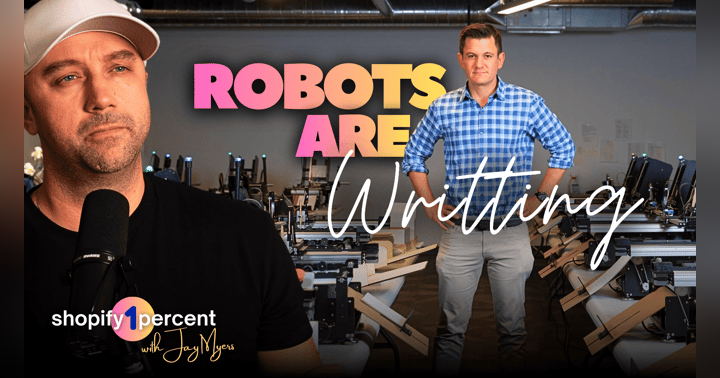
Robots With Pens: How Handwritten Notes Are Turning Shopify Customers Into Raving Fans
Hand written notes are all the craze right now! The reason why is we are getting worse at the easiest part of ecommerce. Making people feel like humans. David Wachs, CEO of Handwrytten, explains why a real handwritten note (yes, real pen) can beat the 135+ emails a day noise, lift repeat purchases, reviews, and referrals, and turn your Shopify store into the brand people actually


Handwritten notes are all the craze! The reason? We are getting worse at the easiest part of ecommerce, making people feel like humans. David Wachs, CEO of Handwrytten, explains why a real handwritten note (yes, real pen) can beat the 135+ emails a day noise, lift repeat purchases, reviews, and referrals, and turn your Shopify store into the brand people actually
Key Take-aways
Why are open rates for handwritten envelopes three times higher than standard printed mail?
Can a robot actually use a real pen to mimic human nuance without looking like a total fraud?
Is it possible to trigger a physical, handwritten note automatically when a customer hits a specific lifetime spend threshold on Shopify?
Why did one company find that intentionally "screwing up" followed by a handwritten win-back note led to a higher LTV than a perfect customer experience?
How can you use uniquely trackable QR codes on physical cards to see exactly which customers are coming back to your store?
What are the two biggest mistakes brands make that immediately ruin the "sincerity" of a physical note?
Bottom line: it’s a simple, emotional way to stand out. In a world of 100+ daily emails, a real handwritten card is memorable, it says “you matter” in a way a promo email never will.
🫶 Support the amazing sponsors that make this show possible 🫶

Omnisend - I personally use Omnisend for every Shopify store I manage! I’ve tried them all and Omnisend is hands down the easiest way to set up email and sms automations and campaigns, leverage segmentation to personalize them, and A/B test everything to optimize conversion. The push notifications and gamified email collection tools are just the icing on the cake 🤌
(plus most report paying about half the price of Klaviyo 🤫)
🚨Listeners (YOU) get an exclusive 30% OFF for 3 MONTHS: https://shopify1percent.com/omnisend

Bold Commerce - Maximize your Shopify sales with Bold's suite of powerful apps. From AI Upselling, to powerful Subscriptions, Memberships, and VIP Pricing tools, Bold has everything you need to Maximize your Shopify revenue!
Try Bold apps for free here: https://shopify1percent.com/bold
Resources & Links Mentioned in the Show
- Handwrytten Shopify integration page: https://www.handwrytten.com/integrations/shopify/
- Handwrytten Shopify App Store listing: https://shopify.pxf.io/19EdgR
- Creating Superfans (Brittany Hodak): https://brittanyhodak.com/book
- Klaviyo: https://www.klaviyo.com
- Zapier: https://zapier.com
Special offer mentioned: Request a free sample kit from Handwrytten (link above).
Did you know leaving a ⭐️⭐️⭐️⭐️⭐️ review on Spotify, or Apple will give your shop gooood ecommerce karma? ❤️
00:00 - Teaser: Machine handwrites postcards & company intro
00:07 - Founder David Wax on starting Handwritten
03:24 - Why handwritten notes matter vs digital overload
04:41 - Survey results: Only 12% feel appreciated by brands
04:59 - How handwritten notes create emotional connection
06:24 - Product overview: No postcards — envelopes, cards, stamps
08:00 - Card sizes, materials and printing quality
09:31 - Shopify integration and automated triggers
10:01 - Common use cases: Thank-yous, anniversaries, abandoned carts
11:03 - Customer retention, LTV focus and Maya Angelou quote
13:26 - Examples & case studies: Snack box windbacks and results
20:34 - Tracking, QR codes and measuring response
22:48 - Pricing and best ways to buy credits or business plans
24:50 - Cohort tracking and long-term ROI considerations
29:47 - How authentic the handwriting looks — tech & nuance
32:52 - Custom handwriting and signature options & costs
36:53 - Memorable campaigns, prospecting, and response rates
40:00 - Future plans: doodles, fulfillment, samples
41:59 - Getting started: samples, Shopify setup, call to action
Jay Myers: I think it was four years ago, I was at subs Summit and I walked by this booth and I saw.
This machine that was handwriting postcards. And I walked up and I asked I said, oh tell me more about this. And the person working in the booth said, oh, well, you know how you, some people send emails and SMS and everything. Well, we automate handwritten cards. And I thought, well, this is just genius because I, there's I know the impact of what a handwritten note means to me when I get it.
I'm so excited to hear more about what this means to a customer, specifically in the e-commerce space and maybe how that drives connection. Because my guest today, he's the CEO of HandWrytten, spelled H-A-N-D-W-R-Y-T-T-E-N. And actually read in a study of yours that. Customers today feel appreciated.
Only 12% of them feel appreciated. And just a couple years ago, that was 18%, it's going down.
David Wachs: Yep.
Jay Myers: So tell us first of all, David, welcome to the show. Take a minute and brag about yourself. Tell us who you are, tell us about your company, and I'm excited to get into today's topic.
David Wachs: Jay, thank you so much. I'm David Wachs, CEO, and founder of Handwritten. You're right. H-A-N-D-W-R-Y-T-T-E-N. Why? Because we love you. So yeah. So I started this company 11 years ago. We're now the largest provider of automated handwriting in the world. To my understanding. By a pretty large margin I believe.
The reason I started is prior to this, I had a company that did text messaging and we'd send. A million texts a day for Abercrombie and Fitch and Toys Ross. We'd send another million or whatever. And while that worked I kind of saw the writing on the wall and I realized, gee, everybody's gonna be overloaded with all this electronic communication.
Whether it is texts or Slack or Teams or Twitter or emails, you know, the average person gets about a hundred. 35 emails in their business email box a day. And that's an old stat. I think it's way more now. And they spend a quarter of their time managing that. So, you know, people are just hitting delete as fast as they come in.
Jay Myers: yeah.
David Wachs: when was the last time somebody thanked you for marketing to them? And that's what handwritten notes do. When somebody gets a handwritten note with an I or, you know, handwritten with an or handwritten with a y. Not only do they. Open it, but they keep it and often put it on display and you might receive a thank you call.
Thank you for sending 'em that, that thank you note or whatever you're sending 'em. That happens all the time because people really appreciate the fact, A, you're doing something different and B, you're trying to connect at that human level and. What handwritten notes do is they shown a deeper investment in time and thoughtfulness than an email or a text would.
So, and then they also just stand out because the average person gets like two to three handwritten notes a month versus a hundred thirty five, a hundred fifty emails a day. So the least used inbox is the one at the end of their driveway, right? So. That's what we try to do. So it's that one, two punch of a, it gets noticed because it's not frequently used, and B, it gets kept and savored because it feels personal.
And to your point on the 12%, yeah, we found that stat pretty staggering. So we've done a survey twice now of consumer sentiment towards their brands that they work with and how they like to be reached out to. And what they said is they only feel in 2025, only 12% of people feel appreciated by brands.
That's down from 2022 when it was 18%, so it's dropped by a third. And then we said, well, what would you do if you do feel appreciated? And they said, well, we would buy more frequently. Rate and review more and refer to friends more. So all the good stuff, everything you want, they would do if they felt appreciated. And then we said, okay, well, emails, texts. Printed brochures, handwritten notes, what would make you feel appreciated? And by and large the answer was handwritten notes. So it's a relatively small lift. You know, a handwritten note isn't some gimmick, expensive thing you gotta ship them or do for them. It's a relatively small lift to make people feel appreciated and that appreciation, you know, depending on the note, you don't want the note to be some spam crap.
You want it to be. A sincere note from you that note can have outsized returns. So that's really what we do. And for all the Shopify listeners and the audience, we have a plugin for Shopify you can use. And if you'd like, we can get into that. But that, you know, I'm here to really preach the benefit of handwritten with an eye, not a why.
Jay Myers: Well, I for sure want to get into how an app would work. I, because I imagine, well, let's, okay. First of all. What kind of note can be sent? Is it like a postcard? Is it a letter? Is it, are there different layouts? Like what does it look like?
David Wachs: Yeah, great question. So we don't actually do postcards because for us. It kind of defeats the point when you get a postcard. There's no, we get really hoity-toity about this stuff. We say there's an unboxing experience with a handwritten note. You know, you get the card in an envelope, you wonder, why did Jay Meyers write me?
You take the time to open that note and read the inside with a postcard. First of all, when it gets to your house, it's all banged up.
Because it's, you know, gone through the mechanicals postcard, system B, it doesn't show really any investment. Postcards are super cheap, and then c there's no unboxing, unboxing experience.
Jay Myers: So wait, so just so even the address on the letter is handwritten.
David Wachs: yeah, everything is handwritten.
Jay Myers: I, that's amazing.
David Wachs: So the envelope is handwritten. There's a real stamp in there on there, and if you're Canadian or you're shipping to Canada and you have a Canadian from and a Canadian to address it's a Canadian stamp is on there. We have a partner in Canada to mail those. And yeah, it's, it, and actually the envelope is one of the most important parts because handwritten envelopes get a three times greater open rate than print.
Jay Myers: Yeah. And just to clarify, it's not a printed handwritten font. It's actually a pen that's moved by a machine, so it look it, it is literally written.
David Wachs: looks the same. Yeah, it looks like it was written. And you know, there's a lot of nuance we can get into there too. If you want to know about that technology. I'm happy to share it. We do letters. We don't recommend it. They're expensive because a letter is a lot of writing and, you know, what are you really gonna say to a client?
You know, my dearest Gwendolyn, you know, it's only been, you know, you're not gonna write a whole letter to somebody. So we say short cards and a card. We do have kind of two sizes that we try to fit you in. One is, it really depends on the envelope more than anything. So a five by seven envelope. Which is a large, typically flat card, and it could be lands sorry, portrait or landscape.
So it could either be vertically oriented or horizontal. And then my favorite is an A two folded card. So that's a little smaller. That's like this size. And then it opens up or it opens to the side. You can go on our website design with money.
Jay Myers: pull it up right now,
David Wachs: yeah.
Handwriting samples.
Jay Myers: so for those listening
David Wachs: sign in where it says sign in, you might not even need to
Jay Myers: yeah. I'm just gonna mention for those listening on the audio version of this podcast, if you jump over to the YouTube channel, you can actually see what we're looking at right now. But I'm pulling up the. The handwritten websites, we can see some examples of this. So, sorry, con, continue.
David Wachs: No. So, you can go to handwritten.com, create an account for free design your own cards, and we operate a full print shop printing press. So every card is printed. It's not like you printed it out on your home printer, it's a full bleed, thick stock custom card. And it can either be Vellum, which is kind of a toothy stock.
Good for. Stationary style, five by seven flat cards, or it could be a C one s, which is a Glossier stock, good for saturated images. So if you're doing a full photo on the front of the card, I'd recommend the C one s. And that's what we do by default. But so yeah, it's a folded card or a flat card completely to your specs.
And then once you've designed that card. You can actually plug in our Shopify app and then send it directly based on triggers in Shopify. So you could say, send this card to everybody on their first purchase, and then design another card like you're a rockstar. Send that card to everybody after they spend a certain amount of money.
And then another one on anniversary purchase. And you can even do abandoned shopping cart style carts.
Jay Myers: So I could send a handwritten note to someone when they don't complete a purchase.
David Wachs: Yeah. I don't know if many people do it, but you certainly can, and you could, even if you're, if you've got kind of, you know what let's say you only have 10 products on your web, on your app, like maybe, or on your store. Maybe you sell expensive saunas. You could actually design a abandoned shopping cart for each of those five 10 saunas and send that separately.
So you know, we're so sorry you decided not to purchase this sauna, blah, blah, blah, blah, blah and send that out so you could do the abandoned shopping cart. Most people are sending, thank you for your purchase. The main use case for handwritten is not really strict marketing. It's long term value of that client because you know, everybody I think is so excited to grow their client base and, you know, there's a lot of CRM dashboards around new sales and that type of thing, but there isn't as much smat around client retention.
And there's a lot you can do to kind of. close up that leaky bucket on the bottom, you know, where not every client just falls through the bottom of the bucket by making clients feel appreciated. Per our 2000 person survey, we show that these clients can come back in again and again. So it's really about customer nurturing and sharing appreciation.
Because as Maya Angelou says, it's not what you do for somebody or sell somebody, it's how you make them feel. And that's what they remember. So if you can help them out there and you know, try to appeal to their emotion, people buy on emotion and that's what we help them with.
Jay Myers: Amazing. I am looking at the screen right here and seeing some of the triggers. Like my mind just spins, like I was an e-commerce store owner since 1998. So when I see stuff like this, I start going, like, my mind starts spinning and I like like lifetime purchase threshold, so. This one seems like a no brainer would set up.
Like once someone has spent $500 or a thousand dollars, like to send a personal thank you. You know, you've been a customer for, and you've spent so much, and we just wanted to give you something like, here is a a coupon for $50 off, something like that. Like on us. We appreciate your business. Like, to me, that would be like one of the first ones I would set up.
Like, what is, what are the ones you see that, work the best. And I guess actually, how do you track that? Is it through coupon codes that you track ROI or
David Wachs: so we do have some clients using coupon coats. We have a, actually a Canadian bespoke suit company out of Vancouver. So they'll send, you know, you, you provide your measurements or whatever, and they'll go to China, get a suit made and send it. And what they do for their best clients every year around Christmas, they send them a special coupon code.
In a holiday card from the company and they see a 17% respo redemption rate on those coupons, which is by far their highest redemption rate. But to your point, usually we're out of the loop. You know, people don't share with us the effectiveness. Why would they, we just raise their rates or so they think.
So, we, you know, we don't know. All we know is our clients see great responses from this because they keep using us year in, year out. Some other use cases that are kind of unrelated to the Shopify app, but available you know, just using handwritten is win backs. So we have a, a snack box company that sends office snacks, you know, snacks to your office every two weeks to refill your pantry.
And when they screw up, you know, whether it's a late box or the wrong box or stuff gets damaged, what have you they send a handwritten note and an additional box of snacks and that handwritten note says, we're so sorry for this mistake. You know, please take this extra box of snacks. And what they find is people that have that.
Win back that the bad experience followed by the win back actually have higher lifetime value than those that were never screwed up with in the first place. And because of that, they then decided to just screw up with everybody, send everybody the win back and raise all boats. So, you know, it is a tremendously effective campaign for them.
But yeah, I mean, for us it's really anniversary of purchase. Thank you. And then, you know, we do Christmas and birthday cards, but a lot of that falls outside of the Shopify plugin.
Jay Myers: It's so funny you mentioned that they don't screw up intentionally. I mean, we talk with our support team at Bold, and I always say that like, when something goes wrong, it's a golden opportunity because you never rave, you never go to a store. Let's say it's a grocery store and just.
Buy something, check out pay, and everything is just normal and rave about it. But if something goes wrong, and then I have this example, I think I've mentioned it on the podcast before, but I'll say it again, but I, there's a coffee shop up in here in Canada called Tim Horton's. I don dunno if throw down the US or not, but Okay.
David Wachs: I mean.
Jay Myers: I think it's, yes. Yeah. It's synonymous with Canada. Anyways, I, went through the drive through one time, sorry, it was, I didn't go through the drive through. My sister-in-law did, and she ordered like three sandwiches and some drinks and stuff, or some dinner. Got home, opened up the bag, and I think two of the sandwiches were missing and it was like gonna be supper for the kids.
And so she was upset because she's like, oh my gosh. And she tweeted something like. Thanks Tim Hortons. How can you like not even put the sandwiches in the bag? Now I gotta drive back, screwed up our dinner. Something along those lines. Well, Tim Hortons, dmd her directly messaged her, apologized and offered to drive the sandwiches to her house and they drove the, they got someone to drive the sandwiches and like, to this day, like that was 15 years ago.
I'm still talking about it. She's still talking about it and it's like had that not gone wrong, it would just been a regular order like every other one. So I do believe a hundred percent that when something goes wrong, correcting it is what customers remember. And if you can manufacture that in a way that is not overly bad, that they're leaving horrible reviews on the internet, but just enough that you can fix it.
David Wachs: I totally agree. I was just talking about this on a podcast the other day. You know when somebody calls into customer service or goes to your chat bot or whatever, that is a double. That is a, you are at two strikes right there. Two, not one, because one, they had the bad experience, right? Like they went to they're contacting you because they had a horrible experience.
They need to fix it. Two, now you're inconveniencing them a second time because now not only did they have the bad experience, but now they have to waste their time getting on your chat bot or calling your 800 number or whatever to fix it. And oftentimes, if you're a bad company. You know, they have to go through an IVR tree and get transferred 18 times and you have to re-explain it.
Five, you know, all that. So if you can walk away from that experience feeling heard, it is huge. Personally, same thing I was, I recently, this wasn't 15 years ago, but I recently bought a new barbecue island for a backyard. And there were a number of pieces and they had to be paled in from some God only knows where, and it took a few days for that to come.
When they came, one of those pieces was damaged. It was all banged up. So I contacted Barbecue Guys, the company I bought it from, happy to mention 'em. And they said, okay, well we're so sorry about that. We'll ship you a new part overnight. And then somehow, and I don't even know how they did, they were able to get that overnight.
And then, which was great. And it was fine. And I said, well, what do I do with the other part? They said, just throw it away or give it to somebody. I was like, great, make it easy. And then two days later they called me and they said, we just wanted to make sure you got your part. Everything's okay. You're happy.
Now, the fact that they called me to follow up that I wasn't a transaction, that was the, that they have a customer for life, right? Like it doesn't take much. It doesn't, it just doesn't take much. But once you do that, once you do that little extra step of following up to make sure people feel heard, it's like, wow.
Right. And it really gets back to that Maya Angelou quote. So, yeah, I think customers and I said this on the podcast a couple days ago, I said, customer service is where you can really create those aha connections by turning a double strike out into a positive. It's not that hard. You just have to, you just have to care,
Jay Myers: Yeah.
David Wachs: And if, you know, my, my my sample here had nothing to do with a handwritten note. It had to do with a phone call. But if you're trying to scale it, maybe handwritten notes. And we had during COVID a client of ours is a flat pack furniture seller. So, you know, they assemble yourself furniture, they ship it to you, you put it together.
They have people calling into their call center. And one person called in, they sent them a handwritten note thanking him for calling in and hoping everything's okay. That person then called back crying. I think a lot of this is elevated due to COVID and people were especially solitary or isolated and that type of thing.
But I think the emotions still there today. Five, five, almost six years later, it's not as heightened. It's there, and if you can tap into that and make people feel heard that's huge.
Jay Myers: Wow. What can you put in a letter? Is it, can you put an, could you put a picture of your team in there or like, can you include things like that?
David Wachs: Yeah, I mean the card itself is fully customizable. If I could get it on frame it's fully customizable. You could customize the front, you can customize the back, and then on a card like this, you could put something on the top on the back. You can put your logo or what have you. Are cards that we sell that, you know, that aren't customized, say Red Wagon.
Because we don't wanna say handwritten and ruin the mystery or whatever, give away the secret. You can also, on a folded card, you could put a QR code at the top,
Jay Myers: Oh wow.
David Wachs: on a flat card.
Jay Myers: that's so smart.
David Wachs: You could do it. And those QR codes are uniquely trackable. So if you have 500 people and you send it out to 520 of 'em.
20 would be a lot for QR codes, but if people actually scan it you know, you have to have real good reason for people to scan
Jay Myers: Yeah. Wait, are they trackable? Per recipient? Per person? So you create a
David Wachs: So if I send this card and it had a QR code to Jay Meyers and Jay's wife, or Jay's kid or whoever scanned
Jay Myers: but if you send a hundred different ones, I can track which one was scanned. So you're creating a hundred different URLs redirects to the, yeah,
David Wachs: correct. Yeah. And because the way we used to, we couldn't use to do this because. When we, you know, when we place your order on our robots, we print out 500 of your car. You know, if you did an order of 500, we just take a card of five, a stack of 500 cards, stick 'em in the robot, and god forbid the robot screws up, we gotta redo it.
But now our system's so mature, we can individually track it all the way through the process. And so we're fully able to do that for you. And then we can provide you a nice chart.
Jay Myers: Like I would imagine if I had. Yeah, thank you. Note. So someone spends a certain amount, they order something, and I say we have an offer exclusive for you. It's not on our website. It's a hidden offer that's only available. Through this QR code. Okay. I, there's something about mystery, like we know, like one of our apps we do upselling and one of the upsell offers that convert the best is a mystery box where the customer doesn't know what they're getting, but there's something about that mystery, right?
Like, or, you know, scan we, we've prepared some, we have a special offer for you scan to see what your offer is, like the click through on that's gotta be
David Wachs: Yeah. So you can absolutely do that. And then you'd have the reporting on our end and the reporting on your end. As far as you know, it would just go through to whatever Shopify, URL you want. Yeah, that's all. That's all very easily doable.
Jay Myers: Amazing. What does it cost?
David Wachs: Well, if you go, so what I would not recommend is CRI account handwritten, signing up on Shopify and paid through Shopify, because Shopify requires us to allow you to buy through Shopify. It's just one of their marketplace terms, but then you're paying rack rate. Instead, if you go to handwritten.com, you can prepay for credits or buy a subscription or now we have these things called business plans.
So long answer to short question, but at the very most, you're paying 3 75 a card plus postage. The very least, you could be paying a buck 49. It just depends on if you do a business plan or not. The business plans run, you can actually pay less than a buck 49 if you do our elite plan. We just don't give that pricing out without talking to us.
So
Jay Myers: Do you have a way to track the cohort of customers who have received a handwritten note versus ones that haven't?
David Wachs: that would be through you or through Klaviyo. That's kind of, we don't capture all your data like that right now
Jay Myers: So but in, in Shopify could, I could,
David Wachs: in Shopify. You could, yeah.
Jay Myers: right. So is there something. Could it apply a tag to a customer, or is there some way that I know that a customer has received a handwritten note?
David Wachs: a great question. Currently, no, we don't apply a tag, however. I'll put that on the short list because that should be very easy. We don't, our problem is we designed the Shopify plugin in a vacuum and we haven't received a lot of feedback, but yeah, we could absolutely apply a tag, or if you use Klaviyo, you could use Klaviyo to trigger handwritten and then add the tag.
Then as well, it would just be a Zapier attachment.
Jay Myers: gotcha. Yeah, I'm gonna play it. There's gotta be a way. What I'm getting at is I am willing to bet anything that if I ran a report on the cohort of customers that have gotten a, had written note, their customer lifetime value would be higher. Than the ones that haven't. And so sometimes with things like this, like they might not buy directly that moment on the QR code.
They might not, but a month later when they need to buy something, they'll feel that little bit more connection and they might come back to the brand that they sent them a handwritten note.
David Wachs: a hundred percent. I mean, if they are, if you, if we aren't racing the LTV, we're doing something wrong. But you know, I think a lot of people put it under too short of a window. I might not need your service. You know, we'll have clients sign up and say, okay, we're gonna do a one month test.
And see what happens with ROI in that month. Well, you know, you're sending people a thank you note. That doesn't mean they're gonna need you within the remaining 12 days of that month or something. You know, you kind of have to have open up your aperture a bit and look at the bigger picture of, okay, well maybe it's maybe it's six months a year.
You know, the whole idea is LTV lifetime. Not two month value. And that's what this is all about. This is about, you know, sending a card maybe two to three to four, no more than four touch points a year. Trying to just stay top of mind because I think a lot of people feel, okay, I'm gonna sell this com.
I'm not even gonna sell them. They're just gonna come to my website, buy, because of course they will. Wrong attitude and they'll be my customer for life because why wouldn't they? Wrong attitude. So, you know, I think as a continent, we have to say you know, we've lost the gratitude. We have to really thank people for finding us among the plurality, the millions of, you know, we live in an age of abundance.
So, picking us among all the opportunities out there. And then, you know, whether they buy from Amazon or they buy from your competitor or they go to Alibaba and they have it made, whatever that is you should thank 'em for that. And then, you know, really just stay in touch with them through meaningful touch points over the course of a year.
But we're talking. No more than four, you know, so unless something crazy happens, they buy, you know, they become your biggest customer. They spend 10 grand or whatever. Maybe there's more, but it's really okay. How does that LTV look in the long term? Not over two weeks, but two years or something, you know?
How does that look different? Because I think everybody's gotten so myopic and it's also very interesting where they choose to measure ROI, you know, we have clients, very large luxury clients spending. God only knows what to be on the back of magazines. You know, we just got a magazine at the house, full page ad on the back of the magazine, but they have a 10 page spreadsheet trying to figure out the ROI of sending a $2 card to a client that spends $30,000 in jewelry, you know, and it's like, boy, that's convenient.
You choose to do ROI on this. What about the ROI on that? Oh, well, you know, there's no ROI on that, right? So it's just, I think people need to. Listen to somebody who's kind of smart, Albert Einstein that said, you know, not everything that can be measured matters and not everything that matters can be measured and really kind of just think about it with more of a holistic long-term framework.
Jay Myers: I like that if someone listening right now had maybe a thousand dollars, $10,000 some amount, they wanted to like budget, they're like, okay, I wanna try this. What is the. The best approach, like there's a lot of different triggers. A batting card, thank yous, spend amount, spend. Like if you, what would you say is the best thing they could do if you're running an online store selling dog food or whatever, what would you do with that test budget?
David Wachs: I would send a thank you. I would the card would be genuine. There'd be no there'd be no call to action on my note on the part I wrote. So it would just be, you know, we're a small bus. I would try to appeal to their emotional heartstrings. We're a small business. We truly appreciate every sale.
You know, we are surprised and delighted that you chose us. Thank you very much. On the back of the card, if it's a folded card
On the back, maybe I'd put a QR code that says, or, you know, visit this URL to get 10% off your next order. So it's more of a, oh, by the way, here's, you know, this is a card I picked off our shelf to send to you.
There just happens to be marketing on it, but it's not mentioned on, you. Don't want to dilute the sentiment. You know what I mean? So that's what I would do. And for quantity like that, I go to handwritten.com, prepay. So you can go there create an account, prepay for credits, that'll get you a better rate with that budget.
And then those credits are good for a year, which you should be able to easily blow through.
Jay Myers: Yeah. Is how authentic does the handwriting look like? I.
David Wachs: Lemme turn off my blur on my camera.
Jay Myers: Oh, we got a live card here.
David Wachs: I mean, I don't know if you can see
Jay Myers: Oh
David Wachs: if it's mirrored in reverse. It's mirrored for me. So we have 35 styles, or more than 35 on the website. You
Jay Myers: Oh, you could do signatures,
David Wachs: do signatures and all that. There's a fee, one time setup fee for that. We do a lot to make the handwriting look real, but not fall in the uncanny valley. what do I mean? We don't write down the straight left edge of the page. It's not like, like you can see it in this one actually.
Jay Myers: Yeah. Yeah.
David Wachs: you know, it's not on the hard edge. It is trying to write on the left side, but it jitters in and out. So we do that. We don't write the same distance from every line, so the line spacing goes up and down a little bit.
We're, again, we're talking points, not inches. It, you know what our com, we have a competitor. There's this zigzag in and out and up and down, and it's crazy, you know, nobody would do that. So you have to not do something that looks fake. You have to be as if you're trying very hard to write perfectly down the edge and you screwed up.
And then we vary the characters. So, two o's look different in a document, you know, at the beginning and at the end. Those might be different. And then two o's together look different than two o's apart. How do you connect those two O's? Do you connect two t's with one bar or two bars? All those little nuances we put in our handwriting styles and those are all available.
And then if there's none that you like, you can design your own. But I'll tell you you know, I'm the founder of the company. I don't even have my handwriting in there. We have employees handwritings, but not mine. I don't, I just don't find it that important on my own.
Jay Myers: So the handwritings that are in there, are they proprietary to your
David Wachs: I There, we design them.
Jay Myers: You designed them, okay.
David Wachs: there are a few that are legacy from when we used an off the shelf auto pen years and years ago, and we were able to kinda reverse engineer them because people liked them. But most of the handwriting styles we designed, we, they're either ours or they're clients that let us use theirs.
So Executive Adam. All the names are kind of chill. Charity, whatever. Tenacious Nick e Executive Adam was a client of ours. He let us use his. We have, but we have celebrities that have their own, that don't let us use theirs. You know, in people that are social media famous, we've got famous quarterbacks and football teams.
It's kind of crazy. Who uses us?
Jay Myers: So if someone had the budget they could replicate their own handwriting.
David Wachs: Yeah,
Jay Myers: So do
David Wachs: don't think it's that necessary. It's, you know, expensive.
Jay Myers: Yeah.
David Wachs: But if they, yes.
Jay Myers: Wow. And then I guess, so how much would it cost to, you said the signature the sign off. You do that's a one-time fee, and then you have it in your profile,
David Wachs: Correct. Yeah, that's $250 one time. If you want your own handwriting, it depends if your block or cursive. So if your block, it's 1500, if it's cursive, meaning the letters connect, we have to spend a lot of time fixing those connections.
It's $2,000 one time
Jay Myers: for every letter.
David Wachs: no one time fee.
Jay Myers: No, but I mean like the whole alphabet, like A, B, C, D,
David Wachs: Oh, yeah, like when you Yeah, it's a one 10 fee total. So,
Jay Myers: actually, I think that's reasonable.
David Wachs: yeah. And so what you do is we'll send you a whole preschool kit, kindergarten kit. You have to write all the letters several times, so we have multiple variations. And then we have you write a bunch of goofy words because you'll fill out that handbook. Like how you want to write, but then you'll write the words how you actually write, and we're trying to capture how you actually write. So it's interesting. But yeah, so, we will, you know, we'll take all that, put it together. It takes about a week, and then we have your handwriting.
Jay Myers: Amazing. I didn't even think that would be a possibility to do that. But I mean, if you're sending, if a big brand who sees the value in this and adopts it, I mean, they're spending tens of thousands of dollars a month on their email bill like that to set up your own handwriting.
David Wachs: it's no big deal.
Jay Myers: yeah. That's very reasonable.
David Wachs: Yeah, and we have like CEOs that do it. We're doing an inbox program, hopefully. With a consumer brand and they're gonna include a little insert in the box and they're having their graphic designer like, do it in Illustrator, the little card, and we'll replicate it, which is great, but I'm like, don't do it in Illustrator, draw it, you know, by doing it in Illustrator, you're missing the point.
It's supposed to look hand drawn. So, I'm trying to convince 'em not doing an illustrator. Do hand draw and we'll take care of the rest and make it look organic.
Jay Myers: That's amazing. What's some of the most memorable notes you've seen?
David Wachs: Yeah. So we did do a, did a program with a mattress company where they did these doodles where, you know. There's a couple ideas with what we do. One of them is it can be personal without being personalized. So, what I mean here is like, if you're doing an inbox, most of the time it's logistically impossible to get a custom note in that box.
You know, like, 'cause you know, in this mattress company, they make thousands of mattresses a day and they put the node in the box when they're getting made. So what we did was we made, I believe, 12 different doodles. And we randomized them and they were inserted in boxes. So it would be like, thank you for your first night on this mattress.
And there'd be a little person dreaming of the moon and the stars or whatever, you know, all these cute little things. But then they stopped the program and they, and I asked them, why did you stop? They said, oh, we just did that when we're a small company. Now we're big. We don't have to, which I think is insane.
You know, you want to create that emotional connection at all stages, big or small. But yeah, that's what they did. I think, you know, we have the snack box company is a great example. We work with automotive dealerships. I know it's kind of outside of your realm, but they send all these printed cards, printed letters saying, you know, come in to trade in or trade up your car.
When they replace those with handwritten, they see a 17 times greater.
Jay Myers: Oh, I bet.
David Wachs: Thousand 700% greater. So, and yes, it costs more, but when you adjust for that ROI, it's still about seven times greater ROI. So, so yeah, there's a lot of, there, there's all sorts of use cases out there.
Jay Myers: Well, and I don't have the data in front of me, but I read this at one point that the average. A piece of direct mail gets touched, I think it was seven times before it's thrown in the garbage and it sits on a shell on a counter or an island for like five days on average.
David Wachs: Yeah. That's why I like our folded cards because they literally stand up on your desk, right? Like a black card's gonna get lost, but a folded, it's gonna stand up. So that's why I like sending 'em folded. And then, you know, we will use them to prospect. We'll send 'em out to people and then we'll call 'em and we say, did you get our card?
And they'll say yes. And they say, great. Then you know it works. Why don't we sign you up? Because, you know, versus an email or a text message, you know, how many times have you printed out a text message and stuck it on anything?
Jay Myers: Yeah, exactly.
David Wachs: Yeah,
Jay Myers: Is there any way to send this, speaking of prospects to. customers or do like, like is there any databases you can plug into as far as getting like addresses and information or.
David Wachs: yeah. We offer it for free on our website, so we. We have a residential database and then a business database. Your mileage may vary. It's just, you know, we provide it for free. And it's updated, you know, it's a service. It's a well-known underlying service. But you know, you can circle an area on a map and select the demographic number of people in household, or value of the house or, you know, whatever. And then send it to those people. So, or if you have a customer list and you're opening a physical store, this is also a great way to do it. So, for example, we work with an eyeglass store that's nationwide, and I'm sure in Canada. And every time they open a store, they send
An invitation to people that have used them either online or gone to another store, but happened to be in their neighborhood.
To drive traffic. We've also worked with a jewelry store when they, and also spas, when they open, we just send it to people using our database. So, yeah, you could do it either way. Either your database or ours.
Jay Myers: And what are some of the ways you can filter that? You said you can filter by, by fa, family size.
David Wachs: Family, people in household. Net income range, net worth range, which I have no idea how they know that maybe there's averages based on zip code. And then gee, what else? Value of home. And then on the business side, it's broken down by NAI CS codes. So if you're targeting, you know, dry cleaners in Phoenix, you could circle Phoenix and then pick the.
A ICS code for dry cleaners and it would send them out. So, and you can limit it and say, you know, don't, you know, only send out a hundred or whatever and do it that way. So,
Jay Myers: What's the biggest mistake are brands are making with this? Like, to avoid, like, what shouldn't you do?
David Wachs: long. If you make your note too long, it's not gonna, people will be like nobody sat down to write me write a love letter. I would say making it all about calls to action. You know what, you know, you know, don't forget to visit this cra and then give a weird URL that nobody would write.
That's, you know, like, you know, whatever, abc.com/x four Q bang, you know, like, nobody's gonna write that. So those would be the big two, you know, focusing too much on calls to action, not enough on sincerity.
Jay Myers: yeah. What what's the future for handwritten? What do you like, what do you got in the works coming up that.
David Wachs: We, we might add, we are, we're updating doodles, so, for a while we allowed you to add a little drawing to your, you know, directly on the website. You could place like a little picture or something. Due to some internal issues, we had to take that down. That'll be back hopefully next week. And then we're probably gonna move into fulfillment.
We, we currently fulfill. Business cards and stickers and that type of thing. So anything that would go in an
But the next step might be physical fulfillment. So if you wanted to include product or have us do all your Shopify fulfillment for you and include a handwritten note in every box, you know, we could do that.
So personalized fulfillment.
Jay Myers: Amazing. Or even like samples, maybe like a, that wouldn't send with it. Like, here's our
David Wachs: Yeah that's actually another use case is sending Instagram influencers, sample kits. We do a lot of that for makeup brands, so that's certainly something too.
Jay Myers: Okay, before we run outta time here, someone's listening. I guarantee there's people who want to try this and they're excited and inspired. Could someone like install? So go to handwritten.com to set up your pricing so you get the better rates. But then like, could they be sending cards today?
Is there a setup time or
David Wachs: yeah. No, it's easy. If you can go to handwritten.com, create an account create your custom card. You can't create the custom card in Shopify. You create it in handwritten, and then it will appear in Shopify. And then install us from the app store. Please give us a five star rating. We don't have enough people rating us And
Jay Myers: I know how hard it is to get ratings. The people are busy, but I, yes
we're in the same boat.
David Wachs: Set up those triggers. And those triggers will automatically send out your card when the time is right. And if you have any questions, we have domestic, you know, US customer support, they're actually right in the other office. So it's not like you're talking to somebody across the world to get help.
We're here to assist you.
Jay Myers: Amazing. Awesome. This has been very insightful. I know that I think there's a lot of brands right now. My, my opinion is there's probably a window. Of time to really jump on this and maybe in five years it's like become easy. Like, but right now if you send a personalized note, I don't get a, I can't even think of one I've gotten in the last year.
I know I've maybe gotten a couple, but like the, it's not like I opened my email and I have a hundred emails every day and my, I just try to close 'em as fast as I can.
David Wachs: Yep.
Jay Myers: Like you can, you could stand out right now with this. I think this is an amazing tool.
David Wachs: Yeah. And again, this is the long play, right? You're not, you're trying to get the lifetime value, not the two week value out of the customer, and really just share some gratitude. It'll really make you stand out. Nobody is saying thank you anymore. Everybody's assuming the sale, so,
Jay Myers: yeah. Ima imagine you get a letter or a note from a brand and it's like, this is not a sales pitch. We just wanna say thank you for being a customer.
David Wachs: Yep. That's it.
Jay Myers: the feeling that would leave inside of you is incredible. Like you, there's no coupon here. There's nothing just like, like you've worded from us five times and j just wanna say thank you like
David Wachs: that's it.
Jay Myers: that would blow people away.
David Wachs: You know, you can put a little bit of your why, you know, I started this company, da dah, you know, just to make that connection. There's a great book, creating Superfan by Brittany Hodak. I recommend people read that book, but you know, you can include something like that in the note and you try to connect.
Emotionally with the customer on your why, but that's it. You know, it's what I call a full stop. Thank you. You're just saying thank you. That's it. You're not upselling, you're not apologizing, you're just saying thank you
Jay Myers: Yeah. Ima,
David Wachs: get that anymore.
Jay Myers: I am, I'm picturing you working with like, with your customers, like no. Just say thank you. Like they all wanna take it further.
David Wachs: Right? Yeah. Everybody is so focused on some ROI in this channel, whereas every other channel, you know, who knows, right? Like, what's the ROI of a restaurant's clean bathroom, you know?
Jay Myers: Right.
David Wachs: If I walk into a bathroom and it's filthy, I'm not going back. But are they, you know, they're, people pick things to set, you know, what's the ROI of the back of that magazine?
What versus, or 10,000 other magazines that they're pro or a billboard you drive. You know, people pick and choose where it's important to try to. I, and I think it's just important to do full stop, so.
Jay Myers: Well, I'm willing to bet that people who get a handwritten note are also engaged more in emails. SMS probably engage more on your social, so it probably raises the ROI impact of other channels as well. So
David Wachs: I agree. Yeah.
Jay Myers: use this channel to make the customer feel appreciated. Build the relationship. And your email is the.
The call to action, but this probably will make them more responsive to it. So David, this has been awesome.
David Wachs: You
Jay Myers: really appreciate. Yeah.
David Wachs: Ium, one of my will be there.
Jay Myers: Awesome. Yeah, I'll be there for sure. I'm there every year. I'll make sure that all the links, I know we've mentioned them in the show, but I'll make sure everything else in the co are in the comments. Is there anywhere you wanna send people to any social platforms you're active on or
David Wachs: well handwritten.com, and then click business at the top, and you can request free samples if you want those. Or click Shopify under integrate and we will set you up on Shopify personally. DB Wax, W-A-C-H-S. So DB wax on Instagram, I'm trying to get out there. But yeah, no it's all about handwritten.com.
H-A-N-D-W-R-Y-T-T-E-N.
Jay Myers: Amazing. Thank you so much, David.
David Wachs: Thanks, Jay.

Founder and CEO
A proven entrepreneur, David's latest venture, Handwrytten, provides scalable, robotic solutions that write your notes in pen. Used by businesses in all industries and nonprofits, Handwrytten changes the way brands and people connect.
Prior to Handwrytten, David founded Cellit, a leading mobile marketing platform. With clients including Abercrombie and Fitch, Walmart and more, Cellit was sold in January of 2012. Both Handwrytten and Cellit were on Inc. Magazine’s Inc 500 list of fastest growing companies.
David is a speaker on marketing technology, has been featured in the Washington Post and Wall Street Journal, and is a contributor to Inc. Magazine.