If AI Can’t Explain Your Shopify Brand, It Won’t Recommend You
If AI Can’t Explain Your Shopify Brand, It Won’t Recommend You
I’m going to start with the sentence that either scares you or fires you up:
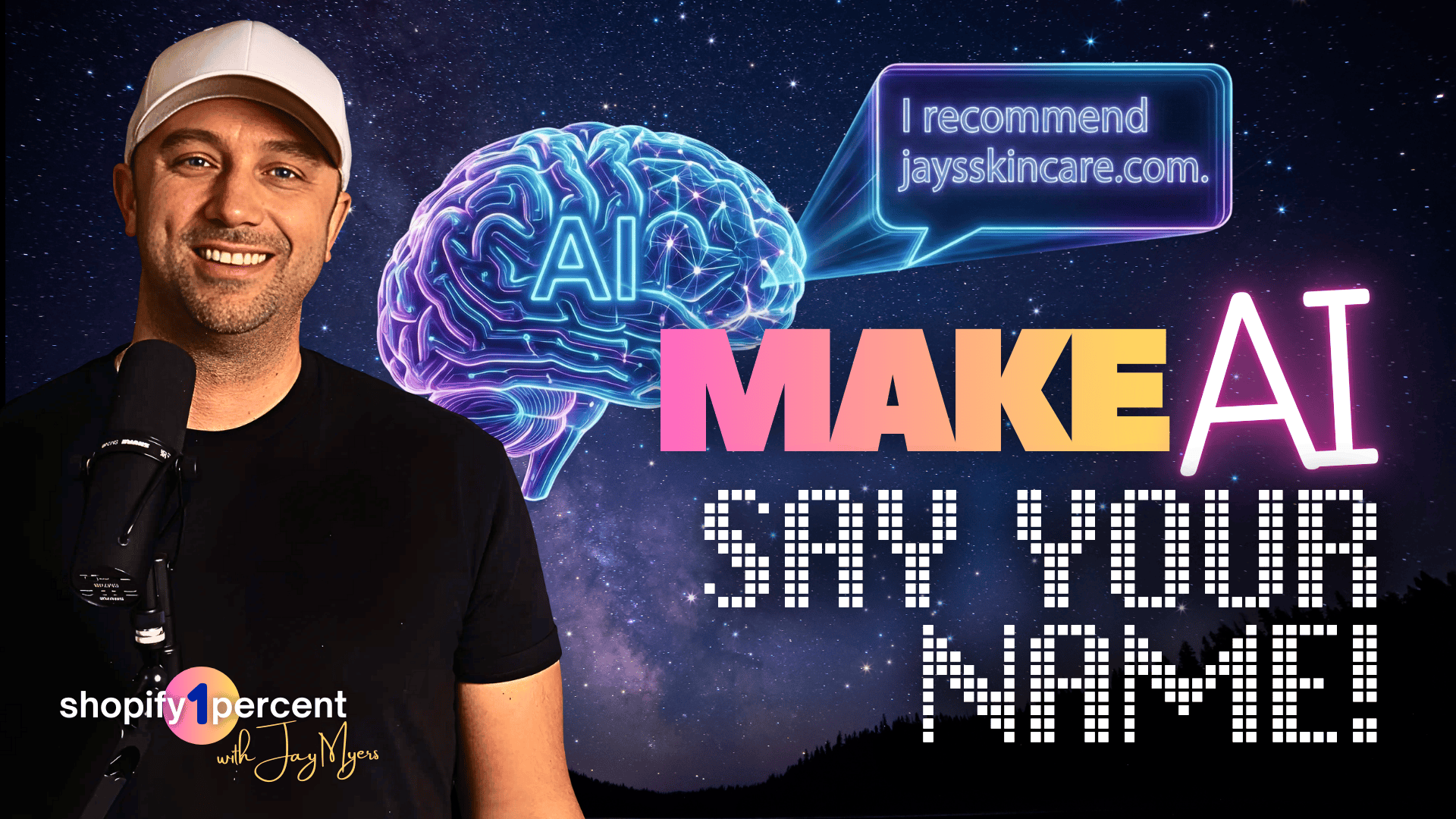
If AI can’t explain your brand in one clean paragraph, it won’t recommend you.
That sounds dramatic, but look at the trend line. ChatGPT alone is sitting at 800 million weekly active users.
That is not a nerd tool anymore. That is the biggest influencer on earth that never sleeps, never scrolls, and never forgets.
And Google is turning search into an answer feed. Multiple datasets show Google’s AI Overviews showing up in a meaningful chunk of queries during 2025, including one dataset that peaked near 25% mid-year, plus others reporting around 30% by October 2025.
Translation: customers are getting a synthesized plan first, and sometimes they never click a single blue link.
So if you run a Shopify store, we need to adjust the goal.
You are not competing for a ranking.
You are competing to be the brand the AI says out loud.
Why Shopify Brands Are About To Get Blindsided
When someone asks an AI:
“How do I fix X?”
“What’s the best routine for X?”
“Who are the experts in X?”
The model is trying to do one job: reduce risk for the user.
To recommend you, it needs four things to be painfully clear:
Who you are
What you do
Who you help
Why you are credible
If those are fuzzy, the AI plays it safe. It recommends the brands with the cleanest footprint, the most repeated message, and the most obvious proof.
Here’s the part most Shopify brands do not want to hear:
AI is not reading your ingredients list and crowning you the winner.
AI is reading the web and asking, “Who looks like the authority?”
The Rosacea Example That Makes This Click
Let’s use skincare because it’s a perfect illustration.
A shopper’s face is red, burning, flaring after workouts. They do not search “best moisturizer.” They ask:
“How do I calm rosacea flare-ups?”
The AI gives a plan:
avoid triggers
protect the skin barrier
use gentle ingredients
skip harsh actives
Then it makes the real money move. It names brands.
Two brands can sell nearly identical formulas and only one gets mentioned because only one has a public footprint that screams:
“We solve rosacea-related redness and irritation.”
Not “we sell skincare.”
That’s everyone.
And this is the key: authority is positioning plus proof, repeated everywhere.
What Most Shopify Stores Get Wrong
1) They confuse content with authority
“5 tips for glowing skin” is fine. It might even bring traffic.
But it rarely builds identity.
2) They write like they are scared
No point of view. No stance. No specificity. No proof.
It reads like a committee wrote it, which is impressive because the committee is usually one person and a cappuccino.
3) They hide the good stuff
Testing, founder expertise, clinical advisors, customer outcomes, certifications, press, sourcing details.
This is the stuff AI loves, and most brands bury it under “Our mission is to make the world a better place” paragraphs.
4) They do not repeat the same message everywhere
About page says one thing. Instagram bio says another. Podcast intro says something else.
AI sees inconsistency and refuses to bet on you.
Humans get bored repeating themselves. AI gets confident.
If you feel like a broken record, good. You are doing it right.
The Framework We Used: Claim, Frame, Prove
In the episode, we talked about a simple framework I picked up from Jason Barnard, CEO and founder of Kalicube, who’s been beating the drum on how AI and search interpret brands for years.
Claim: Say what you are the expert in.
Frame: Put it in context so it sounds natural and specific.
Prove: Stack evidence from trusted places, especially third-party sources.
Kalicube has a great breakdown of this “Claim, Frame, Prove” concept.
This matters because AI is basically doing pattern matching at scale. It is collecting consistent statements about you and deciding if it can repeat them without embarrassing itself.
Your One-Liner Authority Positioning Statement
If you do nothing else, do this.
Authority positioning statement:
“We help [person] solve [problem] using [method], proven by [proof].”
Examples:
“We help people with rosacea flare-ups calm redness using barrier-first routines, proven by dermatologist-reviewed education and thousands of reviews mentioning reduced irritation.”
“We help runners with post-workout acne reduce breakouts using non-comedogenic cleansing routines, proven by clinical testing and customer before-and-after case studies.”
This is not a tagline.
It is the sentence you want AI to repeat.
Put it on your Shopify site. Put it in podcast bios. Put it in your founder’s LinkedIn. Put it in partner pages. Put it everywhere.
The 2026 Accelerant: Your Next Reader Is a Bot
This part is not hype.
AI bots are crawling the web aggressively. One report using TollBit data found that by late 2025 there was one AI bot visit for every 31 human visits, and that more people are starting searches inside AI tools instead of traditional search.
So yes, write for humans. Always.
But also, write in a way machines can parse:
clear headings
explicit claims
concrete proof
structured FAQs
transcripts with speaker labels
The Shopify Play: Build an AI Authority Hub Inside Your Store
Most brands think they need a separate founder site to build authority. That can help, but you do not need it to start.
Your Shopify domain is already your authority domain because it is where transactions happen.
Here’s the build.
Step 1: Pick an expert problem, not a feature
Not “fast shipping.”
Not “premium ingredients.”
Not “made in the USA.”
Pick a problem you can teach for years.
Rule of thumb: If you could talk about it on 20 podcasts, it’s a good problem.
Step 2: Create five core pages on your Shopify site
Authority Page (pillar page)
1,500 to 3,000 words. Actually useful. Clear sections, internal links, and FAQs.Proof Library
Press, certifications, lab tests, testimonials, case studies, reviews mentioning the problem.Method Page
Your strong opinion. Your philosophy. “Barrier-first.” “Clinical-first.” “Fragrance-free.” Explain why your products exist.About Page (rewritten for AI clarity)
Answer the four questions: who you are, what you do, who you help, why credible.
Keep your founding story, just move it to “Our Story.”FAQ Hub (problem-first)
This is where you mirror how customers ask AI questions.
Step 3: Use Shopify metaobjects so this does not become a mess
Shopify metaobjects let you create reusable structured content, like FAQs and proof points, and reuse them across pages and templates.
(And yes, this is how you avoid copy-pasting the same FAQ onto 47 product pages like it is 2016.)
Official Shopify docs on metaobjects are here. https://help.shopify.com/en/manual/custom-data/metaobjects
Step 4: Add authorship like you mean it
AI confidence goes up when content has a real author with credentials and a profile page.
Every educational post should include:
author name
credentials
author bio page
links to relevant profiles and appearances
Even if your credential is “Founder, 10 years in this category,” that is still better than anonymous copy.
Step 5: Build your Podcast and Press hub, then publish transcripts
Every podcast appearance should become a page on your Shopify site:
link to the episode
write your own show summary aligned with your claim
include a cleaned transcript with speaker names and timestamps
Transcripts are machine-readable context. AI loves them. Your customers will probably never read them, but the machines will.
Transcription tools we mentioned:
Descript: https://www.descript.com/
Riverside: https://riverside.fm/
Step 6: Control show notes with one simple ask
Message the host:
“Would you mind adding one sentence to the show notes?
[Brand] helps [person] solve [problem] using [method], proven by [proof].”
That third-party phrasing matters more than your own copy because it is someone else saying it about you.
Step 7: Stack third-party proof over time
Forget the fantasy of one Forbes feature saving your business.
Consistency wins.
Aim for niche podcasts, niche blogs, partners, associations, local press. Every mention goes into your Proof Library. Every mention should link back to your authority hub. You link back to them. Everybody wins.
Step 8: Turn authority into revenue using Shopify-native tools
Authority is not a vanity project. It should pay you.
Shopify Email / Shopify Messaging: send guides as flows, not just promos
https://help.shopify.com/en/manual/promoting-marketing/create-marketing/shopify-messagingShopify Flow: tag customers by interests based on content and product behavior
https://help.shopify.com/en/manual/shopify-flowShopify Collabs: give creators the authority angle to speak to
https://apps.shopify.com/collabsShop Pay: reduce friction once trust is built
https://www.shopify.com/shop-pay
If you are running ads, stop sending everyone to a product grid. Send them to the pillar page that proves you understand the problem.
How To Measure If AI Is Starting To Recommend You
You do not need fancy tools to start.
Once a month, ask:
“Who are the experts in [your problem]?”
“What routine should I follow for [your problem]?”
“What Shopify brands solve [your problem]?”
Track what it says. Track how it describes you. If it is wrong, that is a gift. Now you know what to correct on your Shopify site and across your footprint.
Tools you can use if you want more structure:
Am I On AI: https://www.amionai.com/
Google Search Console: https://search.google.com/search-console/about
Semrush (AI and SERP monitoring): https://www.semrush.com/
The 4-Week Rollout Plan (So This Actually Happens)
Week 1
write your one-liner claim
publish your pillar authority page
update your About page to match the four questions
Week 2
build your Proof Library
add at least 15 FAQs
Week 3
publish two transcripts from anything you already have
create your Podcast and Press hub
Week 4
pitch two podcasts
ask for the show note sentence
Then keep going for 6 to 12 months. This compounds.
You will not feel the payoff in week two.
You will feel it when your competitor asks, “Why are we not getting mentioned?” and the answer is “because you sound like everyone else.”
My Closing Take
AI is not trying to discover you.
AI is trying to explain you.
So make it easy.
Write the one page that proves you are the expert in one problem.
Put it on your Shopify domain.
Link it everywhere.
Repeat until you are sick of it.
Then repeat some more.

Co-Founder @ Bold Commerce // Host Shopify1Percent
Jay Myers has been in the ecommerce game for over 25 years. First as a merchant, then a service provider, and today a software provider. His company, Bold Commerce, has helped over 800,000 online stores sell more on Shopify. Their suite of apps help brands maximize LTV (Customer LifeTime Value), and AOV (Average Order Value).
Bold has been ranked one of Canada's Top Medium Sized Employers, ranked in the top 50 fastest growing companies in Canada by Deloitte multiple years, a Top Growing Company in Canada by the Globe and Mail, and winner of the Ernst and Young Entrepreneur of the Year award.
Create a Referral Flywheel on Shopify. The growth channel you already own