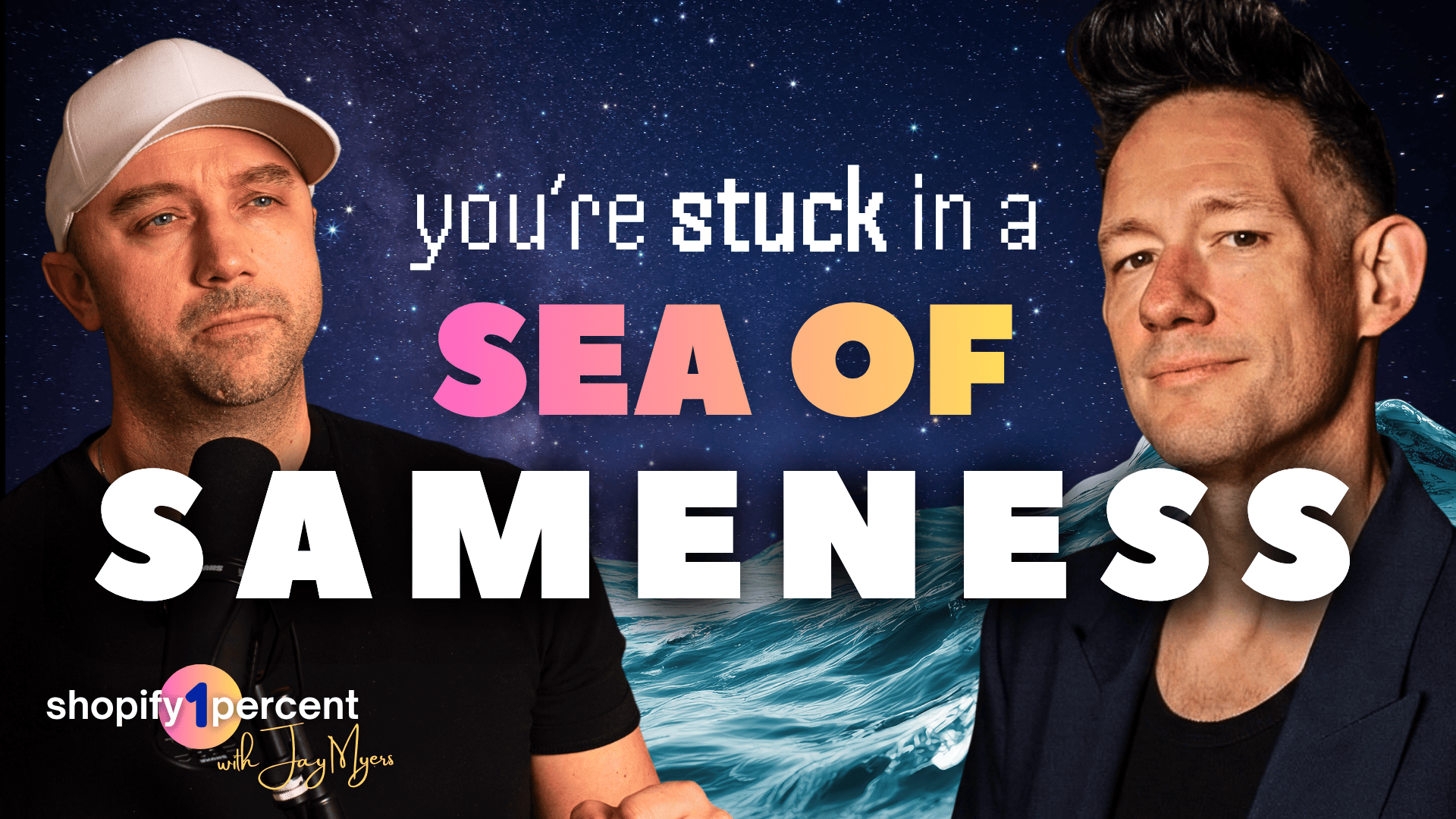
Have Shopify Brands A/B Tested Themselves Into Invisibility? My Conversation With Phillip Jackson on the Sea of Sameness.
Let me ask you something brutal.
If someone stripped the logo off your Shopify store, the typeface off your header, and the branded color off your buttons, could your own customers still tell it was you?
Before you answer "of course they could," you should know that Future Commerce ran exactly that experiment a few years ago. They took major retailer websites, the kind of brands you've heard of like Target and Crate & Barrel, stripped the branding off, and asked real shoppers to tell them apart.
They couldn't.
Welcome to what Phillip Jackson, the CEO of Future Commerce, calls the "Sea of Sameness." And it might be the single biggest threat to your Shopify business in 2026. I sat down with Phillip on the latest episode of the Shopify 1% Podcast, and the conversation went deep, fast. So I wanted to break down everything we talked about into a blog post for you, because there were way too many takeaways to leave on the cutting room floor.
A Quick Word About Phillip
Phillip Jackson is one of those people whose career is so layered it almost sounds made up. He spent a decade brand side, then a decade agency side in ecommerce. He was doing A/B testing and multivariate testing in 2007. For context, most Shopify merchants today were not even thinking about ecommerce in 2007. And here is a fun coincidence we discovered during the interview: Phillip and I both built our first online stores in 1998, both with Microsoft FrontPage. He had a Fox Pro database. I had to call my customers to take their credit card numbers over the phone because online checkout wasn't really a thing yet. We are old. Anyway.
Today he runs Future Commerce, a media and research company trusted by Apple, Disney, Target, LVMH, and a long list of other brands you would absolutely recognize. They publish books, host an annual summit called VISIONS, run multiple podcasts, and do original research on the future of commerce and culture. Their thesis, in three words: Commerce Is Culture. And after talking to Phillip for an hour, I am more convinced than ever that this is the framework Shopify merchants need to be using right now.
Here is what we covered, and what you can do about it on your store this week.
1. We Have A/B Tested Ourselves Into Invisibility
There are 5.6 million live Shopify stores in the world right now (Wytlabs, 2026). The average Shopify conversion rate is a brutal 1.4 to 1.8 percent. And around 90 to 95 percent of Shopify stores are considered unsuccessful. Why?
Phillip's answer is simple. We have all been following the same best practices, using the same themes, installing the same apps, copying the same Instagram aesthetics, and now generating the same AI copy. The result is what he calls "the law of large platforms." Everything optimizes toward an average. That average is the Sea of Sameness.
His point hit me hard. When everyone has access to the same tech stack, the same Shopify themes, the same checkout, the same upsell apps (yes, I noticed the irony as he said it), tactics stop being a competitive advantage. They are table stakes.
Tactical takeaway: Open your Shopify store in one tab. Open your top three competitors in three more tabs. Now mentally strip the logos off all of them. If a customer landed on any of those pages and could not tell them apart, you do not have a brand. You have a template. That is your starting point.
2. Your Brand Is Not Your Logo. It Is Your Worldview.
This was one of those moments in the interview where I had to stop and write something down. Phillip said: "People confuse brands with aesthetics and not a worldview."
Most Shopify merchants I talk to think they have a "strong brand." When I ask what makes them say that, they show me their logo, their fonts, and their Instagram grid. That is not a brand. That is decoration.
A real brand has a point of view. It has an opinion about how the world should be. It has a vision for what the world looks like with your brand in it, what it looks like without your brand, and what it could look like in the future. If you cannot articulate that in a sentence, your customers definitely cannot.
Tactical takeaway: Sit down this week and write a one-page document. What do you actually believe about your category? What do you think the rest of your industry is getting wrong? What is your worldview? Then go back to your About page, your product descriptions, your post-purchase emails, and your homepage hero. Are any of those things actually communicating that worldview? If not, fix the most visible one first.
3. Trust Is the New Conversion Rate
When I asked Phillip what merchants should obsess over now that the technology is mostly solved, his answer was one word: trust.
His reasoning makes complete sense. When everyone has the same tools and the same product quality (a lot of products today are sourced from the same factories, dropshipped from the same regions), the only real differentiator left is whether a customer trusts your brand more than the next one. Trust is a function of brand. Brand is a function of worldview. See how this all ties together?
This is also why nostalgic marketing works so well right now. Nostalgia is essentially borrowed trust from a previous generation of brand equity.
Tactical takeaway: Audit every single touchpoint on your Shopify store and ask "does this build trust or does this erode it?" Generic stock photos? Erodes trust. AI written product descriptions that sound like every other store? Erodes trust. A real founder story with real photos? Builds trust. Real customer reviews with real names and faces? Builds trust. Make a list. Fix the trust leaks first.
4. AEO Is the New SEO, and You Are Probably Already Behind
This was the part of the interview where I started taking aggressive notes.
Phillip said Future Commerce's organic traffic is up 170 percent year over year, and almost all of that lift is from ChatGPT and Claude referring traffic to their site. Not Google. Not social. AI engines.
If you have not heard of AEO (Answer Engine Optimization) or GEO (Generative Engine Optimization), this is your wake up call. Phillip called it the biggest arbitrage opportunity since Facebook ads in 2016. Let that sink in. He has seen a lot of trends come and go in his 20 years. He does not throw around comparisons like that lightly.
The data backs him up. According to BrightEdge, AI referral traffic to ecommerce brands jumped 752 percent year over year during the 2025 holiday season. Future Commerce's own research found that 1 in 3 Gen Z shoppers and 1 in 4 Millennials now prefer AI platforms over other channels for product research. And when an AI recommends a product, 77 percent of consumers click through to the brand's website to learn more or buy.
That means two things. One, your website still matters. AI is not replacing it, it is feeding it. Two, if your product data, brand story, and content are not optimized to be cited by AI engines, you are invisible to the fastest growing discovery channel in ecommerce.
Tactical takeaway: Start treating AI agents as a second type of customer for your content. Make sure your product data is structured, rich, and complete. Look into tools like Ahrefs Brand Radar to see if your brand is even showing up in AI search results. If you are doing zero AEO work right now, start this week. Phillip's exact quote: "There's never going to be a better time than right now."
5. Stop Chasing Trends. Build Mimetic Formats.
This part was fascinating. Phillip walked me through the McDonald's Big Arch burger launch, where the CEO did this bizarre, dorky on-camera tasting that the internet immediately made fun of. It looked like a disaster. Then every other burger chain CEO from Wendy's to Arby's jumped in and copied the format.
And that is when it became genius.
The whole thing turned into what Phillip calls a "mimetic format." A format so simple and recognizable that it can be copied, parodied, and remixed by your competitors and your community, which actually establishes you as the originator. McDonald's did the same thing with the Grimace Shake. Apple did it with the iPod silhouette ads. The format is the asset, not any single piece of content.
The opposite of this is what most Shopify merchants are doing right now. They are spending all their time and energy creating one-off content for trends that die in 48 hours. None of it compounds. None of it builds a brand asset. It is just noise.
Tactical takeaway: Instead of asking "what should I post this week?" ask "what is one repeatable format I can build that my customers and community could copy?" That format becomes your brand calling card. It is way harder than chasing a trend, but it is the only thing that actually compounds.
6. Beat One Drum (Until It Becomes Your Identity)
This was probably my favorite part of the conversation, because it gave me permission to stop trying to brainstorm 10 new ideas a week.
Phillip has been beating the same drum for years: Commerce Is Culture. He has said it on probably 2,000 podcast episodes. He has built his entire media company around that one idea. And as a result, he has become synonymous with it. When people see anything about commerce and culture on the internet, they tag him.
That is the power of beating one drum.
Most Shopify merchants think they cannot say the same thing twice without being annoying. The opposite is true. Your customers are not paying attention as closely as you think. They need to hear the same message dozens of times before it sticks. AG1 has been saying the same thing for years. McDonald's has been saying "I'm lovin' it" for decades. There is a reason.
I shared an analogy from our CEO at Bold during the interview. He came from PayPal and Intuit. He says marketing is a drumbeat. You don't switch instruments every week. You beat the same drum, over and over, until people can hear it from a mile away.
Tactical takeaway: Pick one core idea. One. Write it down. Then build content for the next 6 months that all reinforces that one idea, in different formats. Long form video, short clips, emails, blog posts, social posts. Same drum, different tempo. Then keep going.
The Lightning Round Highlights
We finished the episode with a few quick questions, and Phillip gave some gold.
- Where to spend $10K right now? AEO. Get on Ahrefs Brand Radar or hire an SEO/AEO agency. Start tracking whether your Shopify store shows up in AI search results.
- AI generated product descriptions? Big no, with an asterisk. Depends on the scale of your catalog, but as a default, do not do it.
- One Shopify brand to watch? Higher Dose. They started in red light therapy and have expanded into a serious wellness assortment with high consideration purchases. Their CMO Ingrid Millman Cordy is doing incredible brand work.
- The biggest thing Shopify merchants will regret ignoring in 2026? AEO. Again. This was not a coincidence.
My Big Takeaway
If there is one thing I want every Shopify merchant to take away from this episode, it is this: you do not need to overhaul your entire store. You just need to find one place where you can inject a real point of view that no competitor could copy.
That might be your About page. It might be your post-purchase email sequence. It might be the way you photograph your products or write your shipping confirmation emails. Pick one place. Inject your worldview. Then keep going.
Because in a world of 5.6 million Shopify stores all using the same themes, the same apps, the same AI copy, and the same playbooks, the brands that will win are the ones that actually have something to say.
Listen to the Full Episode
The full conversation with Phillip went a lot deeper than I could fit in this post. We got into time capsules, the Westinghouse Cupaloy time capsule from the 1938 World's Fair, why nostalgic marketing is having such a moment, and the "peaks planning" method for brand building. If you found this post valuable, the episode is even better.
You can find "Have Shopify Brands A/B Tested Themselves Into Invisibility? The Sea of Sameness" on the Shopify 1% Podcast wherever you listen. If you are new here, the Shopify 1% Podcast is the show I host where I interview the best Shopify experts, Shopify merchants, and Shopify partners in the world to help you make your Shopify store 1 percent better every week. We just crossed 85,000 subscribers, which is wild, and I would love to have you join us.
Links and Resources From This Episode
- Future Commerce: https://www.futurecommerce.com
- Phillip Jackson on LinkedIn: https://www.linkedin.com/in/philwinkle
- LORE (Phillip's newest book from Future Commerce): https://store.futurecommerce.com/products/lore-journal-2025
- STRATA (the new zine launching at Shoptalk March 24): https://www.futurecommerce.com
- VISIONS Summit: https://visions.futurecommerce.com
- Higher Dose (the brand Phillip says to watch): https://higherdose.com
- Alex Krefeld's Know Best Practices: https://www.knowbestpractices.com
- Ahrefs Brand Radar: https://ahrefs.com/brand-radar
Now go beat your drum.
Jay

Co-Founder @ Bold Commerce // Host Shopify1Percent
Jay Myers has been in the ecommerce game for over 25 years. First as a merchant, then a service provider, and today a software provider. His company, Bold Commerce, has helped over 800,000 online stores sell more on Shopify. Their suite of apps help brands maximize LTV (Customer LifeTime Value), and AOV (Average Order Value).
Bold has been ranked one of Canada's Top Medium Sized Employers, ranked in the top 50 fastest growing companies in Canada by Deloitte multiple years, a Top Growing Company in Canada by the Globe and Mail, and winner of the Ernst and Young Entrepreneur of the Year award.

Create a Referral Flywheel on Shopify. The growth channel you already own